
Evaluating Military, Diplomatic, and Asymmetric Options in a Volatile Region
Recent rhetoric from former President Donald Trump, promising to "help the Iranian people" and threatening military retaliation for regime violence, has highlighted the potential for U.S. intervention in Iran. Such statements provide a political pretext, if not a legal casus belli, for American action, seeking to align with sympathetic public and allied opinion. However, U.S. strategy is seldom driven by humanitarian sentiment.
With the initial fervour of domestic protests in Iran having subsided, American strategists are likely weighing a spectrum of responses. These range from direct military action designed to catalyse wider rebellion, to a sustained campaign of maximum pressure aimed at long-term containment. Underpinning all options is a fundamental realist objective: not necessarily ideological regime change, but the systematic reduction of Iran's capacity to act as a regional hegemon and threaten U.S. interests and allies.
The overarching U.S. and Israeli goal in the region is the establishment of a stable Pax Judeo-Americana, which necessitates preventing Iran from becoming a peer challenger. The ultimate calculation remains whether any action can truly "cut Iran down to size" without triggering the very regional war all parties ostensibly wish to avoid.
Recent rhetoric from former President Donald Trump, promising to "help the Iranian people" and threatening military retaliation for regime violence, has highlighted the potential for U.S. intervention in Iran. Such statements provide a political pretext, if not a legal casus belli, for American action, seeking to align with sympathetic public and allied opinion. However, U.S. strategy is seldom driven by humanitarian sentiment. With the initial fervour of domestic protests in Iran having subsided, American strategists are likely weighing a spectrum of responses. These range from direct military action designed to catalyse wider rebellion, to a sustained campaign of maximum pressure aimed at long-term containment. Underpinning all options is a fundamental realist objective: not necessarily ideological regime change, but the systematic reduction of Iran's capacity to act as a regional hegemon and threaten U.S. interests and allies. The US has already shown with the Venezuelan precedent that it is open to break certain 'rules' in the geopolitical playfield, will they do the same in regards to Iran?
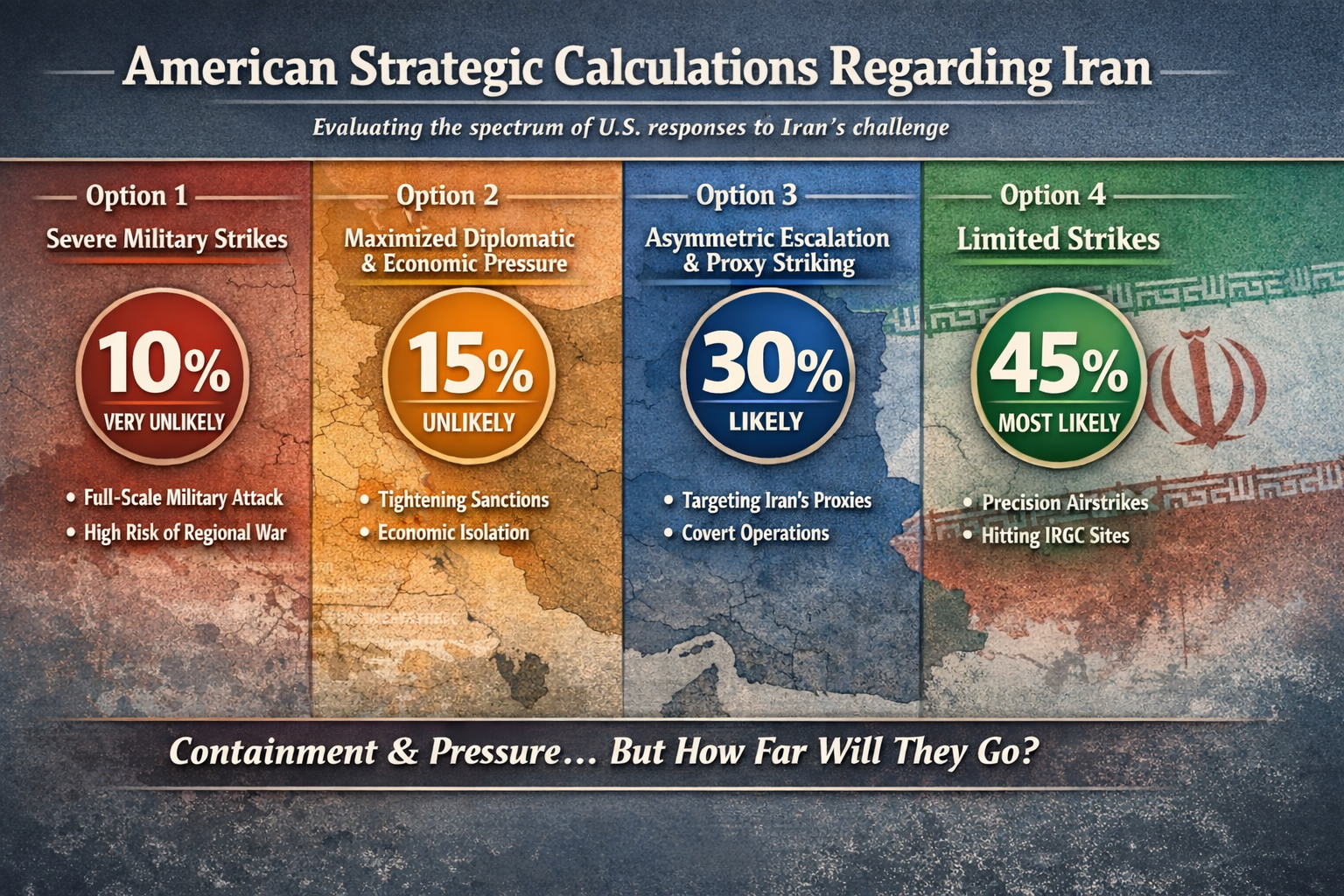
A campaign of direct kinetic and cyber strikes against Iranian military and political infrastructure represents the most escalatory path. Its proponents might argue it could cripple critical capabilities and re-energize domestic opposition. However, the decision to initiate such a conflict would require U.S. and Israeli intelligence to calculate an acceptable level of risk, as absolute certainty is unattainable. Even though it has been clear Mossad is playing their role in the protests, predicting concrete results remains questionable. In case there is not a direct strike, it would certainly be clear to protestors on the street that the words of the Israeli's and US are hollow, this would most likely permanently cripple the current unrest for the time to come.
The primary deterrent is the high probability of a prolonged regional war. While Iranian retaliation would be certain, the cohesion and immediacy of its proxy network's response are not guaranteed. In a hypothetical full-scale conflict, the proxies may not respond uniformly or simultaneously. Historical precedent suggests Iranian-backed militias in Iraq have shown reluctance to be drawn into a direct state-on-state war. The Syrian front, while not entirely neutralized, presents a diminished conventional threat to Israel. Even Hezbollah, Iran's most potent proxy, faces significant internal and external pressures within Lebanon that could constrain its actions. The Houthis in Yemen remain the most likely to join fervently, given their direct confrontation with a U.S.-backed coalition. This complex proxy landscape, rather than guaranteeing a unified multi-front war, creates a volatile and unpredictable escalation risk a scenario that clashes with a perceived American political preference for limited engagements, especially during a domestic electoral cycle. From an Israeli perspective, being drawn into a full-scale war with Iran and its entire axis simultaneously remains a worst-case scenario to be avoided.
Furthermore, practical military constraints vividly demonstrated in recent conflicts are a critical limiting factor. Israel's multi-layered defence system, particularly the joint U.S.-Israeli Arrow-2 and exo-atmospheric Arrow-3 systems, formed the backbone of long-range ballistic missile defence. During the intense 2025 war, these systems were heavily engaged, with dozens of Arrow interceptors fired, significantly depleting stocks and forcing conservation measures. The U.S. Terminal High Altitude Area Defence (THAAD) system, deployed to Israel, was also pivotal for terminal-phase intercepts. In that conflict, U.S. forces fired an estimated 100-150 THAAD interceptors, consuming roughly a quarter of the total U.S. strategic stockpile at a cost of hundreds of millions of dollars. This massive expenditure underscored a key vulnerability: even world-class defences can be strained and depleted by sustained saturation barrages. Interception rates, which started exceptionally high, declined as stockpiles dwindled and Iranian tactics evolved. Thus, the lesson for planners is clear: a prolonged conflict would rapidly exhaust these sophisticated, high-cost interceptor inventories, leaving critical national assets and allied territories vulnerable to subsequent attacks. This material constraint compounds the strategic and political deterrence against opening a direct conflict. This means that to prevent a prolonged conflict the US & Israel are forced to bring about a fast decisive victory, as it would be in the favour of Iran to prolong the conflict and would most certainly force Iran to accelerate their nuclear enrichment to the highest level.
The alternative to overt war is the intensification of the existing "maximum pressure" campaign. This long-game strategy seeks to further constrict Iran's economy through secondary sanctions on trading partners, interdiction of its "shadow" oil fleet, and coercing allies to expand financial isolation. The goal is to exacerbate domestic discontent over time, creating conditions for either internal upheaval or a forced negotiation on Western terms.
However, this option faces the law of diminishing returns. With sanctions regimes already extensive, new measures may have marginal economic effects. More critically, maximal pressure incentivizes counter-escalation: Iran may respond by accelerating its nuclear program, lashing out through proxies, or solidifying anti-Western alliances. The strategic aim remains curtailing Iran's ballistic missile program, achieving full denuclearization, and severing its financial lifelines to proxy networks in Yemen, Iraq, and Lebanon thereby dismantling the architecture of its regional influence. In case of Iran agreeing on these terms, a diplomatic solution might be reached, but chances are close to zero.
A middle course involves intensified asymmetric warfare against Iran's proxy network without immediate strikes on the Iranian homeland. This could manifest as expanded bombing campaigns against Houthi targets in Yemen, Iranian-backed militias in Iraq, or even pre-emptive operations against Hezbollah in Lebanon, with the latter being the most likely as even the Lebanese foreign minister has legitimized further strikes. The calculation is to bluff Iran into a costly response while it is internally vulnerable, thereby degrading its external power and draining its resources. As long as Iran is not directly attacked, it may choose to only respond in a more 'symbolic' manner by bombing a supposed Mossad stronghold in Erbil or elsewhere thereby saving their face.
This option essentially represents an escalation of the current shadow war. Its perceived advantage is plausible deniability and a slower escalation ladder. Yet, it carries the inherent risk of miscalculation. A sustained campaign against its core proxies may be interpreted by Tehran as an existential threat, conversely, a direct strike on Iran might not automatically trigger all its proxies, some of which might hesitate to engage in a full-scale war not of their immediate choosing.
A fourth pathway involves limited, precision strikes on select Iranian military or security infrastructure, designed primarily to demonstrate tangible U.S. and Israeli backing for the protesting Iranian people without triggering a broader or prolonged war. This "demonstration of resolve" approach would aim to reinvigorate domestic unrest by showing that Western rhetoric such as Trump's promises of retaliation against protester killings is backed by concrete action, rather than perceived as empty words that could demoralize demonstrators and allow the regime to suppress dissent unchecked.
Potential targets could include isolated Islamic Revolutionary Guard Corps (IRGC) facilities involved in protest crackdowns, command centres for internal security forces, or symbolic sites tied to regime repression (e.g., bases linked to Basij militias or intelligence nodes facilitating internet blackouts), while explicitly avoiding nuclear sites, major population centres, oil infrastructure, or leadership figures that might force an existential Iranian response. Cyber elements could complement kinetic strikes, such as temporarily disrupting regime communication networks or censorship tools to aid protester coordination and information flow, echoing discussions of non-kinetic tools like restoring internet access via satellite services.
Trump has been quite vocal in regards to striking Iran, which shows that it is no secret whatsoever. If it were Option 1, there would have been complete silence before striking out of nowhere.
The overarching U.S. and Israeli goal in the region is the establishment of a stable Pax Judeo-Americana, which necessitates preventing Iran from becoming a peer challenger. Regime change is a possible means to this end, but not the sole objective. As the Netanyahu government understands, a Trump administration might represent a unique window for aggressive action.
Each strategic option balances this goal against severe risks. Direct military strikes offer decisive potential but risk an uncontrollable regional conflagration. Maximum economic pressure is a sustainable default policy, yet its efficacy is plateauing and it provokes dangerous Iranian counters. In the immediate future, the most probable path is a combination: maintaining and refining economic sanctions while cautiously escalating the proxy war, all under an umbrella of forceful rhetoric. The ultimate calculation remains whether any action can truly "cut Iran down to size" without triggering the very regional war all parties ostensibly wish to avoid.