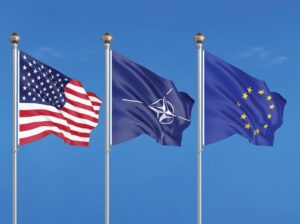
It has been reported by Reuters, as well as by sources working with The Praevisio Institute, that there will indeed be a reshuffle of two major NATO command posts in Naples, Italy, and Norfolk, Virginia (USA). The United States will instead take control of the less significant posts of Allied Air Command, Allied Maritime Command, and Allied Land Command.
The question is: why would the US make such a sudden move? Presumably, the EU’s diversification efforts have not gone unnoticed in Washington. Following the shifting tone of many European nations regarding Trump’s “America First” policy, as well as the recent Greenland threats and Trump’s tariff campaigns, the EU has come to the realization that it can no longer rely on its formerly most trusted ally.
Soft power or strategic warning
This move can be interpreted as yet another exercise in soft power, and potentially even as a diplomatic warning. The more the EU diversifies its economy, assumes greater geopolitical autonomy, and diverges from US foreign policy, the more the US may reduce its NATO commitments.
Europe’s dilemma
As the EU understands that it cannot face a potential Russian threat on its own, it may be forced to find acceptable concessions—seeking greater sovereignty and diplomatic and economic divergence from the US, while still needing to rely on American military commitments within NATO.
Divergence vs. security guarantees
If the EU pushes too hard or too rapidly for autonomy, thereby distancing itself from the US, it should not be surprising if further American commitments within NATO begin to diminish. The command reshuffle is therefore both a tactical withdrawal and a calibrated signal: Washington is watching, and the transatlantic balance is being redrawn.
Analysis by the Praevisio Institute suggests this is the opening move in a broader redefinition of burden‑sharing. European allies are now faced with a choice: accommodate US demands or accelerate defence integration independent of Washington — a path that remains years from maturity.