War Diary • Air Defence Strain • Day 5
Dwindling Patriot Supplies Already? PAC‑2 Missiles from 2000 Spotted in Qatar on Day 5 of US‑Israel‑Iran War
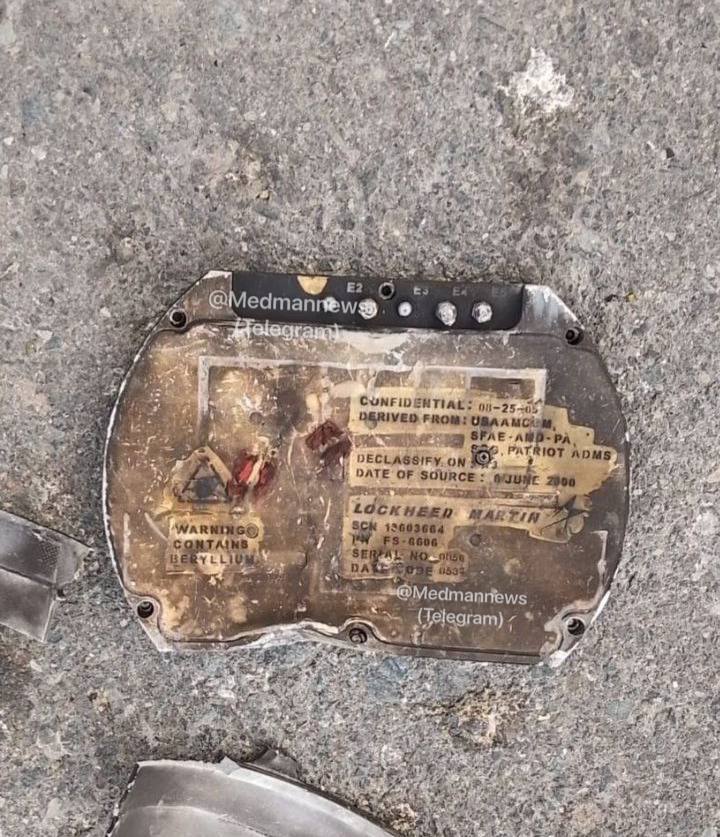
Component fragment recovered near Al Udeid Air Base, Qatar – clearly marked “DATE OF SOURCE: 9 JUNE 2000”. (source: social media/telegram)
Executive summary
Imagery circulating from the vicinity of Al Udeid Air Base (Qatar) shows a Patriot missile component with a manufacture/refurbishment date of June 2000. As Iranian retaliatory strikes enter their fifth day, this debris offers a rare glimpse into the real‑time inventory choices of US and Qatari air defenders. The fragment—consistent with a PAC‑2 GEM‑T guidance section—does not prove imminent depletion, but it confirms that aging but upgraded rounds are being expended in the high‑volume defence of CENTCOM’s forward headquarters. With over 100 projectiles already engaged, the Pentagon is dipping into legacy stocks while husbanding PAC‑3 MSE for the most threatening ballistic re‑entries. This report analyses the technical context, stockpile logic, and what the 2000 date stamp means for sustainability if the barrages continue.
Debris reveals 25‑year‑old Patriot component in active defence of Qatar
Circulating imagery from debris near Al Udeid Air Base in Qatar shows a Lockheed Martin Patriot component plate clearly marked "DATE OF SOURCE: 9 JUNE 2000," along with other identifiers like "PATRIOT ADMS." This has surfaced in recent days (early March 2026) via social media posts and Telegram channels, tied to the ongoing Iranian retaliatory missile and drone strikes following U.S.-Israeli operations against Iran.
The photo depicts a weathered guidance section, electronics module, or canister fragment consistent with PAC-2 family missiles (including upgraded GEM-T variants). While no official U.S. or Qatari statement has directly confirmed this specific debris as coming from a U.S.-fired interceptor, the context aligns with heavy Patriot usage at the base during the conflict's opening phase (late February to early March 2026). Al Udeid, hosting around 10,000 U.S. personnel and serving as CENTCOM's forward headquarters, has faced multiple waves of Iranian ballistic missiles, cruise missiles, drones, and even aircraft like Su-24s. Both U.S. Army and Qatari-operated Patriot batteries are defending the site, with footage showing numerous launches and claimed high interception rates in many salvos.
PAC‑2 GEM‑T: not a relic, but a volume‑fire workhorse
PAC-2 missiles (MIM-104 variants with blast-fragmentation warheads) date back to production surges in the late 1980s through early 2000s, particularly after the 1991 Gulf War. A 2000 date stamp is typical for components from that era's upgrade wave, when large numbers were built or refurbished to GEM-T standards (entering service around 2002 with enhanced seekers, fuzing, and guidance for better performance against ballistic and cruise threats). These are not untouched "Cold War relics"—Raytheon continues refurbishing them, inserting modern electronics while retaining original structural parts, often extending service life significantly through recertification programs.
In high-intensity defense scenarios like this, doctrine favors threat matching: cheaper, sufficient PAC-2/GEM-T rounds handle drones, cruise missiles, aircraft, and lower-end ballistics to conserve scarcer, pricier PAC-3 MSE (hit-to-kill) interceptors for top-tier maneuvering threats. Qatar's Patriot fleet leans toward PAC-2 configurations for volume defense, and mixed U.S./Qatari batteries at Al Udeid follow similar logic. First-in, first-out inventory rules mean older but serviceable stocks get expended first during sustained barrages.
Strain on the stockpile — and the signal from a 2000 date
Analysts note this as part of broader strain—U.S. Patriot stocks were already low pre-conflict from prior commitments, and Iran's opening salvos (hundreds of projectiles) have burned through interceptors rapidly, sometimes requiring multiple shots per threat. Reports highlight that Gulf allies like Qatar could face limits in days at peak rates, though Qatar has denied depletion and emphasized full readiness. Production ramps (PAC-3 toward higher annual output) help long-term but not immediately.
The 2000-dated debris fits pragmatic use of upgraded legacy stocks under pressure, not necessarily outright exhaustion of modern options. It underscores real inventory challenges in a peer-level missile duel, where efficiency matters as much as capability. Defenses continue holding in most reported waves, with footage of both PAC-2 and PAC-3 activity, but prolonged tempo would test sustainability further.
What this means for the war's trajectory
The appearance of a 2000‑vintage component on Day 5 is not a sign of imminent defeat, but it is a clear indicator that the Coalition is dipping deep into its inventory. With each salvo, the interceptor math becomes more pressing. The Pentagon has not commented on the specific photo, but background officials acknowledge that "inventory depth is being monitored in real time." Should Iran sustain launches of 50+ threats per week, the combination of PAC‑2 and PAC‑3 stocks in theater may require emergency airlift from US or European storage depots—some of which also hold refurbished GEM‑T rounds with similar date codes. In that sense, the 2000 fragment may be a preview of more “vintage” metal in the sky over Qatar.