Hezbollah's FPV Campaign: Capability and Limitation
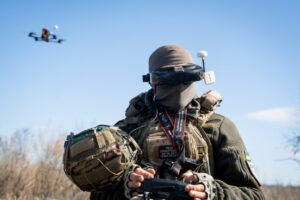
Since Israel launched its ground incursion into southern Lebanon, a new dimension of the conflict has drawn the attention of defence analysts worldwide: the accelerating use of first-person-view (FPV) drones by Hezbollah against Israeli ground forces, equipment, and vehicles. The footage emerging from Hezbollah's own compiled montages is instructive — not only for what it reveals about the group's growing capabilities, but equally for what it exposes about its current limitations.1
The operators visible in the footage are clearly less practised than the battle-hardened drone crews of Ukraine or Russia, where hundreds of thousands of sorties over two years of high-intensity industrial warfare have produced a generation of pilots with near-intuitive mastery of FPV systems. Hezbollah's operators are learning — but they are learning in real time, in contact, against a well-equipped adversary. That trajectory should not be underestimated.
Most of Hezbollah's observed FPV systems are equipped with RPG-7 HEAT warheads — relatively simple, widely available munitions.2 Against an unprotected flank or rear aspect of an Israeli armoured vehicle, these rounds are capable of achieving penetration. The combination of an improving operator pool and a learning curve that accelerates with each sortie creates a compounding threat that the IDF cannot afford to treat as a temporary nuisance.
Hezbollah's operators are learning in real time, in contact, against a well-equipped adversary. That trajectory should not be underestimated — and it will not remain confined to Lebanon.
The Merkava Problem: Adaptation and the Hedgehog Gap
2.1 What Israel Has Done
The Israeli Defence Forces have not been caught entirely unprepared. The majority of combat-ready Merkava tanks have already been fitted with slat armour and cage structures designed to defeat munition-dropping drones — a direct lesson absorbed from the war in Ukraine, where such improvised countermeasures became standard equipment on both sides within months of the 2022 escalation.3 This is a meaningful adaptation, and it reflects genuine institutional learning within the IDF.
2.2 What Israel Has Not Done
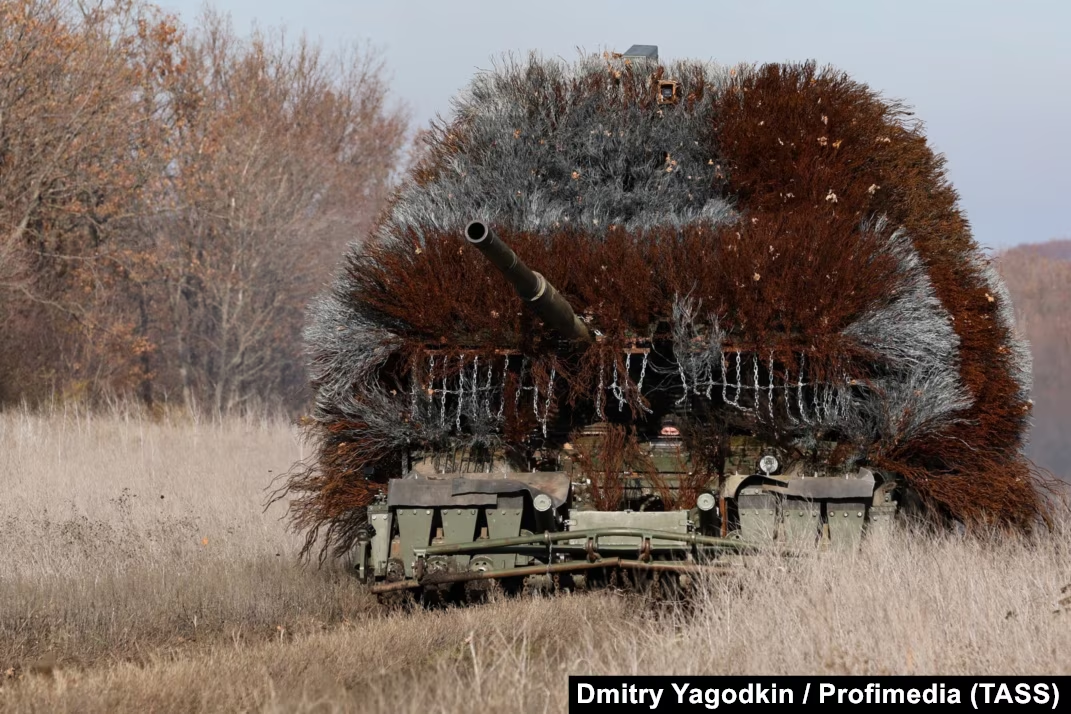
However, one category of adaptation remains conspicuously absent from Israeli armour operating in Lebanon: the so-called "hedgehog" configuration — elaborate anti-drone superstructures welded onto Ukrainian and Russian vehicles, transforming tanks into bristling, angular fortresses of improvised geometry designed to intercept and detonate incoming FPV threats at distance from the vehicle's hull.4 These structures are crude and heavy — but in the theatre of drone warfare, they save crews.
The Merkava's celebrated crew-survival architecture provides considerable protection, but it is not impervious — particularly when struck at vectors the original designers did not prioritise as primary threat axes. The geometry of an FPV approach optimised for rear-hull penetration represents precisely this kind of unanticipated angle, and the RPG-7 HEAT warhead carried by Hezbollah's drones is more than adequate for the task at the right angle of incidence.5
The hedgehog is crude, heavy, and alarming — but in a drone-saturated battlefield, it saves crews. Israel has yet to adopt it at scale in Lebanon.
From Ukraine to Latin America — and Beyond
3.1 The Mercenary Pipeline
What is happening in Lebanon is not an isolated case study. It is one data point in a broader and accelerating global diffusion of FPV drone capability from the Ukrainian theatre outward into every conflict zone and criminal ecosystem on earth. The most striking recent example outside the Middle East is Latin America.
Colombian government forces have been subjected to FPV drone attacks by multiple criminal organisations and militant groups operating across the country's complex internal conflict landscape.6 This is not coincidence. A significant number of Latin American nationals — from Colombia, Venezuela, Ecuador, and other countries across the region — enlisted as mercenaries with both Ukrainian and Russian forces following the 2022 escalation. These individuals were trained, deployed, and in many cases survived to return home.
They brought with them not only operational experience, but production knowledge: the technical understanding of how to source components through fragmented global supply chains, assemble functional FPV systems from commercially available parts, and train others to operate them effectively.7 The export of battlefield doctrine from Ukraine to the streets of Latin America is not coincidental — it is structural, driven by human networks rather than technology leakage.
3.2 The Sub-Saharan Horizon
Sub-Saharan Africa is an obvious next frontier. The continent already hosts numerous armed groups with both the motivation and the existing external support networks to acquire this technology. The path from Lebanese battlefield experience to Sahelian application runs through the same mercenary and training pipelines now documented in the Latin American case. The diffusion curve is accelerating, not plateauing — and the timeline between conflict-zone adoption and criminal application is shortening with each cycle.8
The export of battlefield doctrine from Ukraine to Latin America is structural — driven by human networks. And this pattern will not stop at the Colombian border.
A Warning for Western Security Doctrine
4.1 The Domestic Terror Dimension
Lebanon and Latin America together constitute a strategic signal that Western governments and counter-terrorism agencies have yet to fully internalise. The trajectory of FPV drone proliferation does not terminate at conflict zones in the Middle East or at the borders of Colombia. The barriers to deploying a weaponised FPV drone in a Western urban environment are lower than most public threat assessments currently acknowledge.9
A commercially available racing drone, modified with a small explosive payload, is well within the technical reach of a motivated individual with access to online tutorials and a modest budget. Scale that threat to a group with combat experience — even indirect experience via video analysis and remote instruction — and the operational ceiling rises sharply.
4.2 Scenarios Requiring Active Modelling
Western security planners must now seriously model scenarios that have historically been treated as marginal:
- Drone-delivered munitions detonated over high-density public gatherings or open-air events
- FPV systems guided into critical infrastructure access points or exposed utilities
- Coordinated multi-drone saturation attacks against poorly-defended soft targets
- Munition-dropping drones used to deny access to specific areas during a broader attack
These are not speculative science fiction. They are doctrinal extrapolations from techniques already in active operational use by non-state actors in three separate theatres simultaneously. Irregular and criminal groups have demonstrated a consistent ability to absorb battlefield innovations from conventional conflicts and translate them into asymmetric tools within eighteen to thirty-six months.10 In Lebanon, that clock is already running.
Conclusion: The Lesson Lebanon Is Teaching
The lesson of Lebanon is ultimately the same lesson that Ukraine has been teaching the world since 2022: the age of drone warfare is not coming — it is here, it is spreading, and it is no longer the exclusive domain of state militaries with sophisticated procurement pipelines. Any serious geopolitical risk assessment that fails to model this diffusion curve is operating with an incomplete picture of the threat landscape.
The proliferation of FPV capability from the Ukrainian theatre is not a future risk — it is a present reality. Western counter-terrorism and force protection doctrine must incorporate active drone-threat training, electronic countermeasure deployment at high-value public events, and a fundamental reassessment of the threat matrix facing open societies.
Hezbollah is not the end of this story. It is an early chapter. The question for Western governments is not whether non-state actors and criminal organisations will acquire and deploy FPV drone capability on their soil — but whether their doctrine will be ready when they do.
Lebanon is the signal. The response must be systemic, not reactive — and it must begin now, not after the first domestic incident confirms what the trajectory already makes plain.
Note: This brief was completed on 10 April 2026 and reflects events current as of that date. Assessments are based on available open-source reporting and analytical judgement. Situation assessments remain subject to rapid change.
- Hezbollah has released multiple compiled FPV drone operation videos since October 2023, with an increase in frequency correlating with Israeli ground operations in southern Lebanon from late 2024 onward. Open-source analysis by Oryx, Bellingcat, and Conflict Intelligence Team has catalogued the evolution of Hezbollah's drone fleet.
- The RPG-7 is a Soviet-era rocket-propelled grenade launcher widely proliferated across the Middle East. The PG-7VR tandem HEAT warhead is capable of penetrating up to 600mm of rolled homogeneous armour behind ERA, making it viable against most MBTs at the correct angle. See Jane's Infantry Weapons, annual editions.
- Israeli cage and slat armour adaptations on Merkava Mk.4 platforms were confirmed by IDF footage from Lebanese operations in late 2024. The Windbreaker (Trophy) active protection system fitted to the Merkava is effective against RPG threats but not optimised for high-speed low-altitude FPV approach profiles.
- The "cope cage" or "hedgehog" configuration emerged on Russian and Ukrainian armour from mid-2022. Analysis of Eastern Front footage by the Institute for the Study of War (ISW) and open-source monitors tracked its rapid proliferation across armoured units of both sides. See ISW, Russian Offensive Campaign Assessment, various 2022–2024 editions. understandingwar.org
- The Merkava Mk.4's rear engine placement provides enhanced crew survivability relative to Soviet-era designs, but the hull rear remains a recognised vulnerability particularly to top-attack and rear-arc approach vectors. See Anthony H. Cordesman, Israeli Defence and Security, CSIS, 2022.
- Multiple Colombian armed groups — including dissident FARC factions and criminal organisations — have been documented using commercially sourced FPV-type drones in offensive operations against Colombian security forces from 2023 onward. See InSight Crime, "Drones Emerge as New Weapon for Colombian Armed Groups," 2023. insightcrime.org
- The Atlantic Council documented the systematic adoption of drone technology by Latin American criminal organisations and the role of conflict-experienced individuals in the transfer of operational knowledge. See Atlantic Council, "Drug cartels are adopting cutting-edge drone technology. Here's how the US must adapt." atlanticcouncil.org
- Sub-Saharan African armed groups — including those operating in the Sahel, DRC, and Horn of Africa — have demonstrated an increasing appetite for commercially available military technology. The presence of Wagner Group and other mercenary networks with Ukrainian-theatre experience in the region creates further transmission vectors for FPV doctrine.
- The UK Home Office and European security agencies have published classified threat assessments on commercial drone misuse in domestic contexts. Open-source reporting from the Centre for the Study of Terrorism and Political Violence (CSTPV) at St Andrews has addressed the emerging threat profile. See also: RAND Europe, Drones and Terrorism, 2023. rand.org
- The eighteen-to-thirty-six month adoption window for non-state actor uptake of conventional-conflict innovations has been observed across multiple technology generations: IED construction techniques (Iraq, 2003–2005), MANPADS proliferation, and commercial quadcopter weaponisation (ISIS, 2016–2017). The FPV adoption timeline is tracking within this range. See RUSI, Lessons of the Drone War, 2023. rusi.org