Background: FPV Drone Adoption and Doctrinal Shift
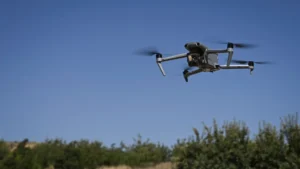
Over the past 18 months, Hezbollah has released a growing volume of combat footage depicting FPV drone strikes against Israeli military targets including Merkava tanks, forward outposts, and individual soldiers. Recent data from the Alma Research and Education Center indicates that unmanned aerial vehicles now account for approximately 24 percent of Hezbollah's attacks — a figure that represents a doctrinal shift, not merely a tactical one.[1] The group has absorbed the core lessons of drone warfare from the Russia-Ukraine conflict and applied them at operational scale in a new theatre.
According to officers from Israel's 36th Division, Hezbollah has decentralised its drone operations, transferring small drone operator cells to the field under a clear standing policy that does not require real-time authorisation from headquarters — a design that prevents exposure and accelerates the decision-to-strike cycle. The operational method combines a reconnaissance drone to locate and confirm the target, followed by a fibre-optic drone strike against specific Israeli vulnerabilities, including vehicle drivers, static military sites, and stationary forces. The pattern is consistent with Ukrainian and Russian small-unit drone doctrine as it has evolved since 2022.
IIThe Jal al-Alam Iron Dome Strike — 7–8 May 2026
On 11 May 2026, Hezbollah published combat footage showing two sequential FPV drone strikes against an Iron Dome battery at the Jal al-Alam military site near the Lebanon-Israel border. The strikes themselves were carried out on 7 and 8 May. The footage shows maintenance personnel attempting to flee moments before impact as the drones approached with minimal warning — analysts reviewing the video assessed that the drones evaded detection until less than five seconds before impact.[2]
The first strike hit what appears to be a fully loaded launcher, concealed behind fortified blast blocks. The second drone was dispatched the following day to the same site, where Israeli military personnel can be observed in the process of dragging the damaged battery away. The second drone then redirects to target three individual soldiers at dangerously close range. Their exact fate remains unconfirmed. The IDF has not acknowledged casualties from these specific strikes.
The two-strike sequence is analytically significant beyond the physical damage inflicted. A decoy hypothesis is eliminated by the follow-up drone's footage of active recovery operations. The decision to return to the same site the next day — to observe, film, and re-engage — reflects a disciplined reconnaissance-strike loop that is not the behaviour of an improvised actor. It is the behaviour of a trained drone unit operating a defined doctrine.
According to defence analysts, the drones were most likely armed with PG-7VL or PG-7AT high-explosive anti-tank (HEAT) warheads, consistent with RPG-7-series munitions adapted for FPV payload configuration. The Iron Dome battery struck had been forward-deployed near the border to intercept rockets, mortars, drones, and short-range threats originating from southern Lebanon.
| Incident Date | 7–8 May 2026 (footage released 11 May 2026) |
| Location | Jal al-Alam military site, northern Israel |
| Target | Iron Dome launcher (forward-deployed battery) |
| Platform | FPV suicide drone (likely fibre-optic guided) |
| Warhead assessed | PG-7VL or PG-7AT HEAT (RPG-7 series) |
| IDF response | Did not dispute footage; launched investigation; deployed fishing nets to southern Lebanon units |
Hezbollah's Anti-Armour Arsenal: Context and Evolution
To understand why the FPV drone represents a doctrinal inflection point, it is necessary to understand the trajectory of Hezbollah's anti-armour capability and the Israeli countermeasures that have progressively constrained it.
Prior to the FPV campaign, Hezbollah's primary offensive capability against Israeli armour rested on a layered anti-tank guided missile (ATGM) arsenal sourced from Russia, Iran, and China. The group has operated a range of first and second-generation systems: the Sagger (effective to 3,000m, manual wire guidance), the Fagot (2,500m, wire-driven), the Metis (1,000m, wire-guided), and the Milan (3,000m, wire-driven). At longer ranges, the 9M133 Kornet — effective beyond 5,500m, improved to 8,000m, with laser beam riding guidance — has served as the group's most capable second-generation system, capable of penetrating armour up to 1,200mm thick.
On the Iranian supply side, Hezbollah fields the RAAD family — an Iranian wire-guided ATGM based on the Soviet AT-3 Sagger, available in multiple variants including the RAAD-T with a tandem warhead designed to defeat explosive reactive armour, and the I-RAAD with an improved SACLOS guidance system. On the Chinese side, the HJ-8 (Red Arrow 8) has been documented in Hezbollah's inventory through Iranian supply chains alongside the broader range of Sagger-class platforms also produced in China as the HJ-73.
Most significantly, Hezbollah has recently fielded the Iranian Almas ATGM — a third-generation weapon and a meaningful capability upgrade. The Almas is an unlicensed Iranian copy of the Israeli Spike missile family, reverse-engineered from Spike-MR systems captured by Hezbollah during the 2006 Lebanon War and transferred to Iran. In its base variant the Almas has a range of 4,000 metres, extended to 8,000 metres from ground-launched positions, with a fire-and-forget electro-optical guidance system capable of top-attack profiles that strike vehicles where armour is weakest. Hezbollah claims to possess Almas-1, -2, and -3 variants, the latter adapted for UAV launch.
The widespread adoption of the Trophy Active Protection System on Merkava tanks has significantly degraded the effectiveness of the ATGM threat — neutralising the Kornet, Almas, and RAAD variants in flight. This forced evolution on Hezbollah's part has accelerated the pivot toward FPV drones. The pivot is not opportunistic. It is a direct tactical response to a specific Israeli defensive measure.
The FPV Drone: A New Doctrinal Problem
The FPV drone — particularly the fibre-optic guided variant — represents a qualitatively different challenge from every system Hezbollah has previously deployed. Unlike radio-frequency guided drones, fibre-optic FPVs transmit operator commands through a physical cable paid out during flight. This renders them immune to GPS jamming, signal spoofing, and all RF-based electronic warfare systems — every layer of electronic countermeasure that modern militaries have developed specifically to defeat drone threats.
The cost-exchange ratio is additionally adverse. An Iron Dome interceptor missile costs in the range of $50,000–$100,000 per unit. An FPV drone of the type used at Jal al-Alam costs a few hundred dollars. The Iron Dome battery itself represents a capital asset worth several million dollars. The asymmetry does not require the attacker to win every engagement — it only requires the attacker to sustain the campaign.
No conventional army has yet fielded a definitive systemic solution to the fibre-optic FPV threat. The Ukraine war has accelerated the development and proliferation of these platforms — and Hezbollah's operational adoption of the doctrine, with Iranian technical assistance, means the threat is not static. As Ukraine and Russia have demonstrated, FPV platforms evolve rapidly: warhead types change, ranges extend, swarm coordination is introduced, and AI-assisted target acquisition is being actively developed. If Hezbollah continues on this trajectory, the threat profile will look materially different in twelve months than it does today.
VIsraeli Countermeasures: Current Status and Limitations
Israel has fielded two infantry-level AI-assisted systems as part of its counter-drone response at the small-unit level:
SMASH (Smart Shooter) — "Pigyon" in Hebrew: The SMASH 2000LE and SMASH 3000SA mount on a rifle's Picatinny rail and use AI and computer vision to track aerial targets, releasing the shot only when the targeting algorithm predicts a high-probability hit. The system is reported to increase effectiveness against drone targets by approximately 400 percent compared to unassisted fire.
ARBEL (IWI — Israel Weapon Industries): A computerised fire-control solution designed for installation on AR-15-configuration assault rifles. ARBEL uses an internal algorithm that analyses the shooter's micro-movements and releases the shot automatically when the weapon is stable on target — removing trigger timing as a variable. Because the system is integrated into the soldier's primary weapon, it requires no equipment switch and no dedicated ammunition. According to IWI, ARBEL can engage drones at ranges of up to 450 metres in daylight and approximately 250 metres at night, increases hit probability by 2–3x, and runs for up to 50 hours of continuous operation on battery power.
Beyond individual weapon systems, the IDF confirmed on 11 May that it was transferring thousands of metres of fishing nets to maneuvering units in southern Lebanon, intended to physically trap drones before detonation — an improvised measure that underscores the pace at which the threat has outrun available doctrine.
The SMASH and ARBEL systems provide meaningful incremental capability at the infantry level. They cannot be characterised as a systemic answer to the Iron Dome vulnerability demonstrated at Jal al-Alam, nor to the fibre-optic FPV variant operating beyond the reach of electronic countermeasures. The gap between what has been fielded and what the threat now requires is not trivial.
Assessment and Strategic Outlook
The Jal al-Alam strike is strategically significant for several reasons beyond the immediate physical damage to a single launcher. First, it establishes that Hezbollah can identify, navigate to, and strike a hardened, concealed air defence battery with a sub-$1,000 platform. The cost-exchange ratio is catastrophically asymmetric and, critically, is sustainable for the attacker at scale. Second, the two-strike sequence — initial impact followed by a drone dispatched the next day to observe recovery operations and re-engage personnel — reflects a mature, disciplined operational methodology. This is not an improvised actor. It is a unit operating a defined reconnaissance-strike doctrine with deliberate execution.
Third, sustained military operations have placed existing Iron Dome interceptor stocks and replacement components under pressure. The Israeli Ministry of Defence finalised plans in November 2025 to expand serial production of Iron Dome systems, supported by an $8.7 billion U.S. military aid package with more than $5 billion allocated specifically to air defence infrastructure. Attrition of forward-deployed batteries through cheap FPV strikes adds a new axis of pressure to an already constrained supply picture — and does so at a cost the attacker can sustain indefinitely.
The central strategic question is one of tempo. If Hezbollah continues to develop its FPV capabilities along the trajectory demonstrated in Ukraine — incorporating longer range, improved warheads, swarm coordination, and AI-assisted target acquisition with Iranian expert assistance — Israeli air defence doctrine will require fundamental revision well beyond the northern border. Systems positioned deeper inside Israel will need to adapt their threat profiles to account for low-cost, low-signature platforms that current radar and electronic warfare architecture was not designed to prioritise.
Whether the FPV drone campaign becomes a genuine force-multiplier for Hezbollah or whether Israeli countermeasures mature quickly enough to close the window depends on three variables: the pace of Iranian technical support, the availability of fibre-optic components at scale, and Israel's willingness to accelerate integration of systems not yet at full operational maturity. One thing is analytically clear: the doctrine of assuming that sophisticated and expensive air defence infrastructure is protected by its own sophistication is no longer viable on the modern battlefield.
Note: This intelligence note was completed on 12 May 2026 and reflects open-source information available as of that date. Warhead assessments represent the analytical judgement of the author based on publicly available footage and analyst reporting. Casualty figures from strikes referenced in this note have not been confirmed by the IDF. This note does not constitute legal, investment, or policy advice.