The Coalition Arithmetic
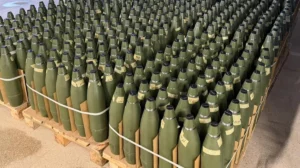
When the Czech initiative launched, its core proposition was straightforward: pool contributions from willing European states, use that capital to bulk-purchase artillery ammunition on the international market, and move it to Ukraine faster than national procurement timelines could manage. At its peak, eighteen countries were part of that arrangement. Deliveries in 2024 came to 1.5 million large-calibre rounds. In 2025, the figure improved to 1.96 million. Pavel himself has stated the scheme now accounts for up to half of all large-calibre ammunition Ukraine receives.
The numbers since have moved in the wrong direction. Funding-secured deliveries for 2026 are projected at 880,000 rounds — less than half of what arrived in 2025. Against a total planned budget of €5.06 billion, only €1.4 billion has been raised and spent. The deficit sits at €3.66 billion. Nine countries are still participating. Prague will not say which nine, or which nine left.
Prague's Domestic Problem
Pavel identified the problem without naming it directly. Germany and certain Nordic countries remain committed, he confirmed. Others, he suggested, had grown uncomfortable financing something that "is not even properly supported by the ruling politicians of the leading country." The leading country is the Czech Republic. The ruling politician — since the January 2025 parliamentary elections — is Prime Minister Andrej Babiš.
The Babiš government has made no financial contribution to the initiative and has not deployed political capital to sustain European support for it. The scheme was conceived and championed under a different Prague administration. Under Babiš, it has been left without an advocate at the moment advocacy matters most — when donor fatigue is setting in and the case for continued participation needs to be actively made. Pavel's remarks, diplomatic in their framing but pointed in their target, amount to a public indictment of his own government's inaction.
An initiative born in Prague and dependent on European political momentum has been left, under the current Czech government, without anyone in Prague willing to sell it. The donors who remain are doing so despite the host country's indifference, not because of its leadership.
Paper Deliveries and Convenient Opacity
The coalition's political problems sit on top of structural ones that have been visible for longer. Czech partners and observers raised concerns as early as April 2026 about the distance between announced procurement figures and verifiable deliveries on the ground.[2] Rounds reported as procured were not always rounds confirmed as received. The scheme's architecture — multiple intermediary layers, procurement decisions made outside standard tender processes, commission structures that suited everyone involved in the transaction — created a setup in which money could move without a clean audit trail following it.
That opacity had a function in the initiative's early phase: it reduced the political exposure of participating governments, allowed faster transactions, and made it easier to work with suppliers who operated in legally ambiguous territory. In a contraction, the same features become liabilities. Governments considering withdrawal cannot point to a clean record of what their contributions actually purchased. And governments considering continued participation cannot easily make the public case for it, because the evidentiary basis for the programme's effectiveness is deliberately difficult to pin down.
Where the Money Is Going Instead
The Czech initiative was designed for a specific phase of the conflict — one in which artillery attrition was the dominant dynamic and large-calibre shell supply was the critical constraint. That phase has not ended. But it is no longer the only frame through which European governments are calculating their support. Whether the initiative adapts to that shifting calculus, or continues to contract until it becomes too small to justify its own administrative overhead, is the question its remaining nine backers have not yet answered publicly.
Part of the retreat reflects a strategic reorientation rather than simple budget fatigue. European defence budgets are under competing claims, and drone investment has become an increasingly attractive alternative destination for the same euros that once went to shell procurement. Ukraine's own battlefield evolution has driven this reorientation — Kyiv's drone doctrine has outpaced its artillery consumption curve, and European procurement thinking is following that signal. In April 2026, the EU selected 57 collaborative R&D projects for a combined €1.07 billion through the European Defence Fund — with drones and autonomous systems as the dominant priority cluster, explicitly referencing Ukraine battlefield lessons as the driver. Several countries within the initiative have quietly redirected funds[3] toward drone-related programmes accordingly.
Note: Research for this intelligence note was finalised on 24 May 2026. Delivery figures and funding data are drawn from publicly available statements by Czech officials and open-source reporting. Nothing in this note constitutes legal, investment, or policy advice.