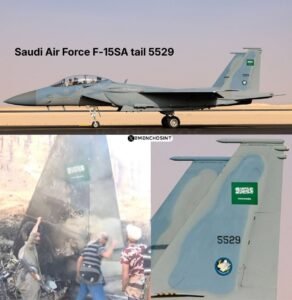
What Happened
The aircraft went down on 15 September, over Marib governorate, while flying what Saree described as a support mission for Saudi-backed ground forces. The first word of it came that same evening in the usual scattered way these things surface: partial claims, no video, nothing Saudi Arabia was willing to touch. Riyadh still hasn't confirmed the loss as of this writing, which is also standard. The coalition has a long habit of sitting on aircraft losses for days or attributing them to "technical failure" when they can't avoid comment altogether.[1]
The confirmation came the next morning. Saree announced the kill on social media and through al-Masirah, Houthi military media's television arm, using the same boilerplate formula the group has opened with for every claimed aircraft kill since 2015, crediting divine aid before getting to the operational details. He said Houthi air defences went on to engage a follow-up formation of F-15s and Typhoons that entered Marib airspace looking for the wreckage, and that the formation withdrew.[2] Open-source accounts collected the wreckage imagery that circulated afterward, tail section, Saudi flag emblem intact, fighters posed on top of it, which is by now a genre unto itself in Houthi media releases.[1]
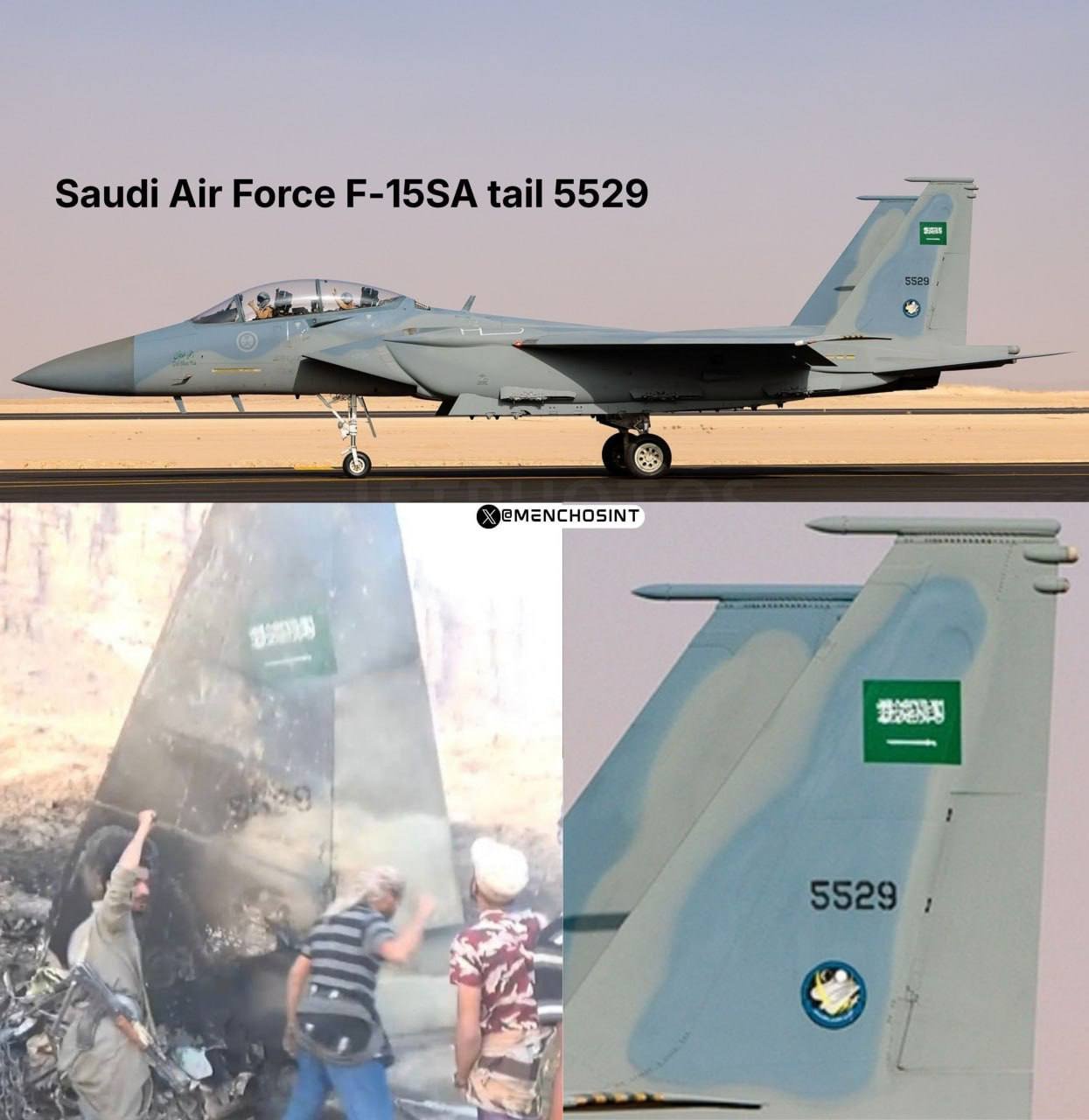
None of this is unusual for a Houthi shootdown claim, and the pattern of Saudi silence followed by eventual grudging acknowledgment, or occasionally outright denial, is also nothing new. What's worth digging into is the missile itself, because Saree's "locally manufactured" line covers a lot of ground and the footage narrows it down considerably.
Identifying the System: Fater-1
Houthi engagement footage has a house style, and it's been consistent enough for long enough that it's become its own kind of fingerprint. The reticle shape, the way the target is boxed and tracked, the specific overlay elements on the HUD, all of it varies system to system but stays consistent within a given system's release history. Running the 16 September footage against the archive of prior Houthi releases, the closest match by a wide margin is the Fater-1, and specifically footage the group put out on 10 December 2021 showing a Fater-1 engagement against another Saudi F-15 near the Yemeni-Saudi border. That earlier missile didn't down the aircraft. Saudi officials at the time acknowledged shrapnel damage and nothing more, and the jet made it home. The tracking geometry and terminal approach in that clip and in the new one are close enough that this isn't a coincidence.
The Fater-1 itself isn't a Houthi invention. It's the group's name for a 2K12 Kub, NATO reporting name SA-6 Gainful, inherited from pre-war Yemeni Army stockpiles and kept running with locally sourced maintenance and whatever help Iran has quietly provided over the years. The Kub is old, Soviet, first fielded in 1967, and it had its moment of real fame in the 1973 Yom Kippur War, where it accounted for a serious chunk of Israeli aircraft losses against Egyptian and Syrian batteries. The missile is the 3M9, a semi-active radar homing round originally guided by the Kub's own "Straight Flush" fire control radar.[3]
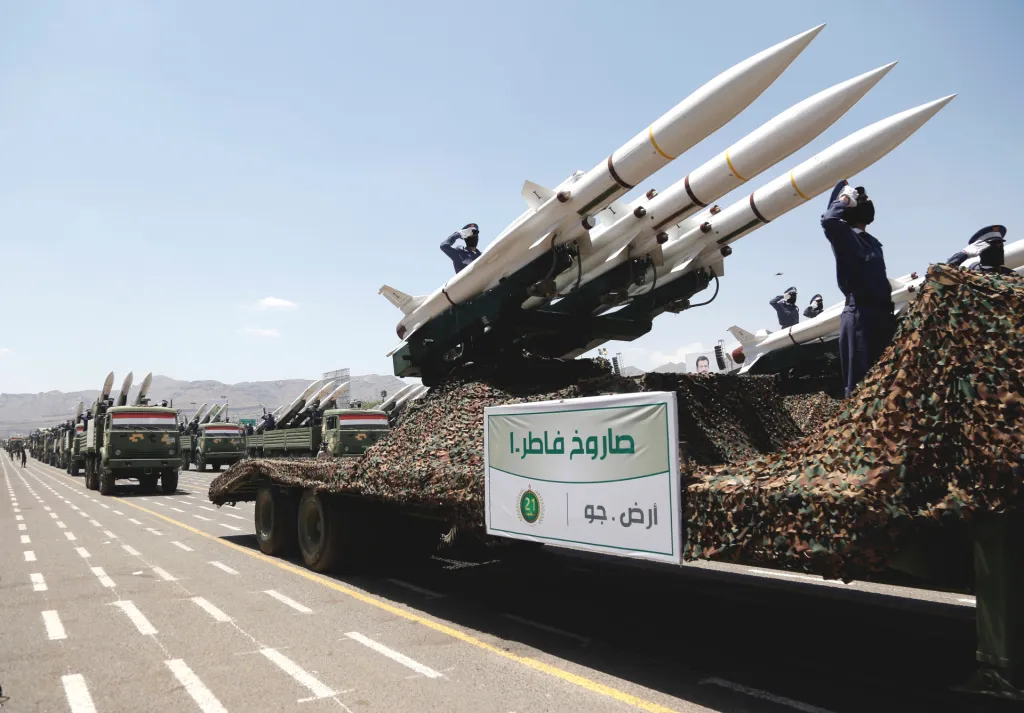
Fater-1 / 2K12 Kub (3M9 missile)
Houthi-operated, ex-Yemeni Army stockThe Optic Problem: Why the Pilot Never Got a Warning
Here's the part that should worry Saudi and coalition pilots more than the headline kill itself. A stock 3M9 round guided by the Kub's original SARH seeker needs continuous radar illumination from the ground station all the way to impact. That's a weakness, not a strength, because it means the fire control radar has to keep painting the target, and a modern radar warning receiver picks that up immediately. A pilot flying against a functioning, radar-guided Kub battery gets a warning tone and a symbol on the RWR display well before the missile is anywhere near lethal range.
What the footage from both the 2021 and 2026 engagements shows is a seeker head that doesn't behave like that. The terminal tracking in the HUD reads as electro-optical, camera and infrared, rather than radar. That tracks with what's been reported about how the Houthis have kept their inherited Kub stock alive: swap the original semi-active radar seeker for a passive EO/IR unit, and you get a round that can still chase an aircraft at Mach 2-plus but never has to paint the target with anything a radar warning receiver can hear. No emission, no warning tone, no time to react. The aircraft over Marib almost certainly never knew it was being tracked until the missile was already inbound.[3]
Swap the radar seeker for a camera and you've turned a fifty-year-old SAM into something that doesn't show up on any of the sensors a modern fighter uses to detect an incoming radar-guided shot.
Fater-1 vs. Majid-08: A Question of Size
This is worth putting next to the incident we covered back in March, when a US F-35 took battle damage over Iran and the evidence eventually pointed to the Majid-08, a much newer, purpose-built Iranian system with phased-array radar and multi-spectral tracking designed specifically to go after low-observable aircraft.[4] The Majid-08 is a serious piece of equipment: search radar, a dedicated guidance system, a footprint that requires real infrastructure to deploy and sustain. Getting a system like that into Yemen past the Saudi-led naval blockade and years of interdiction efforts is a genuinely hard smuggling problem, which is a large part of why nobody has seriously suggested the Houthis have one.
Read our earlier note on the F-35 incident and the Majid-08 identification →
The 3M9 round is a different problem entirely. It's roughly four metres long and a few hundred kilograms, which sounds substantial until you remember the Houthis inherited an entire pre-war Yemeni Army stockpile of them rather than needing to import the missile itself. What gets smuggled in now, on the occasions it needs to be, is guidance electronics and spare parts, not the airframe. A round like that can sit on a repurposed truck bed or a simple fixed rail and be fired without the radar vehicle, the command post, or most of what makes a real Kub battery hard to hide. That's the whole reason this class of weapon has stayed a live threat for a decade of blockade: the individually smuggleable, individually deployable piece is the missile itself, not the launcher.
Ruling Out the 358
Some of the early chatter after the Houthi announcement pointed at the 358, officially the Saqr-1, the Iranian-designed loitering munition that's become notorious for picking off American MQ-9 Reapers. It's a reasonable first guess given how often the 358 shows up in Houthi and Iranian-aligned air defence footage generally, but the profile doesn't fit here and it's worth explaining why in some detail, because the confusion between "any Yemeni air defence footage" and "this specific engagement" is exactly the kind of thing that gets misreported in the first 24 hours of a story like this.
358 / Saqr-1
Iranian-designed loitering interceptor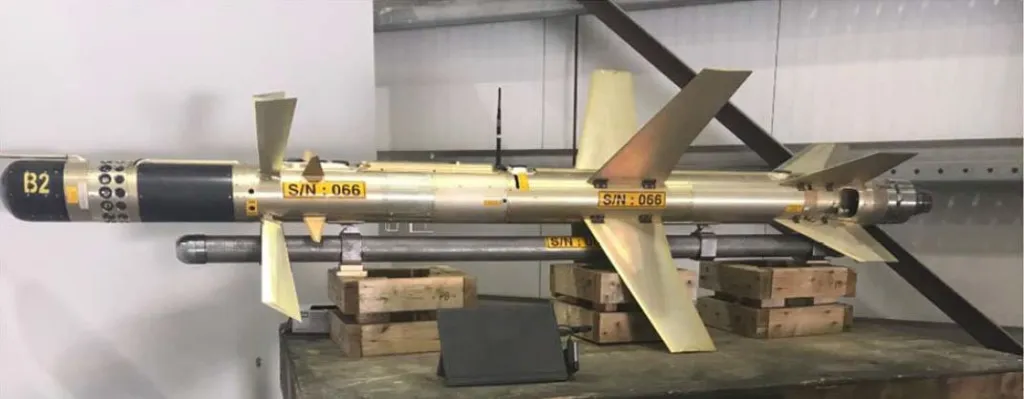
Side by side with the Fater-1 footage, the closing speed and geometry in a 358 engagement look nothing alike. The 358 loiters, picks its moment, and closes on a target that's barely moving relative to it. Whatever hit the F-15 over Marib closed fast, on an intercept course, against an aircraft that had no reason to be flying anywhere near Mach 0.6. That's a Fater-1 profile, not a 358 profile, and it's the same profile as the 2021 clip.
Not the First Time, Not Close
None of this is a new capability showing up out of nowhere. The Houthis have been shooting things out of the sky over Yemen since at least 2017, when the first Thaqib-series conversions, R-27 and R-73 air-to-air missiles rerigged as SAMs, started appearing in their footage. The Fater-1 specifically has a documented history against Saudi and coalition F-15s going back years, with the December 2021 engagement being the clearest prior example and by no means the only one; EurAsian Times counted this as potentially the fifth Strike Eagle lost in the conflict this year alone, coalition confirmation pending.[5]
The drone tally is the bigger number, and it's not close. Wikipedia's running list of Yemen aviation shootdowns documents dozens of confirmed or credibly claimed Houthi kills against Saudi-coalition and US reconnaissance and strike drones going back to 2019: CH-4 and CH-4B Rainbow drones, Wing Loong IIs, ScanEagles, Vestel Karayels, RQ-20 Pumas, an MQ-1C Gray Eagle, and a steady stream of MQ-9 Reapers, several of those Reaper losses specifically attributed to 358 engagements rather than the Fater-1.[6] That's the actual shape of Houthi air defence capability: a layered set of systems, cheap loitering interceptors for slow drones, converted air-to-air missiles and inherited Soviet SAMs for anything faster, and years of practice using both.
Conclusion
Strip away the theatre, the posed wreckage photos, the boilerplate opening every Houthi statement leads with, and what's left is a genuinely notable technical detail: a fifty-year-old Soviet SAM, kept alive through a decade of blockade with an EO/IR seeker swapped in for the original radar guidance, just killed a modern fighter jet without the pilot ever getting a warning. That's not really about the Fater-1 being a sophisticated weapon. It's a mediocre missile with one modification that happens to defeat the specific sensor a fighter pilot relies on to know he's being shot at. The 358 gets more attention because it's flashier and Iranian-branded, but it was never a candidate for this particular kill, wrong speed, wrong target profile, wrong footage entirely. The system that actually did this has been sitting in the Houthi inventory since before the war started, and Saudi Arabia has had five years since the last confirmed Fater-1 hit to find an answer to a seeker that doesn't show up on radar warning gear. Going by Wednesday's footage, they still haven't.
Note: This intelligence note was completed on 16 September 2026. Saudi Arabia had not confirmed the loss of the aircraft as of publication, and the Houthi movement's own account of the engagement, including the claimed repulsion of a follow-up search formation, is single-sourced to the group's own statements and has not been independently verified. The Fater-1 identification is an analytical judgement based on comparative footage analysis, not a confirmed technical determination, and the December 2021 reference footage is drawn from the Institute's own archive rather than a currently active public source. This note does not constitute military, legal, or policy advice.