Preferential religious access established
Religion enters the building as institutional practice, not personal faith

Human rights, democracy, and the liberation of the Iranian people have provided the public justification for the war — but American evangelical Christianity is the ideological fuel beneath it. Now, alongside growing political opposition, a visible religious division is emerging inside the United States itself: one that the administration has so far shown no sign of being prepared for
On Good Friday, 3 April 2026, the Pentagon circulated an internal email to more than 3,500 employees announcing a chapel service with a note that has since circulated widely: "There will be a Protestant Service (No Catholic Mass) for Good Friday today." A Pentagon spokesperson confirmed it was the only service of any kind scheduled. The same day, Archbishop Timothy Broglio — the head of the Catholic Archdiocese for the Military Services, responsible for more than 200 Catholic chaplains serving US troops — told CBS that the Iran war fails the Church's just war criteria and that Pete Hegseth's invocation of Jesus Christ to justify it is "problematic." The war against Iran has generated significant political opposition — from allies, from Congress, from economists watching the energy shock spread across European and Asian markets. But these two events, arriving within hours of each other on one of Christianity's holiest days, point to something distinct and less discussed: a religious division opening inside the United States itself, between the evangelical tradition that has provided the war's theological scaffolding and the Catholic tradition that now — at its highest institutional level within the military — is telling its faithful that the scaffolding does not hold. That fracture has been building steadily since Hegseth took office. Good Friday made it impossible to ignore.
The email was brief and, for a government communication, unusually explicit. Air Force leadership circulated it to Pentagon staff on the morning of 3 April: a reminder that a Good Friday service would be held at the Pentagon Memorial Chapel — Protestant, with a parenthetical that has since circulated widely: "(No Catholic Mass)." A Pentagon spokesperson confirmed to reporters that no separate Catholic observance of any kind had been scheduled. A Defence Department employee who requested anonymity captured the atmosphere plainly: "I guess so the Catholics know their kind ain't welcome."
The liturgical technicality is real and has been deployed in Hegseth's defence. Catholics do not celebrate Mass on Good Friday — the Roman Rite suspends the Eucharistic sacrifice on that day, replacing it with a solemn Celebration of the Lord's Passion, including veneration of the cross and distribution of communion. The phrase "No Catholic Mass" is therefore technically accurate. But it sidesteps the real issue: not whether Mass was cancelled, but whether a Catholic liturgical observance of any kind was offered. According to a Pentagon employee who has worked there since 1980, no Catholic Good Friday service of any kind was held — a departure from four decades of established practice.
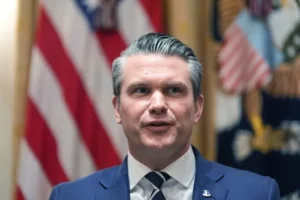
The context is everything. In February, Hegseth invited Pastor Doug Wilson to lead a worship service in the Pentagon auditorium. Wilson is not a mainstream evangelical figure. He is the author of a theological vision of Christian governance in which public Catholic worship — Masses, Marian processions, Corpus Christi devotions — would be prohibited. His presence in the Pentagon was not remarked upon by the Defence Department as inconsistent with its obligation to serve members of all faiths. The monthly evangelical services Hegseth has hosted since May 2025 have been reported as unsettling to some service members and former military officials. At one in late March, he read aloud a prayer calling for "overwhelming violence of action against those who deserve no mercy." These are not the habits of a defence secretary who views the Pentagon chapel as a neutral interfaith space.
The email said "No Catholic Mass." What it did not say — and what the absence made clear — was that Catholics had no service of any kind on the holiest Friday of the Christian year, for the first time in at least four decades inside the building that runs the US Department of Defense.
To understand why the chapel incident matters, it must be placed within the broader pattern of Hegseth's religious conduct as Defence Secretary. This is not a man who practises faith privately. From the Pentagon press room, he has called on Americans to take a knee and pray for victory "in the name of Jesus Christ." In a separate CBS interview, he framed the Iran war in explicitly religious terms: "We're fighting religious fanatics who seek a nuclear capability in order for some religious Armageddon. But from my perspective, I'm a man of faith who encourages our troops to lean into their faith, rely on God." The providence of God, he said, was "protecting those troops."
Inside the military, the effects of this framing have been documented. The Military Religious Freedom Foundation reported receiving more than 200 calls from active-duty personnel raising concerns about commanders who painted the war in Iran in explicitly theological terms. A complaint shared by an anonymous non-commissioned officer claimed NCOs were told the war is part of "God's plan" and Trump was "anointed by Jesus to light the signal fire in Iran." More than two dozen Democratic members of Congress called for a Department of Defense investigation. Retired Army Major General Randy Manner told the Washington Post that "dozens and dozens" of active-duty chaplains who do not share Hegseth's theological posture are being marginalised and excluded from staff meetings.
Hegseth has also pursued a structural reorientation of military chaplaincy itself. On 25 March, he announced that chaplains would no longer wear rank insignia but instead display their religious affiliation symbol, and that the Pentagon's faith codes would be reduced from over 200 to 31 — eliminating what he called an "impractical and unusable" system. The stated rationale was accessibility. Critics noted that consolidating 200 codes to 31 effectively erases the granular distinctions that matter to minority traditions and concentrates the system around the groupings closest to the evangelical mainstream. Military Times noted it could not independently verify all the figures cited — but the direction of the reform was unambiguous.
The conflict between Hegseth's religious posture and Archbishop Broglio's is not merely personal. It reflects a genuine and structurally embedded divergence between two Christian traditions in their relationship to war, to Israel, and to whether God sanctions military violence — a divergence that has shaped American politics for decades but rarely been made this visible within the institutions of the state itself.
White evangelical support for Israel has been one of the most durable features of the American political landscape since the 1970s. Its theological basis is premillennial dispensationalism — a framework in which the restoration of Israel in its biblical geography is a necessary precondition for the Second Coming of Christ, the Rapture, and the final battle at Armageddon. In this eschatology, war is not a tragic last resort to be endured with grief. It is a prophetic inevitability to be supported with conviction. Research found that belief in premillennialism increases the likelihood of strong support for Israel by over 80%, while rejection of it reduces that likelihood by more than half. A Southern Baptist survey found 8 in 10 evangelicals believe God's covenant with Abraham applies "for all time." Evangelicals have constituted the most reliable Republican voting bloc for decades, and their theological commitment to Israel has been a structural underpin of US Middle East policy across administrations from Reagan to Trump.
This theology has a direct political expression in the war's own rhetoric. Israeli Prime Minister Benjamin Netanyahu and other senior Israeli officials have explicitly invoked the biblical figure of Amalek to frame the conflict — first against Hamas, then in broader terms that extend to Iran. The reference is to passages in Exodus, Deuteronomy, and 1 Samuel that describe God's command to Israel to eradicate Amalek in its entirety: men, women, infants, and livestock. It is among the most absolute mandates in the Hebrew Bible, one that admits no negotiation, no proportionality, and no mercy. When Netanyahu cited 1 Samuel 15 in the context of the Gaza war — "Now go and smite Amalek" — the framing was not incidental. It positioned the conflict as a sacred obligation rather than a strategic calculation, and placed those who counsel restraint in the position of defying divine command. The Amalek framing resonates powerfully within evangelical dispensationalist communities in the United States, for whom Israel's wars are by definition righteous and any hesitation to support them is a failure of biblical faithfulness. For Catholics, operating within a tradition whose just war doctrine demands proportionality, civilian protection, and the exhaustion of alternatives, it is precisely the kind of framing that makes a conflict less morally legitimate — not more. The same rhetoric that rallies evangelical support for the war is, within Catholic moral theology, evidence that the war's prosecution falls outside the bounds of justifiable violence.
Catholic teaching operates on an entirely different framework. The just war tradition — developed from Augustine through Aquinas and codified in the Catechism of the Catholic Church — makes moral legitimacy conditional on criteria that must all be satisfied simultaneously: the damage inflicted must be grave and certain; all other means must have been exhausted; there must be a reasonable prospect of success; and the violence used must not produce evils greater than those it seeks to remedy. Crucially, preventive war — acting against a threat before it is realised — has historically been viewed with deep suspicion. The Church demands certainty, proportionality, and the exhaustion of alternatives before any conflict can claim its sanction. These two frameworks are not compatible. And what has changed in April 2026 is that the senior Catholic voice within the US military has made that incompatibility public, in language impossible to misread.
Archbishop Timothy Broglio is not a liberal prelate. He is widely regarded as one of the most theologically conservative Catholic archbishops in the United States — a figure who, before the current pontificate, was a reliable ally of the political right on questions of religious liberty, military culture, and Church doctrine. His alignment with Pope Leo XIV's anti-war position is therefore not the predictable output of progressive Catholic politics. It is a signal of how far Hegseth's conduct has pushed even the conservative wing of American Catholicism into open institutional dissent.
In an interview recorded on 2 April and aired on CBS's Face the Nation on Easter Sunday, Broglio was unequivocal. Asked directly whether the Iran war is justified under Catholic teaching, he replied: "I would think under the just war theory, it is not — because while there was a threat with nuclear arms, it's compensating for a threat before the threat is actually realised." He aligned himself with Pope Leo XIV, who has repeatedly called for negotiation and demanded a ceasefire by Easter. On Hegseth's public invocations of Jesus to frame the conflict, Broglio called it "a little bit problematic," adding that the Lord "certainly brought a message of peace" and that "war is always a last resort." He counselled Catholic service members to "do as little harm as you can, and to try and preserve innocent lives."
The institutional significance is considerable. Broglio oversees more than 200 Catholic priests serving as chaplains throughout the US military. Roughly a quarter of American service members identify as Catholic — approximately 450,000 people across the active-duty and reserve forces. His archdiocese is the Church's direct interface with the armed forces. When Broglio says the war fails just war criteria, he is the senior Catholic authority with jurisdiction over every Catholic service member in the United States military, telling them on national television that their faith does not require them to see this conflict as righteous. He went further: he raised the question of whether generals and admirals "have space to perhaps say, can we look at this a different way?" — and added that those he had spoken to were "in the same dilemma."
This is the institutional context in which the Good Friday chapel decision lands. Its timing — arriving within hours of the Broglio interview transcript being made public — makes the juxtaposition unmistakable: the Defence Secretary's Pentagon is an evangelical institution, and Catholics who find themselves in moral disagreement with the war's theological framing will find no institutional accommodation for that disagreement within its walls.
Archbishop Broglio is not a progressive. He is one of the most conservative Catholic prelates in the United States. That a figure of his profile and institutional authority has aligned himself with the Pope's anti-war position and publicly declared the conflict unjust is not the Catholic left speaking. It is the Catholic centre of gravity shifting.
The defences offered for the Pentagon chapel decision range from liturgical technicality to administrative oversight. Neither is convincing in context. This is a Defence Secretary who has made his evangelical faith a central feature of his public leadership — who invited a pastor explicitly hostile to public Catholic worship to preach in the Pentagon auditorium, who has spent five weeks framing a war as something "sponsored by the Lord," and who restructured the Chaplain Corps in ways that systematically favour traditions closest to his own. The Good Friday decision did not emerge from a vacuum. It is the logical endpoint of a pattern building for eleven months.
It is worth being precise about what kind of opposition this represents. The war has attracted substantial political pushback — from European governments absorbing the energy shock, from Asian allies whose oil supplies transit the Strait of Hormuz, from Democratic legislators challenging the administration's war powers, and from polling that shows Trump's core economic promises being eroded by the conflict's inflationary consequences. All of that is political opposition: the normal friction of a contested foreign policy operating in a democratic system. What Broglio's interview and the Good Friday chapel incident together represent is categorically different. It is religious opposition from inside the American state itself — not from foreign capitals or opposition benches, but from the institutional Church that ministers to roughly a quarter of the people actually fighting the war. That is a form of dissent the administration's political machinery is not designed to absorb or neutralise. You cannot primary a Catholic archbishop. You cannot accuse the Archdiocese for the Military Services of being soft on Iran. The religious division now visible inside American Christianity over this war is not a talking point. It is a structural crack in the coalition of legitimacy on which the conflict depends — and it will widen with every further escalation Hegseth frames in the language of divine mandate.
The broader political consequence is one the Trump administration may not yet have fully reckoned with. Catholics are not a peripheral constituency. They are among the most electorally significant demographics in the United States — heavily represented in the Rust Belt states whose electoral votes have been decisive in every presidential election since 2016, and disproportionately represented in the military communities whose families bear the personal costs of the conflict. JD Vance, who converted to Catholicism, has navigated this tension carefully and avoided direct comment on the chapel incident. The framing of the Iran war as a Protestant-evangelical crusade does not serve the administration's political interests with Catholic voters — particularly as the Pope, the American archbishop leading military chaplaincy, and the broader institutional Church are now collectively and publicly on the other side of the argument.
What the Good Friday chapel incident has done — by stripping away the ambiguity that might otherwise have allowed Catholic service members and voters to reconcile their faith with the administration's posture — is to force a choice. Hegseth has made the Pentagon's religious identity explicit. The question now is whether that explicitness costs the administration anything: inside the institution, among the families of those serving, and in the electoral calculus of states where Catholic voters and the Iran war's economic consequences will both be felt in November.
The Strait of Hormuz remains effectively closed. Brent crude trades above $100. And on the holiest Friday of the Christian year, the building that runs the war had one service — and it was not for everyone.
Note: This commentary was completed on 4 April 2026 and reflects events current as of that date. All factual claims are sourced to open-source reporting available as of publication. Assessments represent the analytical judgement of the author and do not constitute investment or policy advice.