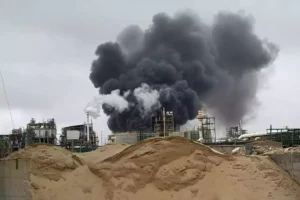
Iran struck the Neot Hovav industrial zone in Israel's Negev desert today, in what Tehran has framed as a direct act of retaliation for Israeli air strikes on Iranian industrial infrastructure. The attack marks the latest exchange in an escalating tit-for-tat pattern that shows no signs of abating — and arrives just eight days before the diplomatic deadline set by US President Donald Trump.
The strike was confirmed by Israeli emergency services, with reports of impacts within or near the industrial zone perimeter. The IRGC Aerospace Force has taken responsibility. At the time of publication, no official casualty figures have been released and the full extent of structural damage to the site's facilities remains unknown.
It is too early to confirm which missile system or delivery platform was used in today's strike. Attribution of the specific weapon and the precise facility or facilities affected within the zone remains pending further assessment.
What is Neot Hovav?
Neot Hovav — formerly known as Ramat Hovav — is Israel's principal industrial zone for hazardous and chemically sensitive manufacturing, situated approximately 25 kilometres south of Be'er Sheva in the northern Negev. It is not a routine commercial or logistics park; it is one of the most concentrated clusters of strategically significant industrial infrastructure in the country.
The density and nature of activity at Neot Hovav gives a strike there a significance beyond the physical damage caused. A successful hit on bromine processing infrastructure, chemical storage, or the hazardous waste treatment plant would carry downstream consequences for Israeli industrial output, export capacity, and potentially public safety in the surrounding area — depending on the nature of any secondary effects.
Source: social media — unverified.
Source: social media — unverified.
Retaliation Announced — The Steel Factory Connection
Today's strike did not come without warning. Iran had explicitly stated its intention to retaliate against Israeli industrial infrastructure following a series of Israeli air strikes targeting Iranian production facilities — most notably a major steel plant that was forced to halt operations after the attacks.
Iranian officials announced that any Israeli strike on Iranian industrial or economic infrastructure would be met with a corresponding response against equivalent Israeli targets. Neot Hovav — home to some of Israel's most concentrated industrial production — appears to have been selected precisely as that equivalent.
Praevisio Institute assessmentFor additional context on the Iranian steel factory strikes that preceded today's retaliation: Production at key Iranian steel factory halted after strikes | The Times of Israel
The symmetry of the targeting logic is deliberate and legible: Iran struck a zone that hosts steel production and chemical industry just as Israel struck Iranian steel and industrial capacity. This is not incidental — it reflects an Iranian doctrine of mirrored industrial targeting designed to impose costs on the Israeli economy and demonstrate that Tehran retains the reach and will to respond in kind, regardless of the military pressure it is operating under.
Source: social media — unverified.
Source: social media — unverified.
Iran's Capability Under Pressure
Perhaps the most strategically significant aspect of today's strike is not the target itself but the fact that it happened at all. Iran is operating under conditions of sustained and severe military pressure — weeks of continuous US and Israeli suppression operations have degraded radar networks, air defence batteries, command infrastructure, and logistics nodes across the country. Washington has described Iranian defences as essentially broken. Tehran demonstrably disagrees.
The ability to plan, authorise, and execute a strike on a target of this sensitivity inside Israeli territory — while simultaneously absorbing an ongoing air campaign — signals that Iran's offensive missile and drone capability has not been neutralised to the degree that either Washington or Jerusalem has publicly suggested. Iran retains meaningful reach. The tit-for-tat cycle is not slowing; it is accelerating.
This matters beyond the immediate theatre. For regional actors, trade partners, and risk managers assessing exposure to the conflict, Iran's demonstrated willingness and residual capacity to strike Israeli economic infrastructure — even under duress — materially changes the calculus of escalation. The assumption that sustained military pressure would produce Iranian restraint has not been borne out.
The April 6 Deadline and the Diplomatic Wreckage
President Trump had publicly designated April 6 as a deadline for Iran to demonstrate meaningful movement toward a diplomatic resolution. The framing was characteristically blunt: reach an agreement or face consequences. Whether that deadline carried any substantive diplomatic architecture behind it — or was primarily a pressure instrument — was already being questioned in Washington and allied capitals before today.
Today's exchange makes those questions largely academic. A Iranian ballistic strike on Israeli industrial infrastructure, followed by the Israeli retaliatory response that will follow, does not create conditions conducive to the kind of confidence-building required for a diplomatic process to gain traction in eight days. Quite the opposite. Each exchange hardens positions, generates domestic political pressure on both sides to escalate rather than accommodate, and reduces the space available for any intermediary — whether Qatar, Oman, or the broader diplomatic back-channel — to operate.
If a deal was possible before today, it is considerably more difficult now. The tit-for-tat logic of industrial targeting entrenches a war economy mentality on both sides, where the pain inflicted becomes the metric of resolve rather than a pathway to negotiation. Trump's deadline may formally remain on the calendar; substantively, the events of 29 March have all but foreclosed the scenario it was designed to force.
This article was published on 29 March 2026. Damage assessment, casualty figures, weapon attribution, and Israeli official response were pending at time of publication. This is a developing story — further updates will follow.