Crisis Brief • Flash Analysis
The Diplomatic Phase Ends: The Strikes on Iran and What Follows
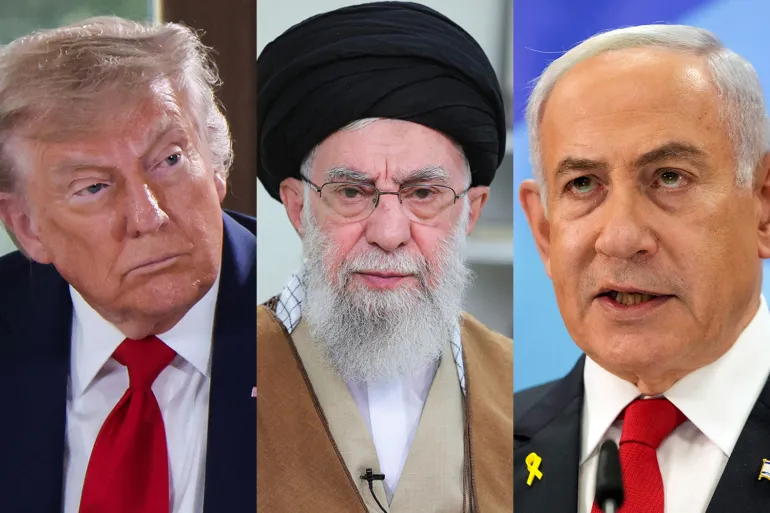
Trump, Khamenei, Netanyahu: the strategic triangle after the strikes
Executive Summary
After the initial strikes by the US and Israel against Iran this morning, several conclusions can be drawn. Many are speaking in terms of an ongoing "regime change" operation. Indeed, numerous IRGC sites have been hit, and most significantly, the palace of the current Ayatollah, Ali Khamenei, has been largely destroyed. Yet this strike was almost certainly symbolic rather than a genuine assassination attempt, a signal to the Iranian people and any latent opposition elements that the leadership is vulnerable, that its protective aura can be pierced. The message was not "we have killed your leader" but "your leader can be reached." Washington understands that killing Khamenei would transform him into a martyr and galvanize the system rather than fracturing it. Yet it remains highly unlikely that regime change is the true objective. The core of Iran's Islamic governance and the stability of the IRGC will continue under new leadership and is de facto immune to any attempt to overthrow the system. The Islamic Republic is not a person; it is a system. And systems with deep societal roots and layered institutional redundancy, the IRGC, the bonyads, the clerical network, do not collapse because one building is destroyed. Khamenei's palace is a symbol; the system's power was never located primarily in its symbols.
The Strikes and Their Immediate Aftermath
After the initial strikes by the US and Israel against Iran this morning, several conclusions can be drawn. Many are speaking in terms of an ongoing "regime change" operation. Indeed, numerous IRGC sites have been hit, and most significantly, the palace of the current Ayatollah, Ali Khamenei, has been largely destroyed. Yet this strike was almost certainly symbolic rather than a genuine assassination attempt, a signal to the Iranian people and any latent opposition elements that the leadership is vulnerable, that its protective aura can be pierced. The message was not "we have killed your leader" but "your leader can be reached." Washington understands that killing Khamenei would transform him into a martyr and galvanize the system rather than fracturing it. Yet it remains highly unlikely that regime change is the true objective. The core of Iran's Islamic governance and the stability of the IRGC will continue under new leadership and is de facto immune to any attempt to overthrow the system. The Islamic Republic is not a person; it is a system. And systems with deep societal roots and layered institutional redundancy, the IRGC, the bonyads, the clerical network, do not collapse because one building is destroyed. Khamenei's palace is a symbol; the system's power was never located primarily in its symbols.
Iran's Preparedness and the Limits of Air Power
The US has been flirting with the idea of striking Iran since the beginning of this year, giving Iran more than enough time to prepare the necessary steps to adapt. Tehran has had months to disperse its nuclear assets, harden key command nodes, and preposition proxies across the region. The strikes this morning, while significant, almost certainly hit a fraction of what Iran has already moved or concealed. As we have discussed in earlier analyses, time is on the side of the Iranians. A prolonged conflict will be a disaster for the Trump administration, both economically and politically, as any further escalation could result in a closure of the Strait of Hormuz and attacks on the oil infrastructure of US-allied countries. The US Navy cannot be everywhere simultaneously, and the missile and drone arsenals of Iran's proxies in Yemen, Iraq, and Lebanon represent a distributed retaliation capability that no amount of strikes on Iranian soil can fully eliminate. If the Iranians can hold out during the initial phase, much of the momentum will be gone.
Miscalculation and the Credibility Deficit
One must seriously question whether the US has accurately calibrated its assumptions. Any expectation of a short, decisive decapitation campaign that cripples Iran's military capabilities appears, on current evidence, quite unlikely. The preparedness of the Iranians, their dispersal of assets, and the inherent redundancy of their military command structure suggest that US calculations may be seriously wrong here. The strikes may be significant, but they are almost certainly not terminal.
However, the fact that strikes were launched in the middle of negotiations demonstrates once again that, in the eyes of the Iranians, the US cannot be trusted. This is not merely a matter of Iranian grievance; it is a structural reality that will shape every subsequent diplomatic interaction. The US has now confirmed, through action, what Tehran always claimed: that American diplomacy is backed by a finger perpetually near the trigger. The consequence is that any future deal will require overcompensation, greater concessions from the US, simply to overcome the credibility deficit created by this strike. So even if the US goal is to cut Iran down to size militarily, focusing on their ballistic missile production and capabilities, the chances of the US successfully enforcing a deal after a week or two are extremely unlikely. The Iranians will not trust the US or Israel whatsoever.
The Nuclear Paradox: Why Sites Were Spared
There is a deeper strategic irony here. The strikes were launched, according to official statements, to prevent Iran from achieving nuclear breakout capability. But by destroying the diplomatic track and ensuring that no future negotiations can proceed on the basis of trust, the US may have guaranteed the very outcome it seeks to prevent. A Tehran that believes it cannot deal with Washington is a Tehran that will accelerate its nuclear program as the only remaining guarantee of survival. The strikes may have bought time; they may also have planted the seeds of the next, more dangerous crisis.
Notably, no nuclear sites have yet been targeted. This omission is revealing. It suggests that the US is not, at this stage, seeking to eliminate Iran's nuclear program outright. The objective appears to be diplomatic enforcement through military pressure: reducing Iran's military capabilities to create leverage for a favourable deal. But the nuance that must be stressed is this: achieving that reduction in a short amount of time is extremely difficult, if not impossible. The dispersed and hardened nature of Iran's military infrastructure means that any campaign to meaningfully degrade it would require either a prolonged air campaign or ground operations, both of which carry risks the US has so far shown little appetite for. The window for a quick diplomatic victory may close before the military window does.
Escalation Ladders: Hormuz, Hezbollah, and the Regional Tinderbox
The longer this war continues, the higher the chances that things will escalate further. Escalation would mean hitting oil infrastructure and creating enormous chaos, the closure of the Strait of Hormuz, which would skyrocket oil prices and trigger global economic disruption. It would mean Iranian retaliatory strikes on US allies across the region, drawing in more actors and widening the conflict beyond the initial battlefield.
Notably, just before the US and Israel struck Iran this morning, Hezbollah targets in Lebanon were also hit. This was not a coincidence. If things escalate further, it remains likely that Israel will seek to achieve more than the degradation of Iran's ballistic missile program. The demilitarization of Hezbollah inside Lebanon, the systematic dismantling of the most formidable proxy force Iran has assembled, would be a strategic prize worth far more to Israel than any single round of strikes on Iranian soil. For Israel, this moment represents an opportunity to reshape its northern security environment for a generation.
Diverging Interests: The US-Israel Timeline Clash
All of this remains more in the interest of Israel than that of the United States of America. Israel gains from a US committed to a prolonged confrontation with Iran and its proxies; the US gains from a quick resolution that allows it to refocus on the Indo-Pacific. These two timelines are now in conflict, and it is not yet clear which will prevail.
References & Further Reading
Praevisio Institute Archives: Previous analysis on Iran's proxy networks (Feb 2026)
Reuters: US officials confirm strikes on IRGC facilities, Khamenei residence damaged (2026-02-28)
Al Jazeera: Hezbollah targets in Lebanon hit in parallel strikes
AP News: Iran had months to disperse nuclear sites, officials say
The Wall Street Journal: Inside the White House's calculus on Iran