Executive Summary
We called it. In our assessment published yesterday evening, we argued that Trump would not follow through on his threats to destroy Iranian civilian infrastructure and that the most plausible outcomes were one of two: either a continuation of the status quo — the conflict grinding on without significant new escalation, painful for the global economy but less dangerous than the alternatives — or a partial, face-saving ceasefire, modest and ambiguous, satisfying to neither side, and viable precisely because of that ambiguity. We assessed both as acceptable exits for both parties. That is what happened. Pakistan's Prime Minister Shehbaz Sharif, working in tandem with Army Chief Field Marshal Asim Munir, produced an agreement between Washington and Tehran in the final hour before Trump's 8:00 PM ET deadline. The framework: a two-week suspension of US strikes conditioned on Iran reopening the Strait of Hormuz, with talks in Islamabad on April 10 to negotiate a permanent settlement.
The deal has immediately come under strain. Iranian oil facilities on Lavan and Sirri Islands were struck by an unattributed airstrike hours after the announcement. Iran blamed UAE Mirage jets — a claim that, if verified, represents a significant recalculation by Abu Dhabi. Iran responded by striking Gulf energy infrastructure in Saudi Arabia and the UAE, despite the announced truce. Reports are emerging that Iran is moving to reclose the Strait.
Israel is openly defying the ceasefire framework. Netanyahu stated explicitly that Lebanon is not included in the deal, directly contradicting Pakistan's announcement that it was. Hours later, Israel launched what its military called the largest coordinated strike of the current war — over 100 Hezbollah targets in Beirut, southern Lebanon, and the Bekaa Valley within ten minutes. Dozens of Lebanese civilians were killed. As we have argued throughout our coverage, Israel's strategic interests in this conflict are categorically different from America's. Israel has not achieved its objectives. It will not accept a ceasefire that leaves Hezbollah armed and southern Lebanon outside its control. The minimum condition for Israel, in any lasting settlement, is permanent Israeli military presence south of the Litani — what its far-right ministers have openly called annexation.
The ceasefire is real on paper. On the ground, it is already eroding. The Islamabad talks on April 10 remain the next meaningful moment. Whether they happen — and whether the ceasefire holds long enough to get there — is the question the next 48 hours will answer.
The Ceasefire: How It Happened
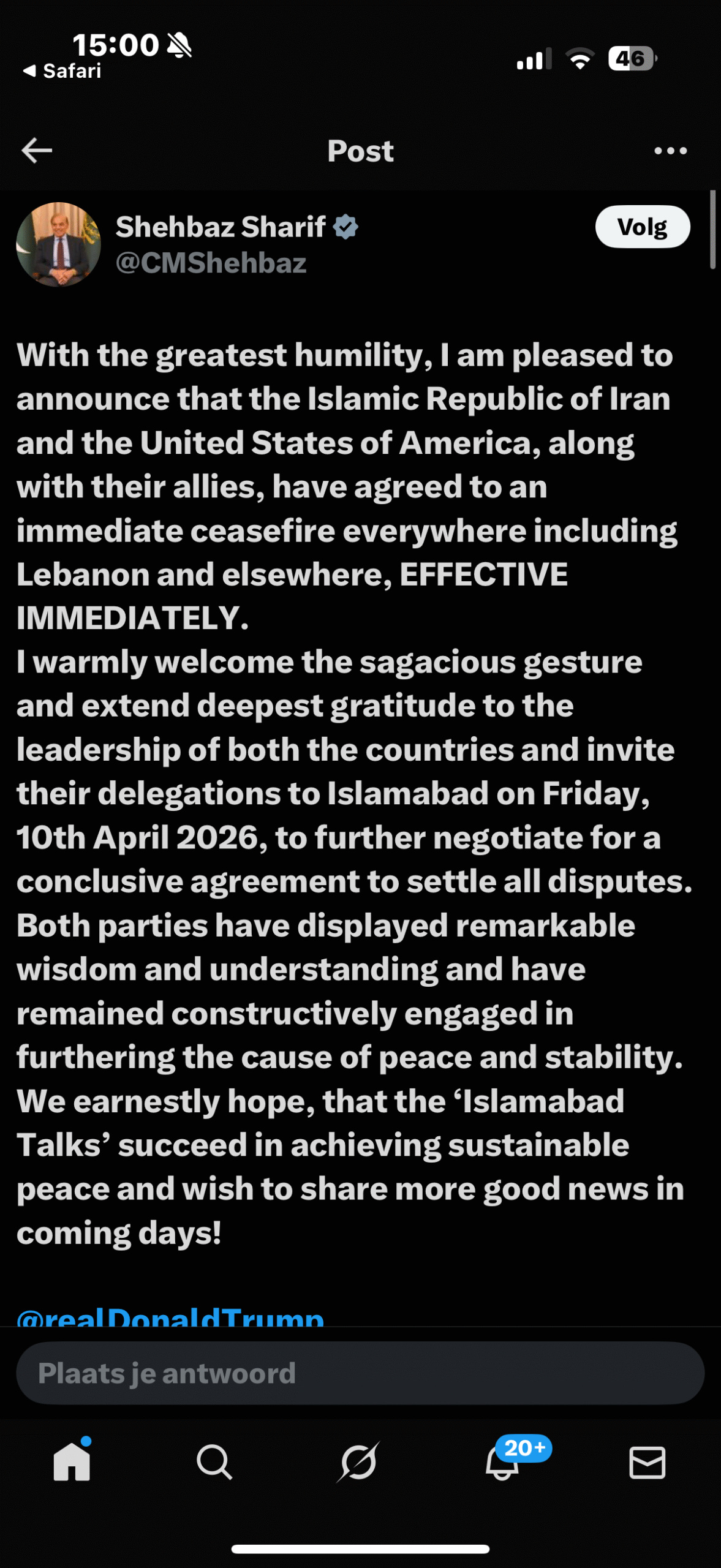
In the early hours of Wednesday, 8 April — with less than one hour remaining before Trump's stated deadline — Pakistani Prime Minister Shehbaz Sharif announced on X that the United States and Iran, along with their allies, had agreed to an immediate ceasefire, effective immediately. Trump confirmed the suspension of strikes on Truth Social, stating the ceasefire was contingent on "the complete, immediate, and safe opening" of the Strait of Hormuz and would last two weeks, during which a final settlement would be negotiated.
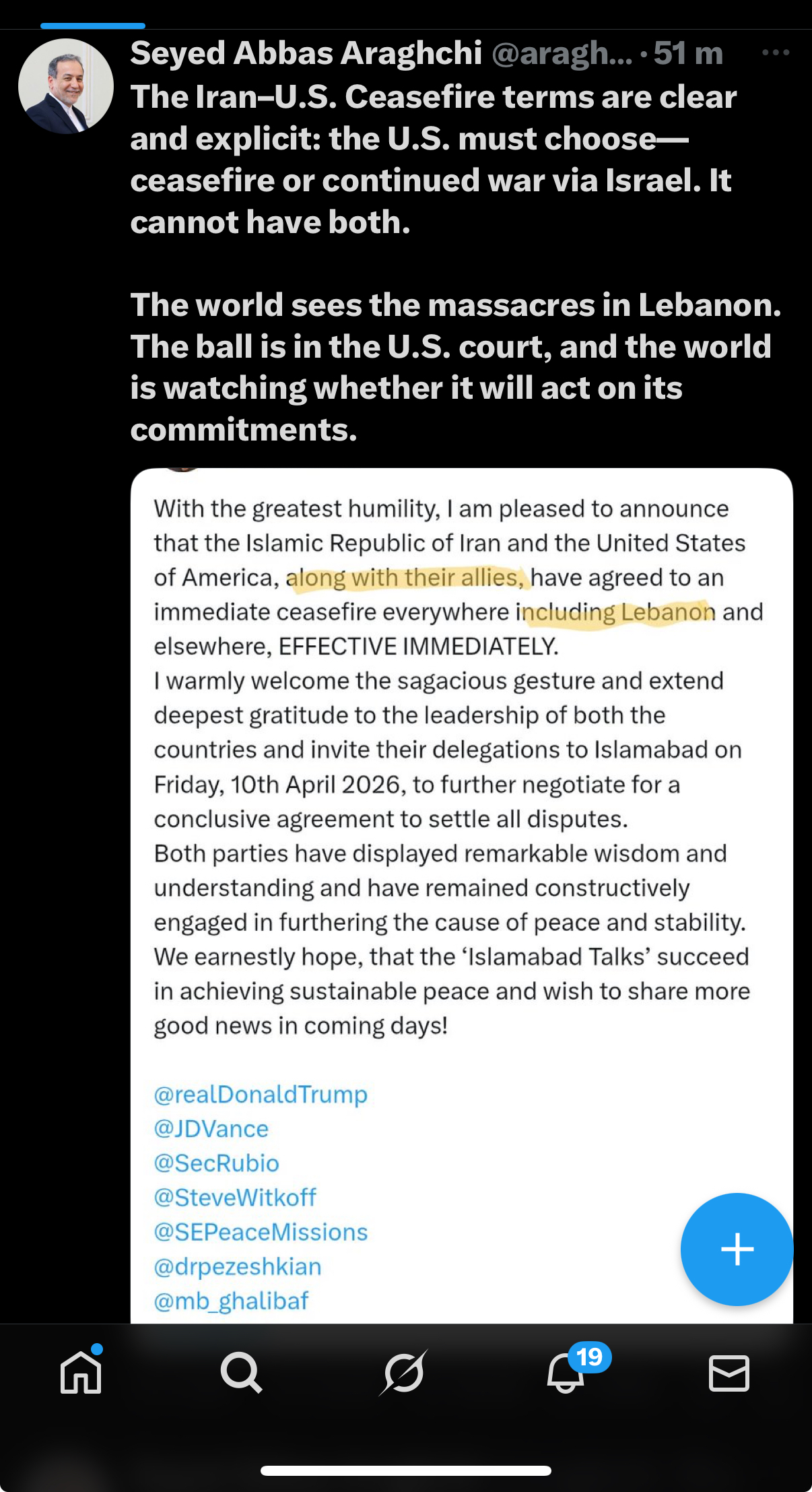
Iran's Foreign Minister Araghchi confirmed acceptance of the framework, declaring that if attacks on Iran were halted, Iranian armed forces would cease defensive operations. He added that for the two-week period, safe passage through the Strait of Hormuz would be possible via coordination with Iranian armed forces — a formulation that notably preserves Iranian authority over the waterway rather than conceding it.
Pakistan's role cannot be overstated. PM Sharif had been pressing both sides for weeks, and it was his direct appeal to Trump — backed by Field Marshal Munir — that produced the final off-ramp before the deadline expired. This represents a significant moment for Pakistan's international standing and for the role of non-Western mediators in major-power conflicts. Sharif announced that both delegations were invited to Islamabad on 10 April for further negotiations toward a conclusive settlement.
As we argued in our previous assessment, a partial ceasefire was the most reachable outcome: face-saving for both sides, satisfying to neither, and viable precisely because it is ambiguous. That is what was agreed. The ambiguity is already causing problems.
The ceasefire was also framed, by Pakistan's announcement, as covering Lebanon. That framing immediately collapsed. Netanyahu stated within hours that the agreement does not extend to Israel's war with Hezbollah — a position the United States subsequently endorsed, despite Pakistan's contrary claim. The contradiction between the mediator's stated terms and what the parties actually agreed to is not a minor discrepancy. It is the central instability of this deal.
Lavan and Sirri Islands: The UAE Question
Within hours of the ceasefire announcement, Iranian state television reported that the country's oil refinery on Lavan Island had come under attack. Explosions were also reported on Sirri Island, Iran's key crude export facility in the Persian Gulf. No party immediately claimed responsibility. Iran, however, attributed the strikes to UAE Mirage jets — a significant and as-yet unverified allegation.
The UAE has not confirmed the claim, and it should be treated with appropriate scepticism while it remains unverified. But if confirmed, it would represent a strategic recalculation by Abu Dhabi of considerable importance. The logic would be as follows: the ceasefire framework implicitly ratifies Iranian de-facto administration of the Strait of Hormuz, including the toll system denominated in Chinese yuan that has been solidifying over the past weeks. From the UAE's perspective, this means that its oil exports — approximately 2.5 million barrels per day — would pass through a waterway under effective Iranian sovereign management indefinitely. That is an intolerable strategic position for an economy whose entire external trade depends on unencumbered Gulf access. An airstrike on Lavan, in that context, would be a statement: the UAE is not prepared to accept the new order in the Strait without contesting it, even at the cost of Iranian retaliation on its own energy infrastructure.
Iran's response was swift: missile and drone attacks on Kuwait and the UAE were reported within hours, with UAE air defences engaged across multiple cities. Fires were reported at the Habshan gas complex in Abu Dhabi. Saudi Arabia, Bahrain, and Qatar also reported incoming attacks, despite the ceasefire that had been announced less than twenty-four hours earlier.
The regional situation, in short, has not stabilised. The ceasefire paused the US-Iran bilateral exchange of fire. It has done nothing to contain the broader regional conflict, whose dynamics — including the Gulf states' own calculations about the Strait — operate on a separate track from the Washington-Tehran negotiating axis.
Israel, Lebanon, and the Ceasefire It Does Not Accept
We have addressed Israel's strategic interests in this conflict at length in our previous assessment. What is happening today is the clearest possible illustration of the argument we made: Israel's objectives are not America's objectives, and no American ceasefire will bind Israeli operations unless Washington makes the cost of non-compliance explicit — which it has consistently declined to do.
Hours after the ceasefire was announced, Israel launched what its military described as the largest coordinated strike of the current war — over 100 Hezbollah targets struck within ten minutes across Beirut, southern Lebanon, and the Bekaa Valley. Lebanon's health ministry reported dozens killed and hundreds wounded in an early estimate, with strikes hitting dense commercial and residential areas in central Beirut without prior warning. Black smoke rose over multiple neighbourhoods of the capital.
Netanyahu stated that the ceasefire with Iran does not extend to Lebanon — directly contradicting the Pakistani PM's announcement that the deal covered "everywhere, including Lebanon." The United States endorsed the Israeli position, stating the ceasefire does not include the Lebanon front. Families in Beirut who had begun packing their belongings to return home after the announcement were forced to abandon those plans as the strikes continued.
Israel's ground invasion of southern Lebanon is ongoing. Its far-right ministers have openly called for the annexation of the territory south of the Litani River. Analysts have noted that the greatest threat to any ceasefire in the region remains Israel, which has historically used ambiguous ceasefires as temporary pauses before resuming operations when conditions are favourable. The precedent is well established. The pattern is repeating.
The strategic calculus for Israel is unchanged from what we described yesterday. Israel has not achieved its core objectives — permanent degradation of Hezbollah, Iran weakened beyond recovery, American commitment locked in. A ceasefire at this stage, before those objectives are reached, is a strategic failure from Jerusalem's perspective. Netanyahu's immediate move to carve Lebanon out of the deal is not a tactical decision. It is the expression of a strategic position that was always going to produce this outcome.
Israel understands that its window of unconditional American support is finite and closing. It will not allow a ceasefire to close that window before it has extracted the maximum possible strategic advantage. Every day of continued conflict is, from Jerusalem's perspective, a day of progress toward objectives that a negotiated peace would foreclose.
The Strait of Hormuz: Nominally Reopening, Reportedly Reclosing
The ceasefire's central condition — from Washington's perspective — was Iranian reopening of the Strait of Hormuz. Iran's acceptance was characteristically precise in its formulation: safe passage would be "possible via coordination with Iran's Armed Forces and with due consideration of technical limitations." This is not the clean, unconditional reopening that the US demanded. It is a continuation of the toll-booth model under a diplomatic veneer — Iran remains the administrator; passage remains conditional on its approval.
As of the time of writing, there are credible reports that Iran has moved to reclose the Strait, citing Israeli strikes in Lebanon as a violation of the ceasefire framework. Iran's position — stated by Iranian media — is that Israel's continued attacks in Lebanon constitute aggression by a US ally, which Iran regards as a breach of the terms under which it accepted the ceasefire. Whether this represents a formal reimposition of the blockade or a temporary pressure tactic in the Islamabad negotiation process is not yet clear. What is clear is that the Strait's status remains the central lever in this conflict and will remain so regardless of what diplomatic language surrounds it.
The Strait problem — which we have argued throughout our coverage is the only problem that ultimately matters — has not been resolved by the ceasefire. It has been temporarily deferred. The question of who administers the waterway, on what terms, and with what recognition from the international community remains open. Iran's parliament has passed legislation codifying its toll regime. Multiple countries have already quietly accepted that framework by paying and passing. The diplomatic clock is running in Tehran's favour on this dimension of the conflict, ceasefire or not.
What Comes Next
The Islamabad talks, scheduled for 10 April, are the next formal milestone. Whether they take place depends on whether the ceasefire holds for another 48 hours — a proposition that looks increasingly fragile. Iran's condition for continued participation is an end to attacks on Lebanon. Israel's condition for anything is that Lebanon is not on the table. Those two positions are directly incompatible, and the United States has, as of writing, sided with Israel.
There are also unverified reports as of this afternoon of US airstrikes on several Iranian cities. These reports originate exclusively from local Iranian media sources and cannot be confirmed at this time. If accurate, they would indicate that the ceasefire has effectively collapsed on the US side as well. We are treating them with appropriate caution pending verification.
The broader picture as of 8 April is this: a ceasefire was announced, celebrated, and began fragmenting within hours. The instruments of fragmentation are familiar — Israeli operations in Lebanon, Gulf state recalculations, unattributed strikes on Iranian infrastructure, and Iran's leverage over the Strait used as a diplomatic pressure tool. None of these dynamics were resolved by the ceasefire announcement. They were paused, briefly, by it.
What the ceasefire has produced, even in its fragile and contested form, is something worth noting: it has established that a negotiated exit is possible in principle. Both Washington and Tehran accepted a framework. Both made public statements of conditional agreement. The architecture of a deal — two weeks, Islamabad, Iran's 10-point proposal as a basis — exists now in the public record. That is not nothing. Whether it amounts to anything depends on whether Israel allows it to proceed, and whether the Gulf states' recalculations — particularly the UAE's — can be managed without triggering a regional escalation that overtakes the diplomatic track entirely.
As we have consistently argued: the strategic interests of Israel and the United States are not the same. That gap is no longer a matter of analytical inference. It is now publicly visible in real time, on the streets of Beirut, in the smoke over Lavan Island, and in the contradiction between what Pakistan announced and what Netanyahu immediately declared. The next 48 hours will determine whether the Islamabad talks happen at all. If they do, the conflict enters a new phase — imperfect, contested, but negotiable. If they do not, the ceasefire will have been the shortest peace in a very long war.
Note: This assessment was completed at 17:58 GMT+1 on 8 April 2026. Several developments referenced — including the UAE Mirage attribution and reports of US airstrikes on Iranian cities — remain unverified at time of publication and are presented as such. All assessments represent the analytical judgement of the author and do not constitute investment or policy advice.