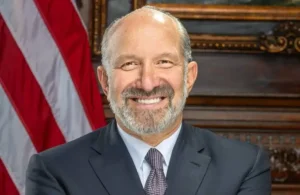
Friday’s Supreme Court decision to dismantle the previous administration's tariff regime was a landmark moment for trade policy. But for a select group of financial players, it wasn't a shock it was a payday. And that payday has a direct line to the family of Commerce Secretary Howard Lutnick, one of the most vocal architects of those very tariffs.
This isn't far fetched; it’s a matter of public record, first reported by Wired back in July. At the heart of it is Cantor Fitzgerald, the financial services giant Lutnick chaired for decades before joining the Cabinet. The firm is now helmed by his sons, Kyle and Brandon Lutnick. And in a move that looks less like clairvoyance and more like an informed wager, Cantor Fitzgerald spent the months leading up to this ruling actively buying up the rights to tariff refunds.
The logic was simple, if cynical: For companies that had paid millions in duties, Cantor offered immediate cash typically 20 to 30 cents on the dollar in exchange for the rights to any future refunds should the tariffs be struck down in court. For a company that paid $10 million, Cantor would hand over $2 or $3 million today. If the courts ruled in their favour, Cantor stood to collect the full $10 million from the government, pocketing a staggering $7 to $8 million profit.
“We have the capacity to trade up to several hundred million of these,” a Cantor representative wrote in a letter at the time, noting they already had one $10 million deal in the bag. Fast forward seven months, and with the Supreme Court’s ruling, those bets are now coming due.
This is where the optics move from "Wall Street savvy" to "Pennsylvania Avenue problem."
Howard Lutnick has been one of the most uncompromising hawks on trade within the administration, consistently pushing back against advisers like Treasury Secretary Scott Bessent who sought to moderate the tariff approach. He has been the public face of a policy that caused significant economic disruption.
And yet, the firm bearing his name, now run by his sons was effectively betting a fortune that his own signature policy would not stand.
This raises an unavoidable question: Was Lutnick simply playing the loyal soldier, championing a policy he personally doubted while his family business quietly positioned itself to profit from its failure?
It’s a classic case of what we might call "legal graft"—the exploitation of one's position for financial gain that doesn't technically cross a statutory line but reeks of a conflict of interest. Lutnick is not accused of breaking a law. He didn't leak a Supreme Court decision before it happened. But he didn't have to. The advantage came from being part of a system where proximity to power provides a privileged and profitable view of the risks.
Did he have a quiet conversation with his sons about the legal fragility of the tariffs? We don't know. But the market signal from his family's firm was clear: they saw the tariffs as a temporary blip, a legal house of cards. It’s a signal that was evidently strong enough for them to pour "several hundred million" dollars into the trade.
Lutnick has yet to comment on the ruling. He has, until now, been a steadfast defender of the policy. But as the saying goes, watch what they do, not what they say. And what his family's firm did was bet against the house a house their patriarch was helping to build. That’s not necessarily a crime. But for a nation weary of seeing public service turned into a family business opportunity, it sure looks like a feature, not a bug, of a system where the line between governing and profiting has been erased.
One thing however is certain, it’s a big club and we’re not in it.