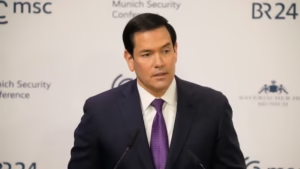
In his address at the Munich Security Conference, U.S. Secretary of State Marco Rubio highlighted the deep historical, cultural, and civilizational ties between the United States and Europe. He described these connections as rooted in shared history, values, and heritage, framing the transatlantic relationship as essential to addressing current global challenges.
Rubio reflected on the historical trajectory of the West, noting that the era of large Western empires ended in the mid-20th century amid communist revolutions, anti-colonial movements, and other forces that reshaped the international order. He characterized earlier Western expansion—including exploration, settlement of new continents, and the establishment of vast empires—as a major chapter in global history that contributed to development and interconnectedness.
The secretary called on Western nations to move away from policies he sees as contributing to decline, such as dependence on fragile supply chains and unmanaged migration pressures, and instead pursue a more unified and proactive strategy. This would include strengthening domestic resilience in critical minerals and advanced technologies, while actively competing for economic partnerships and influence in developing regions, particularly the Global South.
European Response
Rubio advocated for closer coordination between the United States and European allies to renew Western strength and shape what he described as a revitalized era of Western leadership, rather than accepting a narrative of gradual erosion. Many European attendees responded positively, with applause and expressions of support for reaffirming the transatlantic alliance.
Global South Concerns
At the same time, the speech has not been received with the same enthusiasm in much of the Global South. Leaders, analysts, and public voices in Africa, parts of Asia, Latin America, and other developing regions have expressed significant concern over the historical framing and the emphasis on intensified Western competition for resources, markets, and influence in their countries.
Many interpret these elements as signaling a desire to reassert dominance or revive patterns of unequal economic engagement, rather than fostering genuine partnership based on mutual respect and local priorities. Critics argue that such an approach risks being perceived as overlooking the sovereignty, agency, and development aspirations of Global South nations, potentially deepening mistrust and complicating relations in an increasingly multipolar world.
The remarks align with the broader direction of the current U.S. administration's foreign policy, which prioritizes strategic competition, national interests, and active engagement in resource-rich and fast-growing regions, including through partnerships with select European allies in areas such as infrastructure and critical minerals.