Strategic Interests, Alliance Constraints, and the Limits of NATO Cohesion
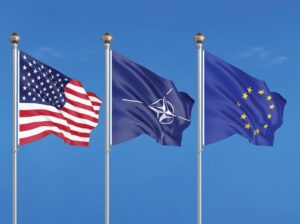
The possible U.S. takeover of Greenland under Donald Trump would manifest the ultimate stress test for the transatlantic security alliance. As Greenland is part of the Kingdom of Denmark, this action would constitute an attack by one NATO member on another. Even if unlikely to occur, the scenario exposes a structural weakness in the alliance regarding design and commitment when confronted with great-power interests.
From a realist perspective, the relevance of this scenario lies in its strategic logic. Greenland lies right in the middle of the Arctic shipping routes and holds some of the most valuable natural resources. The melting ice is transforming the region into a key logistical and military corridor with state actors like China seeking influence through infrastructure investment, shipping access, and resource exploration. For Washington, Greenland would be a critical asset.
From a realist lens, Washington's concern is not Greenland per se, but the risk of rival powers gaining leverage over territory affecting U.S. security concerns. Control over Greenland reduces uncertainty, limits adversarial access, and reinforces U.S. dominance in the North Atlantic territory.
Any unilateral U.S. action affecting Greenland would detriment alliance cohesion, particularly with Denmark and other European partners. However, U.S. strategic planning would likely prioritize the prevention of power vacuums over alliance sensitivities.
The possible U.S. takeover of Greenland under Donald Trump would manifest the ultimate stress test for the transatlantic security alliance. As Greenland is part of the Kingdom of Denmark, this action would constitute an attack by one NATO member on another. Even if unlikely to occur, the scenario exposes a structural weakness in the alliance regarding design and commitment when confronted with great-power interests.
From a realist perspective, the relevance of this scenario lies in its strategic logic. Greenland lies right in the middle of the Arctic shipping routes and holds some of the most valuable natural resources. The melting ice is transforming the region into a key logistical and military corridor with state actors like China seeking influence through infrastructure investment, shipping access, and resource exploration. For Washington, Greenland would be a critical asset.
From a geostrategic standpoint, U.S. interest in Greenland is best understood as part of a broader effort to preserve influence in the Arctic. Greenland sits right in the GIUK gap (Greenland-Iceland-United Kingdom), a historically decisive chokepoint for controlling naval and air movement between the Arctic and North Atlantic. This position makes Greenland indispensable for early warning, missile defense, and anti-submarine warfare – core components of U.S. homeland security.
As Arctic ice recedes, new maritime routes such as the Northern Sea Route and potential trans-polar passages increase the region's military and commercial relevance. Simultaneously, Russia has expanded its Arctic military infrastructure, while China has declared itself a "near-Arctic state" pursuing access to infrastructure, research facilities and critical minerals. From a realist lens, Washington's concern is not Greenland per se, but the risk of rival powers gaining leverage over territory affecting U.S. security concerns.
Control over Greenland reduces uncertainty, limits adversarial access, and reinforces U.S. dominance in the North Atlantic territory. Realism suggests that when such core interests are jeopardized, alliance norms and legal constraints become secondary to power considerations.
By the principles of Realpolitik, any potential U.S. move towards assuming direct or indirect control over Greenland would be driven by strategic necessity rather than territorial ambition. A likely approach would unfold in the shape of rapid consolidation rather than invasion the traditional sense. This could include the expansion and fortification of existing U.S. military infrastructure, the deployment of air and missile defense assets, the securing of ports, airfields and communication infrastructure. In General, sovereignty arrangements remain ambiguous, while in practice the U.S. would exercise decisive influence over Greenland's security environment.
Such a course of action could be framed as defensive and preventative, justified by the need to deny access to other great powers like Russia and China. From this perspective, Greenland represents a critical component of U.S. security strategy.
The Arctic environment imposes significant logistical challenges, including extreme weather conditions, limited infrastructure, and long supply lines. While manageable for U.S. forces, they increase cost and complexity of sustained operations.
More significant, however, are the political and strategic risks. Any unilateral U.S. action affecting Greenland would detriment the alliance cohesion, particularly with Denmark and other European partners. Such action would challenge the established norms regarding allied sovereignty and could weaken perceptions of predictability within NATO.
At the same time, U.S. strategic planning would likely prioritize the prevention of power vacuums over alliance sensitivities. From a realist view, long-term strategic security outweighs any short-term diplomatic tensions.
Furthermore, the U.S. would need to account for local political dynamics within Greenland. While the territory's limited population reduces the risk of organized resistance, long-term stability would depend on a level of local support. Nevertheless, these considerations are secondary to the overarching national security objectives.
Within NATO, institutional responses would be limited. The alliance is structurally ill-equipped to address conflicts involving the strategic actions of its leading member. The asymmetry of power within the alliance ensure that U.S. strategic priorities carry the decisive weight.
European responses, including those of the European Union, would most likely remain within the diplomatic and legal realm. While political criticism and symbolic measures could be expected, there is limited capacity or willingness to impose costs that would fundamentally alter U.S. behaviour. European nations remain dependent on U.S. security guarantees, particularly considering ongoing tensions with Russia.
In practice, such development would underscore the interest-based nature of the transatlantic alliance. NATO cohesion can only be preserved through the adaptation of a new strategic reality.