No coherent war aim stated at the outset
The Ceasefire That Was Never Going to Produce a Deal
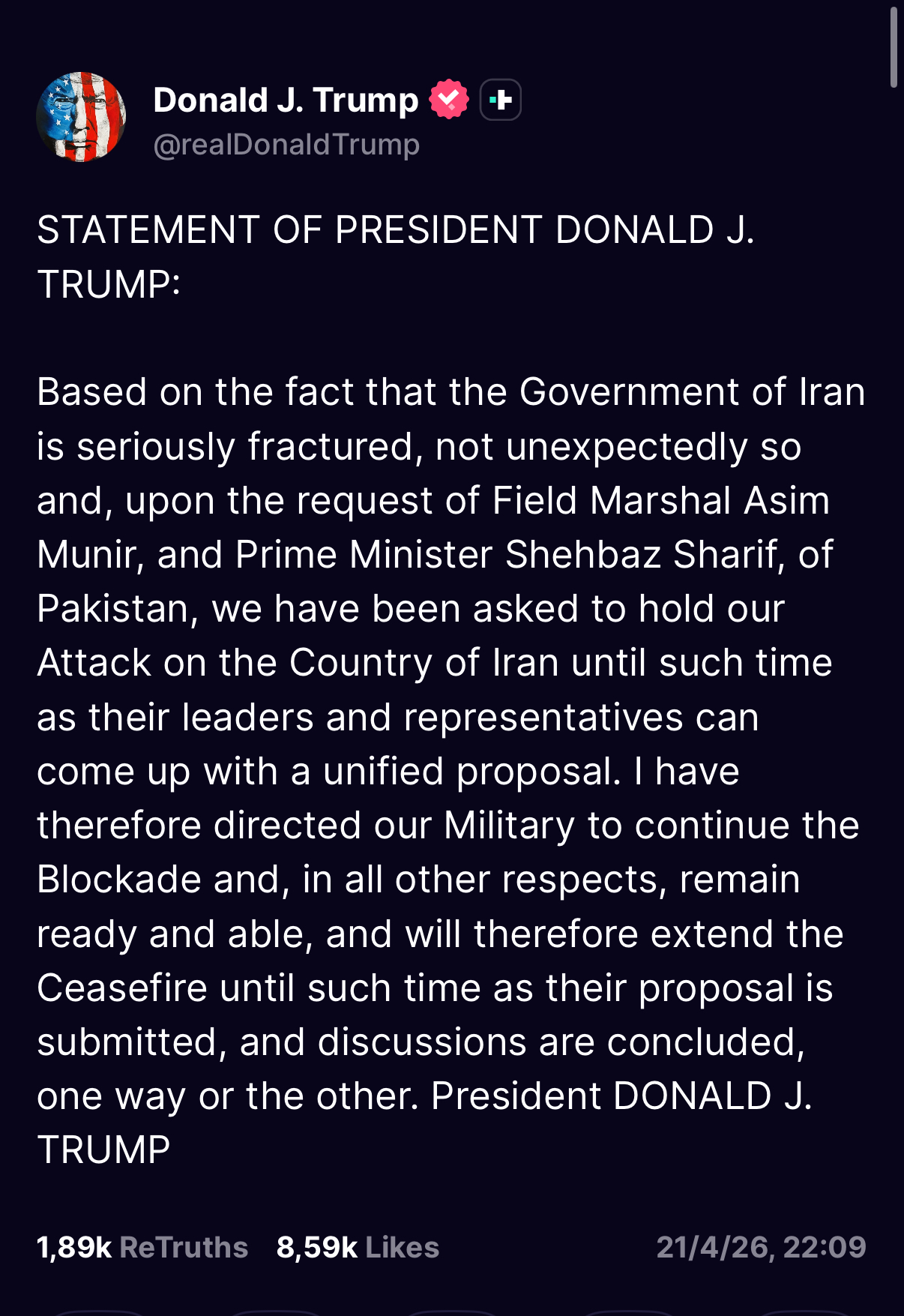
A ceasefire, at its most basic, is a pause in which parties either find common ground or confirm that none exists. This one has confirmed the latter. The ceasefire now approaching its end was entered not because the two sides were close to an agreement, but because neither — for different reasons — was ready to bear the cost of continued escalation at that particular moment. That is a very different thing from a peace process, and it should not have been mistaken for one.
As we argued in Hour Zero, the Trump administration entered this conflict without a coherent strategic objective and has not acquired one since. The public posture — escalatory tweets, civilisational threats, deadline extensions — has functioned as a substitute for strategy rather than an expression of one. This is not an accident of communication style; it reflects the genuine absence of a military or diplomatic option that resolves the one problem that actually matters: Iranian control of the Strait of Hormuz.
Nothing that has occurred during the ceasefire period changes that fundamental picture. The United States has accumulated no new leverage. Iran has not been compelled to make any concession. The diplomatic frameworks remain as incompatible as they were on the first day of fighting. Anyone who believed the ceasefire would produce movement toward a deal was operating on a misreading of the underlying positions — and of what Iran is actually prepared to trade away, which is considerably less than Washington has ever been willing to acknowledge.
Read the preceding assessment
Hour Zero: Why Trump Will Not Pull the Trigger on Iran Tonight — Published 7 April 2026. The paper that established the core analytical framework underpinning this assessment: that the US lacks a viable military option for reopening the Strait, that the Kharg Island capture scenario is strategically incoherent, and that the status quo — uncomfortable as it is — remains less dangerous than any available escalation.
America Has No Cards It Did Not Already Have
The central failure of the Trump administration's approach to this conflict is not tactical — it is structural. The threats have been real in tone and absent in consequence, not because the administration lacks will, but because the available instruments do not match the stated objectives. Strikes on power stations and desalination plants, as argued in Hour Zero, would generate enormous civilian suffering, a propaganda catastrophe, and oil price spikes that would devastate American consumers before any strategic return materialised. The Pentagon understood this in April. Nothing has changed.
What has changed is the window of opportunity for any of these threats to produce Iranian concessions. Every week the ceasefire held without diplomatic progress was a week in which Iran's position hardened and its negotiating posture calcified further. Tehran has watched the United States set deadlines, extend them, set them again, and then enter a ceasefire without extracting a single structural concession. The lesson Iranian decision-makers draw from this sequence is not that American threats should be taken more seriously — it is the opposite.
0
Iranian structural concessions during ceasefire
$100+
Brent crude per barrel (Strait closure effect)
3+
US deadlines set, then extended or abandoned
The incoherence of the public messaging — different rationales from Trump, Rubio, and Hegseth for why this war was necessary, why now, and what it was meant to achieve — has compounded this problem. A government that cannot articulate a consistent casus belli is not a government conducting a war with a settled strategic objective. It is a government that made a decision and is constructing the justification retroactively. Iran's negotiators are not naive. They read this clearly.
The blockade of Iranian oil shipping, which has emerged as the primary instrument of continued pressure during the ceasefire period, is the one element of the American approach that reflects sound strategic logic — and it was, notably, the approach we outlined in our earlier paper as preferable to the Kharg Island capture scenario that dominated commentary at the time. Interdicting Iranian vessels at sea is enforceable, does not require holding territory within Iranian missile range, and applies genuine economic pressure over time. That it has been deployed is correct. That it is being deployed as part of a strategy that lacks a defined endpoint is the problem.
What a Victory Would Actually Require — and Why It Will Not Happen
Any serious assessment of this conflict requires an honest accounting of what a meaningful outcome for the US-Israeli side would actually look like. The minimum threshold for what could be called even a Pyrrhic strategic victory — one that carries sufficient cost to be deeply problematic, but that nonetheless advances core objectives — would include at a minimum: Israeli annexation of southern Lebanon, a substantive reduction of Iran's regional reach and its ability to project power through proxy networks, and some form of curtailment of its nuclear programme. Regime change, which has circulated in certain Washington and Tel Aviv circles, is not a realistic objective and appears, rightly, to have been removed from any serious planning.
Even this reduced threshold is not achievable in any near-term diplomatic framework. Iranian counter-offers have not approximated even the lower end of what American planners would consider an acceptable outcome. The gap between the two positions is not a negotiating gap — it is a structural incompatibility. Iran will not dismantle its proxy network because that network is the primary vehicle through which it projects regional influence. Iran will not make nuclear concessions that leave it more vulnerable than it already is. And Iran will not, under any circumstances, surrender what it regards as its core deterrent: its ballistic missile programme.
The question of who benefits from this war has a clearer answer than the question of what it was for. China is the most obvious strategic winner. Every month Washington is consumed by the Middle East is a month Beijing does not need to spend countering American pressure in the Indo-Pacific. Iran's toll system runs in Chinese yuan. The conflict is a gift of extraordinary proportions for Beijing — and it requires no Chinese action whatsoever to sustain.
It is also worth being clear-eyed about the divergence of Israeli and American interests in this conflict, which is greater than public statements from either capital suggest. For the United States, the ideal outcome is a negotiated reduction in Iranian regional power that stabilises oil markets, removes a nuclear threat, and allows Washington to pivot strategic attention back toward the Indo-Pacific. For Israel, the calculus is different. If regime change is off the table — which it appears to be — then the next best outcome from an Israeli strategic perspective is Iran in a state of permanent economic and socioeconomic chaos. A weakened Iran that cannot recover, that cannot fund Hezbollah or Hamas, that is consumed by internal instability, is a strategic asset for Israel regardless of whether a formal agreement is ever signed. Critically, this logic extends beyond the battlefield: neither Israel nor the United States would accept a deal that allows Iran to economically recover and rebuild its strategic capacity over time. Even a ceasefire that leaves Iran intact but economically bruised is, from their perspective, a defeat deferred — a problem paused, not resolved.
This divergence extends further. Israel has a long-standing strategic interest in seeing the Gulf states weakened — a point rarely stated publicly but analytically defensible. The Gulf states, even those that have normalised relations with Israel, are not unconditional allies. They are transactional partners. An energy shock that weakens their economic position and their ability to project independent influence is not, from an Israeli strategic perspective, an unambiguous negative. The Gulf states, for their part, are caught in a structural trap of their own: they have no interest in a prolonged war, but they are equally opposed to Iranian de-facto control of the Strait of Hormuz, which would hand Tehran direct leverage over their own oil exports. They retain a latent card — the threat of denominating oil sales in Chinese yuan rather than US dollars — that, if deployed, would accelerate the erosion of dollar hegemony at a moment when Washington can least afford it. That card has not been played. It does not need to be played to exert influence. Its existence is pressure enough.
The question of who is shaping American decision-making on this conflict is complicated further by the financial entanglements of Jared Kushner, who serves as Trump's special envoy on Iran negotiations while his private equity firm Affinity Partners holds approximately $6.16 billion in assets under management, the overwhelming majority from Gulf state sovereign wealth funds — including a $2 billion investment from Saudi Arabia's Public Investment Fund, with Qatar and UAE funds also participating. Congressional investigators from both the Senate Finance Committee and the House Judiciary Committee have raised Foreign Agents Registration Act concerns. No explicit quid pro quo has been documented. The structural conflict of interest is nonetheless unambiguous — and it is the kind of overlap that makes any clean reading of American strategic intent in this region considerably more difficult.
The Ballistic Missile Programme: The Issue That Ends the Conversation
More than the nuclear question, more than the proxy network, more than the Strait itself, the issue that makes any durable deal structurally impossible in the near term is Iran's ballistic missile programme. This is Iran's primary deterrent. It is what prevents Israel from acting against Iran with the kind of impunity it can exercise against less well-armed adversaries. It is what gives Tehran the ability to credibly threaten every Gulf state and American military installation in the region. It is the foundation upon which Iran's entire strategic posture rests.
The programme is also increasingly impervious to external intervention. Iranian ballistic missile production has advanced significantly in recent years, and crucially, it is moving underground — hardened into facilities that no combination of Israeli and American air power can comprehensively destroy. No actor in the region, including the United States with its full conventional military superiority, has the ability to eliminate the programme in its entirety. Degrading it, yes. Ending it, no.
Iran will not trade away its ballistic missile programme. Not for sanctions relief. Not for a non-aggression guarantee. Not for economic recovery. Without its missile deterrent, Iran is left at the mercy of the US-Israeli axis — a position no Iranian government, reformist or hardline, could accept and survive politically. This is not a negotiating position. It is a structural reality.
The implications for any deal are direct. The United States and Israel have made clear — through their stated objectives and their military targeting — that the ballistic missile programme is the threat they are most determined to eliminate. Iran has made equally clear that it will not dismantle it. This is not a gap that patient diplomacy can bridge. It is a foundational incompatibility. Any agreement that does not address the missile programme will be seen by Washington and Tel Aviv as inadequate. Any agreement that does address it will be seen by Tehran as capitulation.
The nuclear question, paradoxically, is in some ways more tractable — Iran has engaged in nuclear negotiations before and the precedent for some form of monitored limitation exists, however contested. The ballistic missile programme has no equivalent diplomatic history. It is the issue that most directly and most immediately determines Iran's ability to deter an existential threat. Iran will fight a war — this war — to retain it. And that is the war that has no exit through a negotiated deal.
What Comes Next: The Status Quo as Default
The ceasefire will either end formally on its stated date or it will dissolve informally before then — through an Israeli strike, an IRGC provocation, or a Trump administration decision that the cost of continued inaction is higher than the cost of resumed engagement. Any of these triggers would restart hostilities on essentially identical terms to those that obtained before the ceasefire. No new military capability has appeared on the American side. No new vulnerability has appeared on the Iranian side. The structural picture is unchanged.
What the ceasefire has confirmed is the assessment we offered in April: that the most likely sustained outcome of this conflict, absent a dramatic shift in the underlying power balance, is an indefinite continuation of the status quo. Not a peace deal. Not an Iranian capitulation. Not an American military breakthrough. A grinding, costly, inconclusive contest in which Iran retains control of the Strait, the missile programme continues to harden underground, oil prices remain elevated, and the Trump administration finds frames — diplomatic momentum, Iranian blinking, strategic patience — through which to characterise non-resolution as a form of success.
The most dangerous scenario is not the status quo itself — uncomfortable as it is — but the pressure that will accumulate on both sides to break it in ways that escalate rather than resolve. Israel, whose strategic interests diverge from Washington's in ways that matter, has every incentive to prevent a diplomatic off-ramp that leaves Iran intact and in a position to recover. The risk of a staged or opportunistic provocation at precisely the moment when ceasefire conversations approach critical junctures is not theoretical. It is a pattern with historical precedent, and it is a scenario that planners in both Washington and Tehran should be modelling seriously.
For now, the war continues — not because anyone has chosen continuation as a desired outcome, but because none of the parties has an alternative that costs less than the conflict itself. That is the definition of a strategic trap. The United States walked into it in February. It has not found a way out. The ceasefire was a pause inside the trap, not an exit from it. When it ends, the trap will still be there.
It is worth stating this conclusion plainly, because it applies equally to any extension of the ceasefire that may be negotiated: no pause in fighting, however long, produces a permanent structural peace as long as the dominant parties — the United States and Israel — have not reached a single major strategic objective. A ceasefire extended by a week, a month, or a year does not change the underlying incompatibility of positions. It does not rebuild American leverage. It does not degrade Iran's deterrent. It does not bring Israel closer to its minimum threshold. What it does is give all parties a moment to rearm, recalculate, and return to the same impasse on marginally different terms. The structural conditions for peace do not exist. Until they do — until one side has absorbed a cost it cannot sustain, or until the power balance shifts in a way that makes the current positions untenable — this conflict has no closing move.
Note: This assessment was completed on 21 April 2026 and reflects events current as of that date. It builds on and should be read alongside Hour Zero: Why Trump Will Not Pull the Trigger on Iran Tonight (7 April 2026). All factual claims draw on open-source reporting and public documents. Assessments represent the analytical judgement of the author and do not constitute policy or investment advice. The ceasefire deadline referenced as "April 22" reflects the author's stated information and should be verified against official communiqués.