A landlocked country finds its fortune
The Final Stretch
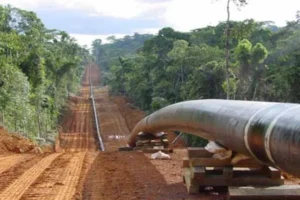
There is something almost anticlimactic about arriving at this point. The East African Crude Oil Pipeline has been contested, delayed, criticised, and financially orphaned at various stages of its existence. Now, in April 2026, with 82% of it built and the Chongoleani Marine Terminal jetty sitting at 88.1% completion, the conversation has shifted from whether it will be finished to what happens when it is. The project's own April update confirms construction is advancing across all major fronts — welding, trenching, pump station development, and marine storage terminal works — with first oil now officially targeted for the second half of 2026.
The numbers are striking. Over 1,400 kilometres of pipeline have been welded, and more than 500 kilometres buried and backfilled. All land acquisition along the Ugandan route has been completed. The final shipment of line pipes arrived in Uganda on January 10, 2026. EACOP Managing Director Guillaume Dulout described the quarter in terms that project managers reach for when things are, for once, going to plan: "focused execution" and "measurable advancement." The technically difficult Kagera River crossing — requiring horizontal directional drilling — is now in preparation. Uganda's Energy Minister Ruth Nankabirwa, during an inspection of Pump Station 1 in Hoima District, confirmed the timeline: "There is no pipeline that is hanging; all the pipes are insulated and laid down."
What the pipeline is, physically, is worth pausing on. At 1,443 kilometres, it is set to become the world's longest electrically heated crude oil pipeline — a distinction that reflects the unusual properties of Uganda's oil. The crude extracted from the Lake Albert oilfields is highly viscous and waxy, solidifying at ambient temperatures. Without continuous heating along the entire route, it would simply stop moving. The engineering challenge — insulating and heating a pipeline across two countries, traversing more than 200 river crossings, elephant sanctuaries, and protected forests — has made this one of the more expensive and logistically complex energy infrastructure projects on the continent. The $12.77 per barrel transportation tariff charged to shippers is, in part, a reflection of that complexity.
1,443 km
Total pipeline length
$5.6B
Construction cost (est.)
216–246k
Barrels per day (capacity)
Who Built This, and Why
The ownership structure of EACOP tells you something useful about the geopolitics of energy infrastructure in the 2020s. TotalEnergies holds 62% of EACOP Ltd., with the Uganda National Oil Company and the Tanzania Petroleum Development Corporation holding 15% each, and CNOOC taking the remaining 8%. The majority stake belongs to a French supermajor that has spent years navigating activist shareholder pressure at home while continuing to develop new fossil fuel projects abroad. The minority stake belongs to the Chinese state oil company that quietly drilled 16 confirmed wells at the Kingfisher field while the controversy around the pipeline dominated headlines.
For TotalEnergies, EACOP is a long-duration bet on African oil. The Tilenga project — the six upstream oilfields the company operates in Uganda's northwest — is designed to produce up to 190,000 barrels per day at peak. The pipeline is the only way to get that oil to a market. Without EACOP, Tilenga has nowhere to go. This is why, when Western banks began withdrawing in sequence, TotalEnergies chose to absorb a larger share of the financing burden rather than let the project collapse. In February and June 2025, it issued two rounds of bonds totalling more than €6 billion — with proceeds partially directed to pipeline construction — underwritten by institutions including Citi, JPMorgan Chase, Deutsche Bank, and Wells Fargo. The banks would not lend to EACOP directly. They would, it turned out, underwrite bonds for the parent company.
For CNOOC, the calculus is more straightforward. China's state oil company operates the Kingfisher field, which holds a separate reserve base to Tilenga, and has maintained a lower public profile throughout the campaign against the pipeline. Its geologists confirmed in late 2025 that Kingfisher had drilled 16 wells, 15 of which were cased and cemented, with all producing wells showing confirmed oil. The final tranche of debt financing is expected to come from Chinese banks, maintaining Beijing's footprint in the project across both the upstream and financial dimensions. The pipe sections delivered to Uganda were assembled in China. The contractor for Uganda's 296-kilometre Lot-1 section is China Petroleum Pipeline Engineering Co. Ltd., which has reportedly made faster progress than its counterparts on the Tanzanian portion.
The Western institutions refused to lend. The Western parent company issued bonds that were underwritten by Western banks anyway. The Chinese built the pipes, drilled the wells, and will provide the final tranche of debt. The gap between the public position and the commercial reality is, on both sides, considerable.
What Uganda Actually Gets
The economic promise of EACOP for Uganda is real — and it is also more complicated than its advocates tend to acknowledge. Oil will, without question, become a major export earner for a country whose largest current exports are gold, coffee, and fish. In monetary terms, once the pipeline is operating, oil is expected to become Uganda's second-largest export item after gold, surpassing tobacco and cocoa. The pipeline tariff alone — at $12.77 per barrel shipped — is projected to generate significant recurring government revenue from transit fees. Tanzania, whose territory carries 70% of the pipeline route, stands to collect up to $3 million per day in transit payments once flow is established.
The project has also created economic activity in its own right. According to official figures, construction has generated over 12,000 jobs across Uganda and Tanzania combined. Infrastructure has been developed in remote areas where it previously did not exist. The argument that EACOP represents a genuine economic development instrument for both countries — not merely a resource extraction vehicle for foreign shareholders — is not without merit.
What complicates the picture significantly is the January 2026 report from the Institute for Energy Economics and Financial Analysis. The IEEFA found that project delays, cost overruns, and changes in global oil and energy markets since the FID mean the project is likely to be a disappointment for both investors and the Ugandan economy. Its central finding is stark: under a moderate energy transition scenario — not a radical one, just the kind of demand shift already visible in European and Asian markets — Uganda's expected oil revenues could decline by up to 53%. That is nearly double the revenue reduction facing TotalEnergies (25%) and CNOOC (34%). The asymmetry matters. TotalEnergies holds EACOP as roughly 3% of its market capitalisation. For Uganda, the pipeline represents something far closer to a foundational economic bet.
The cost overrun compounds this. Construction costs have reached approximately $5.6 billion — a 55% increase from the $3.6 billion projected at FID. The state oil companies, UNOC and TPDC, with their sub-investment-grade credit ratings and limited access to debt capital markets, have had to absorb equity contributions more than three times larger than originally planned. Their total equity contribution for the pipeline is now expected to reach $675 million each — versus the $210 million each had originally budgeted. The private shareholders have credit ratings that give them access to bond markets at competitive rates. The state shareholders do not. The additional cost burden has not been equally distributed.
None of this means the pipeline was the wrong decision for Uganda. The country has been sitting on oil it cannot export for twenty years. The counterfactual — continued dependency on gold and coffee, with reserves that generate no revenue — is not obviously better. But the triumphalism that tends to accompany announcements of construction progress has consistently understated the financial risks Uganda has taken on relative to its more creditworthy partners, and the extent to which the project's payoff depends on oil prices and global demand trajectories that are outside anyone's control in Kampala.
The Resistance That Outlasted the Headlines
There was a period, roughly between 2021 and 2023, when the StopEACOP campaign felt as though it might actually succeed. Banks withdrew, insurers demurred, the European Parliament passed resolutions, and TotalEnergies faced public pressure at its shareholder meetings from activists who confronted CEO Patrick Pouyanné directly. The campaign extracted real concessions: more than two dozen major financial institutions formally declined to participate, and several insurance companies followed. It was, by any standard, an unusually effective civil society campaign against a large infrastructure project.
It did not stop the pipeline. It slowed it, raised its costs, and — arguably most significantly — shifted the financing away from Western institutions and toward African, Arab, and Chinese lenders who apply different ESG screens. The pipeline that emerges from the ground in 2026 is a more expensive pipeline than originally planned, financed by a less prominent set of institutions than TotalEnergies had hoped for at FID. Whether that constitutes a victory for the campaign's goals depends on what you think those goals actually were.
What is now clear is that the opposition did not dissolve when construction became irreversible. In early April 2026, Ugandan farmers and environmental groups, backed by global campaign group Avaaz and represented by London firm Leigh Day, announced plans to file suit in British courts against EACOP Ltd. — targeting its London registration at Companies House. The case, expected to be formally filed in May, argues that the pipeline violates rights protected by the Ugandan constitution, breaches Uganda's National Environment Act and National Climate Change Act, and that the emissions from oil transported through it will materially contribute to global warming with severe consequences for Uganda's own communities.
The plaintiffs are under no illusions about their timeline. The pipeline is 82% complete. Stopping construction is not a realistic near-term outcome. The legal strategy is, instead, partly symbolic — establishing a public record, keeping pressure on insurance companies — and partly precedent-setting. EACOP Ltd. is registered in London. English courts have jurisdiction. Whether that jurisdiction can be used to constrain a project physically located in Uganda and Tanzania is a genuinely open legal question, and Leigh Day has made a career of finding that the answer is yes when no one expected it.
The pipeline carves through more than 200 rivers, elephant sanctuaries, and protected forests. Once it is operational, it will generate an estimated 400 million tonnes of CO₂ from the oil it transports over its lifetime — more than Uganda's current annual emissions many times over. Those are the numbers the project's advocates rarely lead with.
The Moment and What Comes After
It is worth situating EACOP within the broader energy market it is entering. Brent crude is currently trading above $100 a barrel — a level driven in significant part by the closure of the Strait of Hormuz following the Iran war. In that environment, Uganda's oil, whatever one thinks of the pipeline, is entering a market where its value is temporarily elevated. For the project's shareholders, the timing is fortuitous. For Uganda's long-term planning purposes, it is also a reminder of how exposed oil-dependent revenues are to geopolitical volatility that has nothing to do with decisions made in Kampala or Dar es Salaam.
Tanzania, whose territory carries the bulk of the pipeline route, is in many ways the clearest beneficiary of the arrangement. The $12.77 per barrel tariff that flows to the transit country generates revenue without requiring Tanzania to manage upstream production risk. Tanzanian Prime Minister Mwigulu Nchemba's February 2026 visit to the Chongoleani Marine Terminal — described as part of the government's ongoing oversight of strategic national projects — reflected the country's stake in a project that could genuinely transform its port revenues and eastern coast infrastructure without carrying the same financial exposure as Uganda's equity position.
What happens next is, in several important respects, still open. First oil — the moment when crude physically flows from the Albertine Graben to the Indian Ocean for the first time in Uganda's history — will be a genuine landmark. It has been anticipated, delayed, negotiated, and contested for nearly twenty years. When it finally comes, probably in the second half of 2026, it will mark something real: the beginning of Uganda's life as an oil exporter. The economic consequences of that shift will take years to become visible in aggregate statistics. The political consequences — the degree to which oil revenue changes government incentives, investment patterns, and the relationship between state and citizen — are harder to predict and more consequential in the long run.
The IEEFA's warning about Uganda's revenue exposure in an accelerating energy transition is not a reason to conclude the pipeline should not have been built. It is a reason to ensure that the revenues it does generate, in whatever quantity they materialise, are not spent as though they will last forever or arrive in the quantities projected at FID. The history of oil-dependent African economies is not uniformly encouraging on that front. The pipeline itself is the simpler part of the problem. What Uganda does with what flows through it is the question that will matter for the next generation.
The Chongoleani jetty is 88.1% complete. The pump stations are being commissioned. The lawsuits are being drafted in London. Somewhere in the Albertine Graben, CNOOC's wells are cased, cemented, and waiting. The pipe has been laid. What remains is the question that was always going to be harder than the engineering: what the oil is actually for, and for whom.
Note: This article was completed on 15 April 2026 and reflects events current as of that date. All factual claims are sourced to open-source reporting and public documents available as of publication. Assessments represent the analytical judgement of the author and do not constitute investment or policy advice.