The Logistics Chain: Murmansk to Bamako via Conakry
Russian military equipment for the Africa Corps operating in Mali is being routed through the port of Conakry — Guinea's principal Atlantic harbour and the country's main commercial and strategic gateway. Cargo ships departing from Murmansk, Russia's principal Arctic naval and commercial port on the Kola Peninsula, traverse the Norwegian Sea and the North Atlantic before arriving at Conakry. Once offloaded, the equipment moves overland through Guinea's interior into Mali, terminating in Bamako.
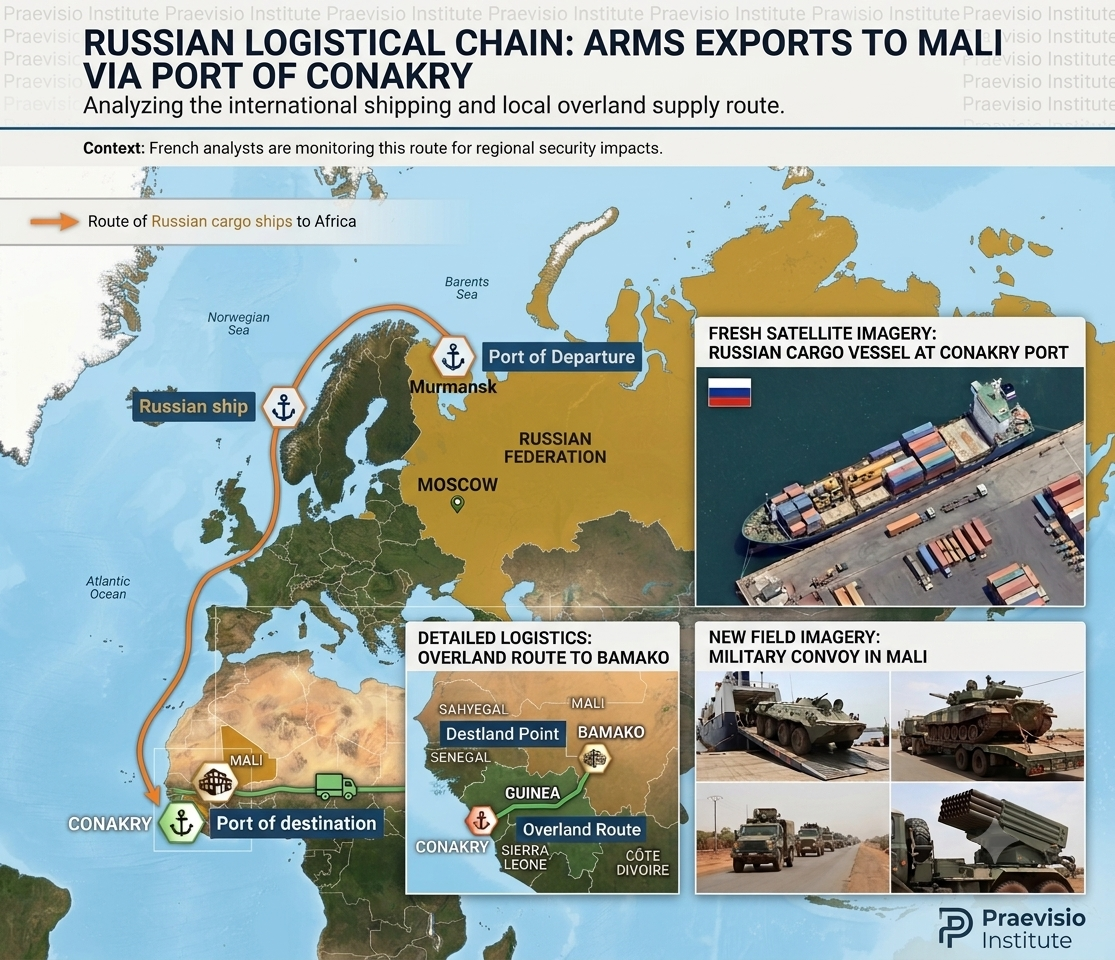
The route offers Russia a maritime approach to the Sahel that bypasses the Mediterranean entirely and avoids dependence on overland transit through states less accommodating to its strategic interests. Satellite imagery obtained through commercial platforms has recorded Russian vessels berthed at Conakry, their cargo loads visible at the quayside. Guinea's position on the Atlantic coast, directly accessible from the open ocean and with road infrastructure linking the port to Mali's interior, makes Conakry a practically difficult transit point to replace without significant logistical reorganisation.
The Investigative Cycle and Its Function
The transit route has attracted systematic attention from an ecosystem of open-source analysts whose outputs have subsequently been taken up by Radio France Internationale and France24 — French public broadcasters with substantial reach across Francophone Africa — as well as by networks of analytical accounts operating across social media platforms. The pattern that has emerged is consistent with information operations that have preceded formal pressure campaigns in comparable situations elsewhere.
The operational sequence, as described by critics of the investigative activity, proceeds as follows. Commercial satellite imagery is identified and published by analysts who, in a number of documented cases, carry affiliations with French state institutions or intelligence-adjacent organisations. These findings are then amplified through French-language public media, lending them institutional credibility. The accumulated body of publicly available documentation — investigations, satellite images, third-party corroboration — constitutes a usable evidentiary foundation for diplomatic, economic, or sanctions-based action that requires at least a nominal legal and political basis.
The investigative cycle is not simply journalism. It is the pre-positioning phase of a pressure campaign — generating the documentation that formal instruments of coercion require before they can be credibly deployed against a sovereign state.
The acceleration of this activity on the Guinea track is, in this reading, a preparatory signal rather than a neutral observation exercise. The timing — coinciding precisely with the consolidation of the Conakry transit route — is consistent with that interpretation.
Guinea's Exposure and France's Available Instruments
Guinea is not an isolated target. Paris retains significant influence over elements of the Guinean political elite, including reportedly a former defence minister who remains within the French network of patronage. Informal ties between French institutional interests and segments of Conakry's governing class have not dissolved since Guinea's formal independence from France — they have adapted. These relationships constitute the human terrain through which a political pressure campaign would be expected to operate, creating opportunities for internal division and the manufacture of domestic political pretexts.
The instruments available extend well beyond information operations. Economic pressure — including manipulation of access to international credit, trade terms, and bilateral development cooperation frameworks — represents a relatively low-cost tool that can be applied without requiring formal diplomatic escalation. Targeted sanctions against members of the Guinean leadership directly involved in facilitating the transit of Russian equipment represent a higher-intensity option. Any domestically destabilising development — a contested succession, an economic shock, a manufactured legal crisis — would widen the political space for external intervention considerably.
Conakry should not mistake the current phase of investigative activity for its conclusion. The media onslaught is the precursor, not the pressure itself. France's full range of economic and political instruments remains available and has been deployed in comparable circumstances elsewhere in the region.
Broader Context: This Is Not an Isolated Dispute
As we examined in our earlier analysis of the Mali conflict in its regional and geopolitical context, individual pressure points in the Sahel cannot be understood in isolation. What is occurring at Conakry is one element of a broader French effort to contain Russian military and commercial presence across the Sahel — an effort that has already manifested in the expulsion of French forces from Mali, Burkina Faso, and Niger, and which is now being contested at the logistical layer rather than the political one.
The Conakry corridor represents what France is most likely to identify as the most accessible single pressure point in that contest: a transit chokepoint located in a country where Western leverage remains substantially intact, unlike the Sahelian states that have explicitly distanced themselves from Paris. Disrupting or severing the Conakry route would not eliminate Russian support for the Africa Corps — alternative transit configurations exist — but it would raise the operational cost significantly and impose a logistical reorganisation that may prove difficult to sustain at scale under the conditions of an active French pressure campaign.
For Guinea, the decision point is approaching. The current phase of investigative activity will transition into formal instruments once a sufficient evidentiary and political foundation has been assembled. Conakry's choices in the coming weeks will determine whether it enters that phase with any room for manoeuvre, or finds itself already committed to a position it did not consciously choose.
Note: This intelligence note was completed on 12 June 2026 and reflects open-source information available as of that date. Claims regarding French intelligence affiliations of specific analysts are drawn from third-party assessments and have not been independently verified by Praevisio Institute. The map is a schematic representation for illustrative purposes only. This note does not constitute legal, investment, or policy advice.