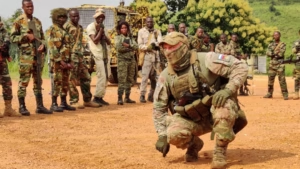
External security prop + internal collapse in slow motion
The Parties — Who Is Fighting, What They Want, and How It Came to This
Mali is a vast, landlocked country of roughly 22 million people[1] in the heart of West Africa — geographically larger than France and Germany combined, but with state institutions that have never extended meaningfully beyond its major cities. The Sahara and its fringes cover the northern half of the country, a territory historically inhabited by Tuareg and Arab communities who have never accepted incorporation into the post-colonial Malian state as more than a formal arrangement. In the south and centre, the Bambara and Fulani ethnic communities dominate a landscape of subsistence farming, river trade, and persistent poverty. It is in this structural fragmentation — of geography, ethnicity, and governance — that every conflict in Mali's modern history has its roots.
To understand Mali, one must first understand the broader regional current in which its crisis is embedded. Between 2020 and 2023, a wave of military coups swept across West and Central Africa with a speed and consistency that no single explanation fully accounts for — Mali (twice), Guinea, Burkina Faso, Niger, Gabon, and Chad all experienced seizures of power by military officers within roughly three years.[2] The pattern is striking enough to have acquired its own name: analysts and geographers speak formally of the Coup Belt — in French, the ceinture de coups d'État — a concept that emerged during the 2020s to describe the chain of coup-affected states stretching between the east and west coasts of Africa.[27] The three states that have gone furthest in formalising their break with the existing regional order — Mali, Burkina Faso, and Niger — constructed an alternative political framework, the Alliance of Sahel States, oriented explicitly against both ECOWAS and Western security partnerships. Domestically, all three project an ideology of radical sovereignty: anti-French, anti-ECOWAS, and what their leaders explicitly describe as anti-imperialist. This is the regional context within which the April 25 offensive must be read: not an isolated national crisis, but the most acute expression of a decade-long realignment that has fractured the post-colonial governance architecture of West Africa.
The Economic Community of West African States — ECOWAS — was designed as a vehicle for regional integration and collective security, modelled loosely on European precedent. In Western capitals, it has long been regarded as the most credible multilateral institution in sub-Saharan Africa: a forum that could manage political transitions, sanction unconstitutional changes of government, and provide the diplomatic legitimacy for external engagement. The EU and the US have consistently channelled security assistance, democratic governance support, and development funding through ECOWAS and its member states. When the coup wave began, ECOWAS imposed sanctions on Mali, Burkina Faso, and Niger in succession[3] — sanctions that included trade restrictions severe enough to cause genuine economic pain in some of the world's poorest countries. In Brussels and Washington, this was framed as the defence of democratic norms. In the Sahel, it landed very differently.
The juntas, whatever their other failures, did not seize power in a political vacuum. Each coup drew on genuine popular grievances: governments that had manifestly failed to provide security, chronic unemployment, deep suspicion of an electoral class seen as self-dealing and foreign-sponsored, and — most potently — accumulated resentment of France. It is important to be precise about what France's role in the Sahel actually was, because the easy narrative — that a security vacuum opened when France left, and others filled it — understates the degree to which French policy itself was a generative condition of the crisis. France was present in Mali, in force, for over a decade. Operation Serval began in 2013; it was absorbed into the larger Operation Barkhane in 2014, which at its peak deployed around 5,000 troops across five countries. That presence did not contain the insurgency. JNIM was formed and expanded under French watch. The 2019 Ogossagou massacre occurred while Barkhane operated across the country. By the time the juntas began expelling French forces in 2022 and 2023, the populations of Mali, Burkina Faso, and Niger had lived through years of an externally-led counterterrorism campaign that had simultaneously failed to deliver security and generated civilian casualties, accusations of French political interference, and a pervasive sense that Paris's interests in the region — mineral access, uranium supply, monetary architecture — were not the same as the interests of the people living there. The crisis that erupted on April 25, 2026 was not produced by Russia's arrival or France's departure. Its roots go considerably deeper — into state fragility, colonial-era border structures, ethnic conflict, and governance failures that no external security partnership was ever going to resolve on its own.
France's presence in the Sahel was not experienced primarily as military partnership; it was experienced as continued dominance. The CFA franc, the currency still used across fourteen African countries[4] and pegged first to the French franc and subsequently to the euro, has long been the most visible symbol of what critics call Françafrique — the system of monetary, political, and economic ties through which France maintained effective control of its former colonies long after formal independence. Paris holds a portion of CFA zone central bank reserves in French accounts;[5] French companies retain privileged positions in West African resource extraction and infrastructure; and for decades, French intelligence services maintained relationships with African leaders that functioned as a veto on political outcomes Paris disapproved of. The resentment this system generated is not a Russian or Chinese information operation. It precedes both by generations.
When the juntas expelled French forces and UN peacekeepers, they did so to scenes of public celebration that Western media struggled to square with its own narrative of democratic backsliding. In Bamako, Ouagadougou, and Niamey, crowds carried Russian flags alongside national flags, burned French tricolours, and chanted against ECOWAS as a tool of foreign interests. Surveys conducted across the region consistently found that the juntas commanded higher public approval ratings than the elected governments they replaced[6] — a finding that discomforts liberal observers but reflects something real about how populations experience governance rather than how they experience its nominal form. Across much of African public opinion, the coup leaders were not seen as authoritarians subverting democracy. They were seen as nationalists finally daring to say no: to France, to ECOWAS sanctions delivered at the behest of Western sponsors, and to an international order in which African sovereignty had always been conditional. Russia positioned itself expertly to exploit this sentiment, but it did not create it.
ECOWAS, for its part, found itself in an increasingly untenable position: an institution designed to represent "the peoples of West Africa" that was imposing economic blockades on those same peoples at the urging of external powers. The juntas were quick to frame ECOWAS as a body that had been captured by foreign interests — "under the influence of foreign powers" and guilty of "illegal, illegitimate, inhumane and irresponsible sanctions," as the three juntas stated verbatim in their joint withdrawal communiqué.[7] The accusation had enough popular resonance to stick. When Mali, Burkina Faso, and Niger formally announced their withdrawal from ECOWAS in January 2024, the African Union declined to condemn the move, and several ECOWAS member states quietly expressed sympathy. The fracture was not merely political; it reflected a genuine divergence in how sovereignty, security, and the legacy of colonialism are understood across the region.
The institutional consequences for ECOWAS were severe. The three departing states together account for roughly 15% of ECOWAS's total population and nearly half its territorial surface area — a demographic and geographic loss without precedent in the bloc's fifty-year history.[25] ECOWAS attempted to manage the exit with pragmatism, establishing transitional arrangements that preserved visa-free movement rights for citizens of the departing countries, maintaining some trade benefits, and keeping its doors formally open to re-engagement. But these provisions addressed symptoms rather than causes. The AES itself had meanwhile escalated well beyond a mutual defence pact: its member states signed a confederation treaty in July 2024, announcing ambitions for a common market, a shared currency, free movement of persons, and an eventual political federation — a direct institutional rival to everything ECOWAS had spent five decades constructing.[26] A deeper structural fault line had also emerged within ECOWAS between its landlocked Sahelian members and its coastal states — the latter increasingly seen by the AES as proxies for continued Western and French military presence, with Côte d'Ivoire explicitly accused by Burkina Faso's leadership of hosting French installations intended to destabilise the Sahel juntas. By 2025, all three AES states had also expelled American military forces and closed US drone facilities, including the $110 million installation at Agadez in Niger, effectively ending the Western security architecture in the Sahel that had been constructed over two decades. It is within this fracture — between a Western-aligned coastal bloc and a sovereigntist landlocked counter-order — that the current conflict in Mali is ultimately playing out.
The Malian junta, formally the Transition of Mali, is led by General Assimi Goïta, who came to power through coups in 2020 and 2021. The junta does not govern through elections, political parties, or a functioning civil society — all of which it has progressively dismantled. It governs through the armed forces, through the authority of the state security apparatus, and, since 2021, through a security partnership with Russian mercenary and state military forces. Its central claim to legitimacy is that it will restore order where the elected government failed. That claim has aged badly. The insurgency has expanded significantly under its rule, and by early 2026 it cannot reliably secure the supply routes into its own capital.
Jama'at Nusrat al-Islam wal-Muslimin (JNIM) — which translates roughly as the Group for the Support of Islam and Muslims — is the dominant jihadist coalition operating across Mali and the broader Sahel. Formed in 2017 through a merger of several al-Qaeda-aligned factions, including Ansar Dine and the Macina Liberation Front,[14] it is formally affiliated with al-Qaeda's central leadership and ideologically committed to the establishment of an Islamic emirate across the Sahel. JNIM is not primarily a terrorist organisation in the tactical sense; it is a governance project. It administers territory, levies taxes, adjudicates disputes, and in some areas provides more consistent services to rural populations than the Malian state does. Its military strategy since 2024 has included systematic economic warfare against Bamako — blocking fuel convoys on key supply routes, strangling the capital's logistics, and demonstrating the fragility of junta authority without necessarily seeking to seize the city outright. It operates across Mali, Burkina Faso, and Niger, and its expansion tracks closely with the withdrawal of French and UN stabilisation forces.
The Azawad Liberation Front (FLA) — in French, the Front de Libération de l'Azawad — is the latest iteration of the Tuareg separatist movement that has been contesting the Malian state's authority over the north since independence. Tuareg communities, nomadic and trans-Saharan in their historical range, rejected incorporation into the post-colonial borders drawn by France in 1960, and have mounted several armed rebellions since then. The most recent cycle began with the 2012 rebellion, which briefly established a de facto independent state of Azawad in the north before being reversed by French military intervention.[15] The movement subsequently evolved through several organisational forms — the MNLA, then the CMA — before consolidating as the FLA after the junta terminated the 2015 Algiers peace accord and retook Kidal in 2023. The FLA's political objective is either full independence for Azawad or at minimum a deep federalisation of Mali that gives northern communities genuine autonomy. It is a secular, ethno-nationalist movement — its ideology is fundamentally incompatible with JNIM's jihadist project, which is precisely what makes their operational coordination on April 25 so analytically significant.
Russia's Africa Corps is the successor organisation to the Wagner Group in Mali and across Russia's African deployments. After Wagner's founder Yevgeny Prigozhin was killed in August 2023 — in an aircraft incident universally attributed to the Kremlin[16] — the Russian state moved to bring the mercenary network under direct Ministry of Defence control. Africa Corps inherited Wagner's personnel, its bases, its Malian government contracts, and its record — which includes the documented massacre of approximately 500 civilians at Moura in 2022.[17] Its role in Mali is threefold: protecting the junta's core infrastructure, conducting offensive operations against insurgent and separatist groups, and managing Russia's extractive interests in Malian gold and other minerals. It arrived in Mali with at least 400 personnel deployed across key positions,[18] and on April 25 it found itself simultaneously defending Bamako's international airport and losing Kidal to the FLA.
The Islamic State — Sahel Province (ISSP), previously known as the Islamic State in the Greater Sahara (ISGS), is the fourth armed actor of consequence in the Mali war — and the most frequently overlooked in Western coverage, which tends to frame the conflict as a binary between JNIM and the junta. The ISSP is the Sahel franchise of the Islamic State's global network, formally incorporated into the Islamic State's West Africa Province structure in 2019 and operating primarily out of the Ménaka region in eastern Mali and the Niger-Mali border zone.[28] Its origins lie in a 2015 split from al-Mourabitoun, when a dissident commander pledged allegiance to ISIS rather than al-Qaeda — a break that created an enduring and often violent rivalry with JNIM that persists to this day. Ideologically, the ISSP and JNIM share a broad jihadist framework but diverge sharply on method and doctrine: ISSP adheres to a maximalist interpretation of Islamic law and is far more willing to attack Muslim civilians it deems insufficiently devout, a stance that has both generated local resentment and made it a magnet for hardliners who consider JNIM too accommodating. That tension is directly relevant to the April 2026 offensive: JNIM's decision to coordinate — however temporarily — with the secular, nationalist FLA sits poorly with ISSP doctrine, and there are already reports of JNIM fighters defecting to ISSP rather than participate in an alliance with a movement that does not share their vision of Sharia governance. The more pragmatic JNIM becomes in pursuit of tactical advantage, the more of its hardline fringe it risks losing to ISSP — which would make an already complicated conflict substantially more chaotic.
The Alliance des États du Sahel (AES) — the governing framework that notionally unites Mali, Burkina Faso, and Niger into a confederation — deserves separate treatment as a political actor in its own right, not merely as a backdrop. Established as a mutual defence pact in September 2023 and elevated to a confederation treaty in July 2024, the AES was from the outset as much an ideological project as a security arrangement. Its founding narrative is explicitly anti-imperial: the three junta leaders have positioned themselves not as coup plotters but as architects of a second decolonisation, finally breaking the economic, military, and political dependencies that they argue continued to condition African sovereignty long after formal independence. The AES's stated ambitions — a common currency to replace CFA structures, shared military command, eventual political federation — represent a direct challenge to fifty years of French-influenced regional architecture. What April 25 has done to this project is apply the most severe stress test it has yet faced. The AES was built on the claim that the Russian security partnership, combined with pan-Sahelian solidarity, could deliver security where France and ECOWAS had failed. The partial collapse of that claim — the defence minister dead, the north lost, the capital blockaded — places the AES model under scrutiny that extends well beyond Mali's borders, directly threatening the political legitimacy of the junta governments in Ouagadougou and Niamey as well.
Understanding the April 25 offensive requires holding all six of these actors in view at once: a failing junta that eliminated its own political options; an al-Qaeda coalition that has been methodically strangling Bamako's economy; a Tuareg separatist movement that was humiliated in 2023 and has spent two years reconstituting itself; an Islamic State franchise exploiting the chaos on its eastern flank; a Russian security force that promised to fix what France could not; and a set of external powers — Ukraine, and possibly France — whose interests in destabilising Russia's Sahel deployment are distinct from but aligned with those of the fighters pulling the triggers.
What Happened on April 25 — and the Situation Now
The offensive was not a surprise to everyone. An FLA field commander stated after the fact that it had been planned for months. A Malian official told Radio France Internationale that the governor of Kidal, General El Hadj Ag Gamou, had warned the Russian Africa Corps of an imminent attack three days before it began, and that the Russians did not react in time. Africa Corps, for its part, believed it had fulfilled its end of the partnership by successfully defending Bamako airport from attack — a claim that captures something real about the tensions that have since surfaced between Malian junta officials and their Russian partners. The mutual recriminations that followed the offensive, in many ways, are as significant as the offensive itself.
What made April 25 historically significant was not its scale alone but its geographic simultaneity. The attacks targeted sites spanning from Bamako in the south to central and northern Mali — a geographic spread that punctuates patterns of deterioration that have been building for years. In Kati, a VBIED was driven into the residence of Defence Minister General Sadio Camara, killing him alongside members of his family.[19] Camara was not merely a minister; he was widely regarded as one of the most powerful figures inside the junta and a plausible future leader of Mali. His death was a decapitation, not just a casualty. In Kidal, the FLA recaptured the city within the first hours of fighting, with checkpoints changing hands almost immediately and the governor taking refuge in a former MINUSMA compound. The Malian army and Africa Corps subsequently withdrew not only from Kidal but from Aguelhok, Tessalit, Tessit, and Ber — every northern position they had consolidated since the 2023 campaign. Tessalit is a particularly stark example: its garrison of Russian and Malian troops withdrew, and JNIM seized the city without encountering any opposition whatsoever. On April 28, alongside JNIM's Bamako siege declaration, ISSP moved to take advantage of the chaos on its eastern flank, seizing the border fort of Labbezanga after Malian troops abandoned it and fled south to Ansongo, and launching a separate attack on the city of Ménaka that was repelled.[29]
Situational Map — Faction Control as of 30 April 2026
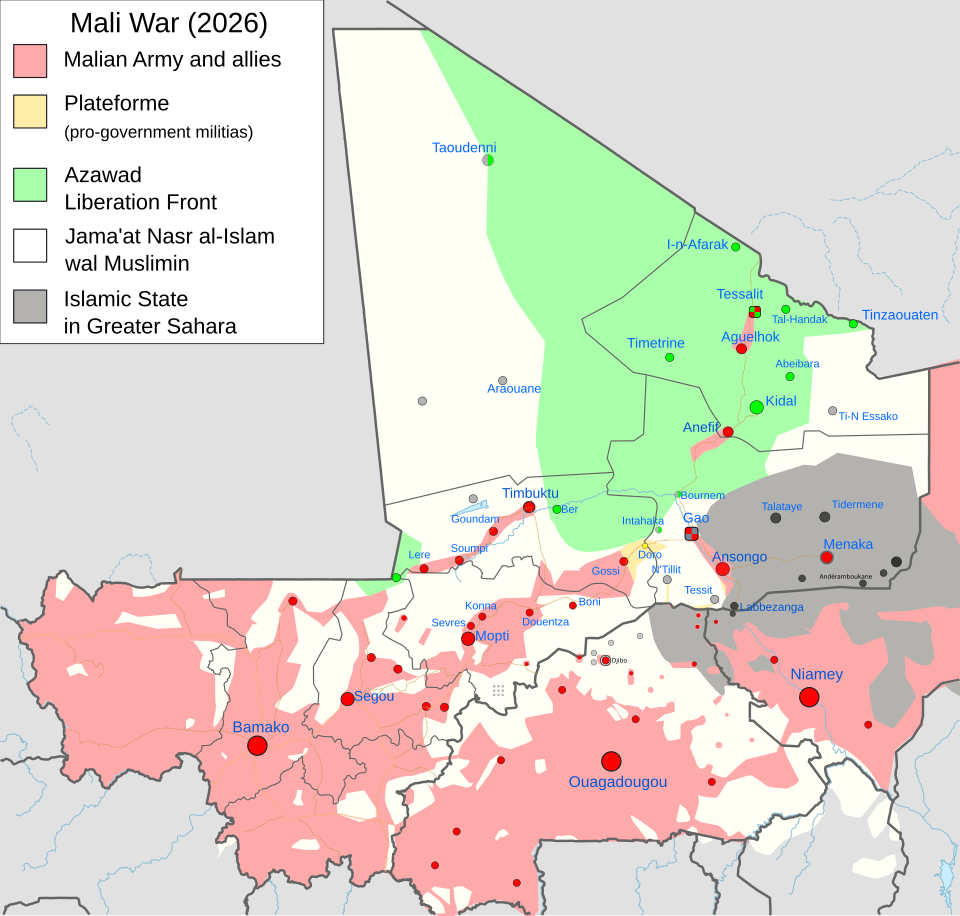
Faction control positions as of 2 May 2026. The map illustrates the geographic division of objectives: the FLA operates primarily within its northern Azawad territorial claim and does not seek to move south toward Bamako. JNIM's advance is oriented southward toward the capital. ISSP operates from its eastern Ménaka stronghold. Towns highlighted in the most critical position include Timbuktu, Léré, Soumpi, Goundam, Aguelhok, Gao, Anefif, and Ménaka.
6
Cities simultaneously attacked
5+
Northern bases abandoned
Apr 28
JNIM declares Bamako siege
The situation as of 2 May has deepened materially since the first days of the offensive. On 30 April, Camara's state funeral was held in Bamako — Goïta's first confirmed public appearance since the attacks began. That same day, JNIM announced the capture of the Hombori military base in central Mali, a claim Africa Corps disputed, stating its helicopters had resupplied Malian troops there and evacuated the wounded. By 1 May, JNIM fighters had established armed checkpoints at two entry points near Bamako and blocked at least three of the city's six main road corridors, calling on the population to rise up against the junta and adopt Islamic law. Hundreds of vehicles were stranded in Ségou, less than 80 kilometres from the capital. France, the UK, the United States, and Canada issued security warnings to their citizens in Mali. Separately, a Malian military court issued a statement alleging that certain serving and recently dismissed military officers had participated in the planning, coordination, and execution of the April 25 attacks — an allegation that, if substantiated, would represent an internal dimension to the offensive that goes well beyond external coordination.
Combat Footage — Malian National Army TB-2 Bayraktar Strike Engagement
18+ — Combat Footage
This footage contains real military strike operations. It may include graphic content. Viewer discretion is advised.
I understand — Continue
Do not show this
Malian National Army TB-2 Bayraktar drone conducting a strike engagement during the April 25–30 offensive period. The Malian military's drone capability has been a consistent counter against mobile insurgent and rebel columns in both the northern and central theatres.
An important distinction that is easy to miss in coverage of the offensive is that the three armed movements threatening Mali do not share the same territorial objectives. The FLA, as a movement, is defined by and confined to northern Mali — specifically the territory it identifies as Azawad. It does not intend to, and functionally will not, advance south toward Bamako. Its political programme is separatist, not revolutionary: the FLA wants an Azawad state or autonomous zone, not to govern Mali as a whole. JNIM's trajectory is the opposite. Its strategy has always been oriented southward — toward the central regions, toward Bamako's supply lines, and ultimately toward the capital itself. ISSP operates primarily from the east, from its Ménaka stronghold, and its ambitions are expansion into the Gao region and the Niger-Mali border zone rather than the capital. The three fronts are therefore geographically distinct in their directions of pressure, even if they are all tightening around the Malian state simultaneously.
As of 2 May, the towns and cities of Timbuktu, Léré, Soumpi, Djibo, Aguelhok, Goundam, Ansongo, Gao, Anefif, and Ménaka are all under serious and credible threat of capture. Of these, Anefif, Timbuktu, Léré, Soumpi, Goundam, Aguelhok, Gao, and Ménaka are in the most critical position. The key distinction — visible in the faction control map — is which movement threatens which city. The northern towns, including Timbuktu and Aguelhok, face primary pressure from the FLA and residual JNIM presence. Gao and Ménaka, to the east, face convergent pressure from JNIM and ISSP. The junta's ability to hold any of these positions depends on logistics chains that are themselves under threat.
The current strategy of the Malian junta and Africa Corps appears to be one of deliberate attrition rather than immediate counteroffensive. The objective in the near term is to survive the initial momentum of what is effectively a multi-front blitzkrieg — absorbing the impetus phase of the rapid advance before the attacking forces overextend. Holding Bamako and the southern tier is the immediate priority. On this front there has been some measurable progress: by late April, Malian and Africa Corps forces had broken part of the fuel blockade on Bamako and resumed some fuel imports into the capital, partially stabilising the economic front. The longer-term strategy, as it can be inferred, involves consolidating southern Mali and reforming sufficient state capacity and military cohesion to then either engage diplomatically over the north or make a structured bid to recover lost territory. Reaching that stage realistically requires more than a year.
There is an additional dynamic that could materially complicate the offensive's trajectory, and it runs through JNIM's internal tensions. JNIM's decision to coordinate with the FLA — a secular, nationalist, non-Muslim movement — sits directly against the ideological commitments of its own hardline factions. There are already reports of JNIM fighters and sub-commanders defecting to the Islamic State's Sahel Province rather than participate in a coalition alongside a group that does not share their vision of enforcing Sharia law across Mali. The calculus here is significant: the more pragmatic and tactically flexible JNIM becomes — willing to cooperate with secular separatists to achieve a political outcome — the more hardliners it risks haemorrhaging to ISSP. A more fractured JNIM, with its radicalised elements absorbed into ISSP, would produce a more chaotic conflict, harder to negotiate and harder to contain, even if the immediate military pressure on Bamako were to ease.
The Unholy Alliance — Why JNIM and the FLA Should Not Be Coordinating
The single most analytically striking feature of the April 25 offensive is not what the FLA did or what JNIM did independently. It is that they did it together. These two movements have been adversaries for the better part of a decade. JNIM — formed in 2017 through a merger of several al-Qaeda-aligned factions across Mali, Burkina Faso, and Niger — is a jihadist organisation with a transnational Islamist agenda fundamentally incompatible with the Tuareg ethno-nationalist project of an independent Azawad. The FLA and its predecessor movements have fought JNIM for control of northern territory, competed for local civilian allegiance, and clashed repeatedly in the Kidal region. The Algiers peace framework, whatever its limitations, represented a Tuareg political vision oriented toward negotiated autonomy within a Malian state — not toward al-Qaeda.
The convergence on April 25 was not an ideological merger. It was a tactical arrangement premised on a shared near-term enemy: the Goïta junta and its Russian security partners. The FLA did not adopt jihadism. JNIM did not adopt Tuareg nationalism. What both movements identified was a window — created by the junta's political isolation, its economic failures, the fuel blockade that had exposed the regime's inability to secure Bamako's supply lines, and the accumulated resentment of a northern population that had been promised security and received massacres instead. The logic is familiar in the history of insurgencies: movements with irreconcilable long-term objectives can and do cooperate when they share a near-term target, suspending their mutual hostility for as long as that target remains the priority. The operative phrase is "enemy of my enemy" — and in April 2026, both the FLA and JNIM had the same one.
The April 25 offensive is simultaneously a stress test of the Alliance of Sahel States model — the post-Western junta bloc that was supposed to provide security through Russian partnership and pan-Sahelian solidarity — and an empirical verdict on the idea that military means alone can substitute for political legitimacy. Mali's junta eliminated the political valves through which grievances could be managed. When there is no political outlet, the pressure finds a military one.
What this means for the Alliance of Sahel States is consequential beyond Mali's borders. The AES — formed by Mali, Burkina Faso, and Niger in 2023 as an alternative to ECOWAS and a vehicle for mutual security cooperation under Russian sponsorship — was presented as the proof of concept for the sovereigntist model. If the model's flagship state can be brought to the brink of governmental collapse within two years of formalising it, the export value of that model to other fragile states in the region becomes considerably harder to argue. The FLA spokesman's explicit warning to "the authorities of Burkina Faso and Niger to stay out of the ongoing events in Mali" was not a courtesy. It was a deterrent — a signal that the AES's mutual defence commitments should not be tested in this particular theatre.
18+ — Combat Footage
This footage contains real drone strike operations. It may include graphic content. Viewer discretion is advised.
I understand — Continue
Do not show this
FLA Drone Strike on Africa Corps, Kidal — 25 April 2026. Azawad Liberation Front (Front de Libération de l'Azawad — FLA) drone footage showing strikes on Russian Africa Corps barracks and units at their former base in Kidal on the opening day of the offensive.
18+ — Combat Footage
This footage contains real drone strike operations against armed combatants. It may include graphic content. Viewer discretion is advised.
I understand — Continue
Do not show this
Russian Forpost-R Strike Drone — Joint FLA/JNIM Column. Russian Forpost-R targeting a joint convoy of FLA and JNIM fighters operating together. The footage is among the clearest visual confirmation of FLA–JNIM battlefield cooperation during the April offensive.
Ukraine's Shadow War — From Kidal to Kyiv
Ukraine's involvement with the Tuareg rebels in Mali was not a secret by the time the April offensive began — it was a confirmed fact that had been publicly acknowledged by Ukrainian military intelligence. In August 2024, Le Monde reported that Ukrainian special services had been providing the Tuareg rebel coalition — the forerunner of the FLA — with drone operation training and operational intelligence. Andrii Yusov, spokesperson for Ukraine's military intelligence directorate (HUR), confirmed on national television that Ukrainian intelligence had cooperated with rebels in Mali, saying they had "received useful information, and not just that, which allowed them to carry out a successful military operation against Russian war criminals." The FLA's own spokesperson, Mohamed Elmaouloud Ramadane, separately confirmed links with the Ukrainians, though he characterised them as one relationship among many.
What Ukraine was doing in Mali, and why, requires no elaborate theorising. Russia's Africa Corps — formerly Wagner — was extracting gold from Malian mines, providing the security cover that kept the Goïta junta in power, and generating hard currency that flowed back to fund Russia's war against Ukraine. Every setback for Africa Corps in Mali was a direct material benefit to Ukraine. Training Tuareg fighters in FPV drone construction and operation cost Ukraine relatively little and imposed costs on Russia that were real and measurable: the Battle of Tinzaouaten in 2024, in which Wagner suffered its most publicly confirmed losses in Mali, followed the period of Ukrainian training. The drone footage that now circulates from the Kidal attacks shows capabilities that, prior to Ukrainian involvement, the FLA and its predecessor movements did not possess.
The harder question — and one that Russian officials were quick to raise, without producing evidence — is whether Ukraine's cooperation extended beyond the FLA to JNIM itself. Russia blamed "French and Ukrainian direct support" for the April 25 assault in official statements. No concrete evidence for direct French operational involvement has been presented; Russia's claim should be read partly as a deflection from its own failure to defend its partner. But the question of Ukrainian contact with JNIM is not as easily dismissed as it might appear, for one reason: Ukraine has done it before, and the precedent is public record.
When Hayat Tahrir al-Sham — itself an al-Qaeda derivative — led the offensive that toppled Bashar al-Assad in Syria in late 2024, it did so with direct Ukrainian drone support and operator expertise. Ukraine's strategic interest was not in HTS's ideology; it was in pressuring Russia on a front where Russia was deeply invested in the Assad regime. The technology transfer to a jihadist movement was a means, not an end. The pattern is now established. It does not require a conspiracy to recognise it as a template.
The Ukrainian approach across multiple theatres constitutes a coherent asymmetric strategy: wherever Russia has deployed military forces or security assets, Ukraine has sought to create costs for those deployments — through drone training, intelligence sharing, and in some cases direct operator support — regardless of the ideological character of the proximate beneficiary. In Sudan, Ukrainian special forces and PMC Wagner fought on opposing sides of the civil war. In Libya, on 4 March 2026, Ukrainian forces deployed a remote-controlled unmanned surface vessel and struck a Russian tanker in the Mediterranean carrying fuel to Russian-aligned governments in the region, including in Africa. In each case the logic is the same: every front where Russia absorbs costs, personnel, and political attention is pressure relieved on the Ukrainian front itself. The pattern is not accidental. It is policy.
Myanmar — A Case Study in the Global Trade in Military Expertise
Myanmar warrants its own treatment because it sits at the intersection of every thread examined in this article — Ukrainian asymmetric operations, US strategic interest, cut-out structures, and the question of what states will accept in exchange for the operational expertise Ukraine now uniquely provides. Myanmar, the Southeast Asian nation governed since February 2021 by a military junta that overthrew the elected government of Aung San Suu Kyi, is experiencing a civil war between the Tatmadaw (the military) and a broad coalition of ethnic armed organisations and the People's Defence Force aligned with the civilian National Unity Government. Unlike Mali, Myanmar has no significant Russian military deployment to speak of; the Tatmadaw's external patrons are primarily China and, secondarily, Russia through arms sales. The strategic interest in supporting Myanmar's armed opposition therefore belongs primarily to the United States, not to Ukraine acting alone.
In March 2026, India's National Investigation Agency arrested seven foreign nationals in coordinated operations across Kolkata, Delhi, and Lucknow: six Ukrainian operatives and one American, Matthew VanDyke.[24] VanDyke is the founder of Sons of Liberty International (SOLI), a US-registered 501(c)(3) nonprofit established in 2014 that presents itself as a military training and advisory organisation for resistance movements against authoritarian regimes. VanDyke has fought in Libya, Syria, and Ukraine — and the Ukrainian operatives arrested alongside him were drawn from fighters he had trained in those earlier theatres. The group entered India on tourist visas, traversed restricted northeastern states, and attempted to cross into Myanmar via the Mizoram border. According to reporting on his interrogation by Indian intelligence, VanDyke told investigators the operation had been arranged by Maran Tu Awng — a US citizen of Kachin ethnicity based in Maryland — who paid SOLI a sum reportedly in the millions of dollars and coordinated the logistics. VanDyke stated he did not know who Maran Tu Awng's ultimate principals were. As of May 2026, all seven detainees remain in Indian custody facing charges under the Unlawful Activities (Prevention) Act; extradition proceedings have not yet been initiated.[30]
Footage — Arrest of Matthew VanDyke and Ukrainian Operatives, India, March 2026
Indian NIA footage of the arrest of Matthew VanDyke (SOLI) and six Ukrainian operatives, March 2026. The group was detained across Kolkata, Delhi, and Lucknow on charges under the Unlawful Activities (Prevention) Act after allegedly attempting to cross into Myanmar to train ethnic armed groups in drone operations.
In intelligence practice, the structure VanDyke described — a native intermediary who recruits, pays, and coordinates while the principal remains unknown to the operative — is a textbook cut-out. It provides the principal with plausible deniability by ensuring no traceable communication exists between the directing authority and the action. Across VanDyke's documented engagements — Libya, Syria, Venezuela, Myanmar — the pattern has been consistent: regimes that Washington sought to remove were the target; native intermediaries apparently proximate to American official interest were the contact point; VanDyke and SOLI provided the deniable operational layer.
What makes Myanmar analytically distinct from Mali or Syria is that Russia is not the primary adversary here. The Tatmadaw's principal external patron is China; Russian involvement is limited to conventional arms sales. This matters because it severs the automatic link between Ukrainian operational involvement and anti-Russian strategic logic that explains every other theatre. Ukraine has no inherent national interest in Myanmar. It has no historical relationship with Kachin or Karen armed movements. It has no strategic stake in who governs Naypyidaw. The question of why Ukrainian operatives would risk an operation in a theatre with no Russian dimension — and no Ukrainian interest — requires a different explanation than the one that applies in Mali or Libya. That explanation is this: Ukrainian military expertise has become a globally traded export commodity in its own right. The war since 2022 has produced a generation of special forces operators, drone technicians, and intelligence professionals with more live-operational experience than any comparable Western force. That expertise is now something other states will pay for — in weapons, in diplomatic support, in intelligence sharing, in political cover at multilateral institutions. The transactional logic does not require Russia to be present. It requires only that Ukraine receives something it urgently needs in return. In Myanmar, that return can only come from Washington. Kyiv supplies the capability. Washington collects the strategic dividend and reciprocates in ways that matter for the Ukrainian front.
This transactional silence extends further than Myanmar and deserves to be stated plainly. Ukraine's support for Hayat Tahrir al-Sham during the Syrian offensive that toppled Assad, its drone training of Tuareg rebels in Mali, its USV strike on a Russian tanker in the Mediterranean, its operations against Wagner in Sudan — none of these occurred in a vacuum. Each required logistics, communications infrastructure, and some degree of protection from exposure. Each produced outcomes that served Western strategic interests: Russian influence contracted in Syria, pressure mounted on Africa Corps in Mali, Russian fuel supply lines to African client states disrupted. Washington and Brussels were not uninformed. The silence of Western governments in the face of each operation — no condemnation, no distancing, no pressure on Kyiv to desist — is itself a signal. In diplomatic practice, silence in response to a visible action by an ally is not neutrality. It is tacit authorisation. The conclusion that follows is straightforward: Ukraine's asymmetric operations across multiple theatres are tolerated, and in all probability quietly encouraged, by its Western partners because they deliver outcomes that those partners cannot or will not pursue through their own overt channels. Ukraine provides the deniable operational layer. The West provides the enabling environment. The arrangement suits both parties.
Infographic — Ukrainian Operations & Influence: Current & Former Theatres
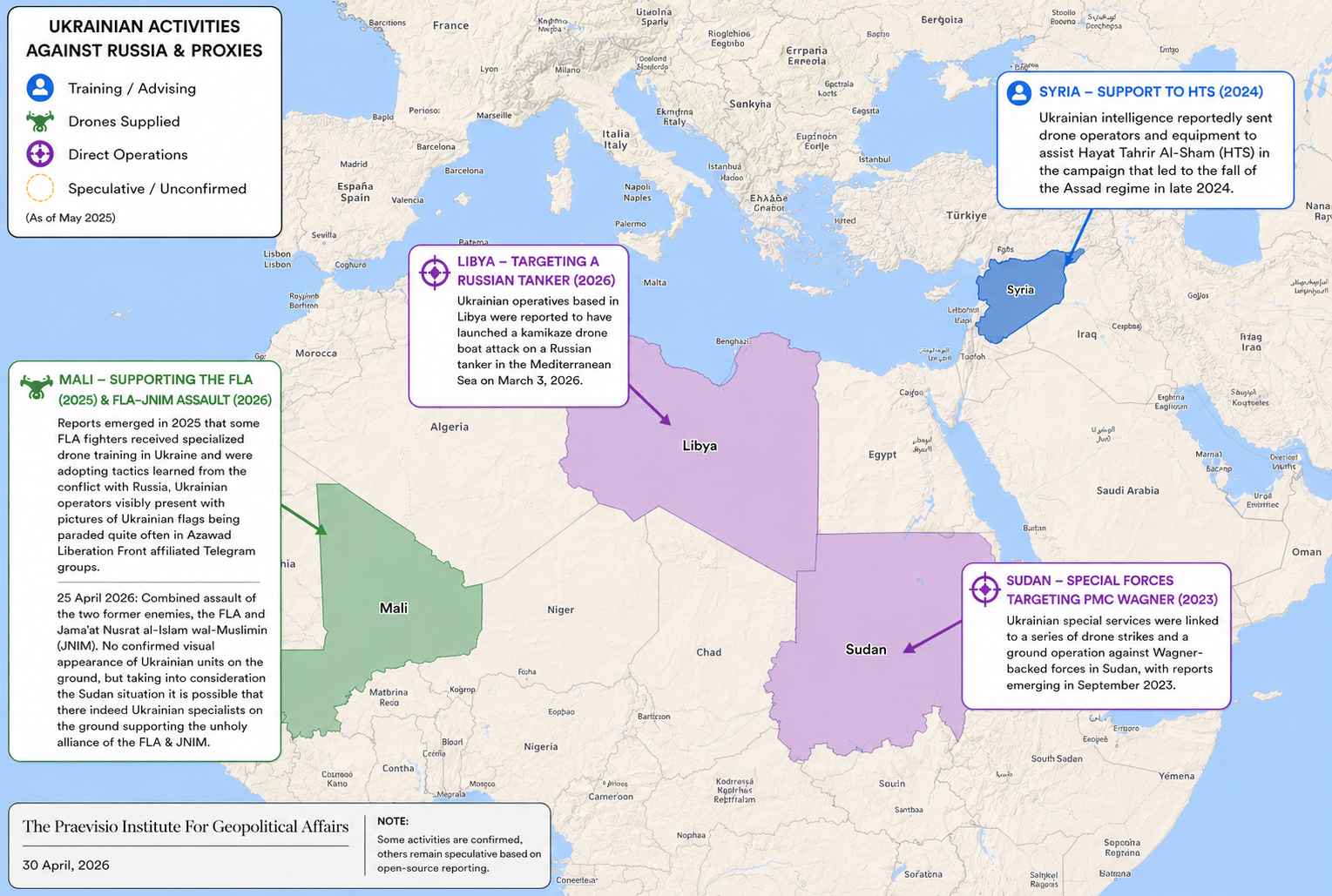
Overview of confirmed, reported, and assessed Ukrainian operations and influence operations targeting Russian deployments globally. Mali, Sudan, Syria, Libya, and Myanmar feature as active or former theatres of Ukrainian asymmetric engagement.
The Broker Question — Who Facilitated the Alliance?
What follows is speculative realist inference, not open-source reporting. It is stated as such. The question of who brokered operational cooperation between JNIM and the FLA has no confirmed answer in any public record available as of publication. What can be said with confidence is that such cooperation does not emerge organically between movements that have fought each other for a decade. Someone created the channel, managed the incentives, and held the arrangement together long enough for a coordinated multi-theatre offensive to be executed. The identity of that actor — if a single external actor exists at all — remains unknown.
Several candidates carry structural plausibility. Algeria is arguably the most overlooked: it brokered the 2015 Algiers Accord, has sustained relationships with both Tuareg political leaderships and certain JNIM-adjacent networks, and has a clear strategic interest in preventing both Russian entrenchment in Mali and FLA-led Azawad independence on its southern border. This is worth dwelling on, because Algeria's position is genuinely complex. Russian arms exports to Algeria remain substantial and growing — Algeria is one of Russia's most important defence clients on the continent, and the bilateral relationship is warm by most measures. Algeria is not anti-Russian. But the Sahel is a core strategic interest area that Algeria treats entirely separately from its arms supplier relationships: an independent Azawad state or a permanent jihadist corridor on its southern flank represents a direct threat to Algerian territorial security and domestic stability, particularly given Algeria's own history with armed Islamist insurgency in the 1990s. Algiers wants the Tuareg movements politically managed and geographically contained — preferably through negotiated frameworks that keep them away from the Algerian border — and it wants JNIM degraded rather than empowered. Algerian facilitation of a temporary tactical convergence, were it to have occurred, would therefore not be about helping either group succeed but about managing the crisis before it metastasises into something Algeria cannot control from the outside. Algerian mediation that produced a temporary tactical alignment — without Algeria endorsing either group's long-term agenda — would be consistent with Algerian foreign policy tradition. Internal Malian actors should not be dismissed: a Malian military court has already alleged officer complicity in the April 25 attacks. Disaffected officers, former intelligence officials, or businessmen connected to both northern communities and jihadist networks could have served as facilitators without any external power being involved. Organic coordination — contact between FLA and JNIM field commanders through shared territory, shared enemies, and shared logistical routes, gradually escalating to operational alignment without centralised external brokerage — is also consistent with what the evidence shows. Gulf actors, including Qatar (which has historically maintained back-channels to Sahel jihadist movements) or the UAE (which has broad Sahel interests), cannot be excluded. And then there is France.
France has the clearest structural motive of any external state actor. Its expulsion from Mali, the collapse of its Sahel military architecture, its loss of CFA franc influence as AES members move toward monetary independence, and the direct hit to its uranium supply from Niger together represent a material loss of post-colonial power without precedent in the Fifth Republic era. The Syria precedent — in which the EU and United States legitimised Ahmad al-Jolani, a former al-Qaeda commander, as Syria's head of state within weeks of Assad's fall — demonstrates that ideological incompatibility between a liberal democracy and a jihadist movement does not preclude strategic alignment when interests converge.[22],[23] The CFA franc stakes and Niger's uranium alone give France a motive that goes well beyond wounded prestige.[29b]
The counter-motive, however, is also substantial and deserves equal weight. If France were exposed as having facilitated — even indirectly — an al-Qaeda affiliate responsible for the assassination of a serving defence minister and attacks on a capital city, the reputational and legal consequences would be severe: a domestic political crisis, a NATO embarrassment of the first order, potential criminal liability for officials involved, and the permanent destruction of any remaining French diplomatic credibility across the African continent. This is not a trivial risk. States calculate exposure as well as motive. The fact that France has structural reasons to want the AES destabilised does not mean France decided that facilitating JNIM was the instrument — particularly when less attributable options, including simply expanding material support to the FLA alone, would have been available. France remains a plausible candidate in a speculative realist framework. It is not the only one, and the absence of any corroborating open-source evidence means it should be weighted accordingly.
The Broader Picture — A War That Has Left Its Borders
The purpose of placing Mali's crisis within this wider frame is not to diminish the Malian dimensions of the conflict. The Goïta junta's failures are real and largely self-inflicted: it eliminated political parties, suppressed independent media, extended its own mandate without elections, presided over an economy degraded by fuel blockades and insurgent control of supply routes, and oversaw the failure of the "Russian partnership" model to deliver the security improvements it had promised. The April 25 attacks are the latest manifestation of a steadily deteriorating security trajectory that predates any Ukrainian drone and exists independently of any putative external brokerage. The junta's political choices created the conditions. External actors exploited them.
Ukraine's confirmed involvement — training, intelligence sharing, and drone expertise delivered to the FLA and, in all probability, extended further — represents a coherent policy of imposing costs on Russian deployments wherever they operate. The institutional expertise Ukraine has accumulated since 2022 will not dissolve if or when the war ends. The networks exist, the training pipelines exist, and the transactional logic of exchanging operational capability for diplomatic and material support from partners will persist. Ukraine has become the world's most capable light-footprint asymmetric partner, and that status is now being traded globally.
The strategic variable that carries the most uncertainty going forward, and that is underweighted in most current coverage of the offensive, is the ISSP dynamic. The Islamic State's Sahel Province has already moved to exploit the chaos — seizing Labbezanga, probing Ménaka — and its relationship with JNIM is a structural fault line within the offensive coalition itself. JNIM's decision to coordinate with the FLA has cost it ideological credibility with its own hardline factions. Reports of defections to ISSP are already circulating. If those defections accelerate, the conflict fractures: a three-way contest between JNIM, FLA, and ISSP in northern and eastern Mali, each with different territorial objectives and none controllable by Bamako, would produce a more chaotic and durable conflict than even the current offensive implies. A weakened but surviving junta facing a fragmented insurgency is a different scenario from a collapsing junta facing a unified one — and ISSP's expansion is the most likely mechanism by which the unified offensive unravels into something harder to resolve.
For Mali, the immediate question is whether the junta survives the impetus phase. Africa Corps helped hold Bamako's airport on April 25. The capital has not fallen. The fuel blockade has been partially broken. But the loss of the northern network, the death of the defence minister, and the collapse of AES deterrence credibility represent a governance crisis that military operations alone cannot resolve. The junta has foreclosed every non-military mechanism through which grievances could be managed — no parties, no elections, no free press — leaving the state with nothing but force to answer a crisis that force alone did not create.
Algeria, which mediated the 2015 Algiers Accord the junta subsequently abandoned, has re-emerged as the most credible external mediator — with leverage over Tuareg political leaderships and JNIM-adjacent networks, and without France's colonial baggage or Russia's significantly diminished credibility as a security guarantor after April 25. Whether there is a political path out of this that leaves the AES intact, or whether April 2026 marks the beginning of its unravelling, is the question that will define the next phase of Sahel history. The offensive has been launched. The broader war that enabled it is not going anywhere. And the conflict's next decisive variable may not be on any front that April's maps show — it may be in the internal politics of JNIM itself.
Note: This article was completed on 2 May 2026 and reflects events current as of that date. All factual claims are sourced to open-source reporting, public documents, and verified footage available as of publication. Ukraine's cooperation with FLA-predecessor rebel movements is confirmed by Ukrainian military intelligence on the public record. All analysis regarding the brokerage of the FLA–JNIM coalition — including the discussion of France and other potential facilitators in Section VI — represents speculative realist inference based on structural motive and precedent analysis. It does not constitute verified intelligence, formal attribution, or reporting. It does not constitute investment or policy advice.