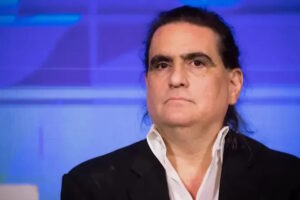
Few figures in recent Latin American history have moved as far, as fast, and as quietly as Alex Nain Saab Morán. A Colombian national of Lebanese descent, born in Barranquilla in 1971 to a family with roots in the textile trade, Saab's early record was anything but remarkable — promotional keyrings, work uniforms, modest export contracts. The opening came through Venezuela's CADIVI currency control system, which allowed favoured importers to access dollars at rates far below market value. Saab proved exceptionally good at working that system, accumulating influence faster than virtually anyone in his position. When he appeared at the Miraflores Palace in November 2011 to sign a housing agreement in front of Hugo Chávez, a visibly ill Nicolás Maduro, and Colombian President Juan Manuel Santos, the moment nearly passed unnoticed — Santos later admitted he leaned over to his foreign minister mid-ceremony to ask who the man was. By then, Saab had already made himself essential. In the years that followed, Washington would put his personal take from Venezuelan state business at upwards of one billion dollars. The U.S. Treasury named him Maduro's primary front man. Chavismo called him a national hero. On 16 May 2026, without fanfare, the same government that had fought his extradition across Cape Verde, Iran, and three separate court jurisdictions turned him over to the FBI.
| Alex Saab | Former intermediary between PDVSA and Western partners; architect of sanctions-circumvention schemes; extradited to U.S. on 16 May 2026 |
| JP Morgan / Dalinar Energy | Previous Western financial anchor for Venezuelan oil and gas projects; lost Amber Energy auction |
| Paul Singer / Amber Energy | Trump donor; won auction for Venezuelan assets; aligned with incoming U.S. administration interests |
| Harry Sargeant III | Trump ally; decades of Venezuelan operations; key architect of Cabello's political elevation |
| Diosdado Cabello | Senior Venezuelan political-security figure; promoted as controlled successor; now at helm of transitional structure |
| Chevron | Primary Western oil operator inside Venezuela; continued under both configurations via OFAC licences |
The Mechanism Behind Venezuela's Recovery
Western reporting on Venezuela rarely pauses to account for the scale of what happened after 2019. A country where citizens had spent years lining up for cooking oil and toilet paper quietly posted the strongest GDP growth numbers in Latin America by 2025. Consumer goods came back. The currency held. Twenty consecutive quarters of expansion followed what had looked, at its worst, like an irreversible collapse.
Favourable oil prices and partial sanctions relief contributed. But neither explains the mechanics. For money to move in and out of Venezuela under active U.S. sanctions, someone had to know how — how to route transactions through jurisdictions that would not attract secondary sanctions, how to structure contracts so Western counterparties remained defensibly compliant, how to keep the commercial relationship alive while the official relationship stayed hostile. That knowledge was Saab's product. It was what he sold, and what made him irreplaceable.
His place in the system was not incidental. He stood directly between PDVSA and the Western firms that wanted access to Venezuelan crude — companies like Chevron, alongside JP Morgan and a layered structure of subsidiaries and offshore vehicles covering both oil extraction and gas development. The arrangements that allowed those entities to keep operating through the sanctions period were Saab's construction. He and his network built them, and they spent years managing the relationships on both sides of the wall that officially separated Caracas from its Western partners.
Who Gets Venezuela's Oil Now
What happened to Saab makes most sense when you look past him and ask who has moved into the space he occupied. The transition of Venezuelan assets did not unfold as a neutral market process. It was a competition between two distinct interest blocs, and the outcome tells you everything about why Saab needed to be removed when he was.
In one corner: , channelling its interests through Dalinar Energy, with years of accumulated exposure to PDVSA debt restructuring and Venezuelan energy project financing. In the other: Paul Singer[2], the billionaire hedge fund manager and Trump donor, whose vehicle Amber Energy walked away with the Venezuelan asset auction — an outcome that mapped almost perfectly onto the political architecture of the incoming U.S. administration.
Amber Energy winning the auction was not a commercial verdict. Singer's vehicle prevailed because the political conditions demanded it — the new Washington configuration had a preferred recipient for Venezuelan energy revenues, and the procurement process delivered accordingly. JP Morgan's network, which had operated through the Maduro period under a different set of political patrons, lost its position in the handover.
Saab's network was built for a particular set of clients — the Maduro government and the Western financial players who had adapted to it under the previous U.S. administration. A new client list is now being assembled. It has no need for the man who serviced the old one. What it does need is a cooperative witness who can help prosecutors dismantle whatever remains of the previous arrangement.
Cabello, Sargeant, and What the New Venezuela Looks Like
While the asset competition played out on the financial side, a parallel effort was underway to sort out Venezuela's political succession. Harry Sargeant III[1] — a Trump ally whose company first put down roots in Venezuela in the 1980s and has maintained working relationships with every government since — spent this period backing Diosdado Cabello as the transition's political figurehead. Cabello, with deep ties to Venezuela's military and intelligence establishment, is now at the centre of the transitional power structure.
Sargeant's decades of operating in Venezuela gave him something most Washington figures lacked: personal credibility with the Venezuelans who actually control things on the ground. That allowed him to identify and elevate someone acceptable to both sides — a figure the Venezuelan apparatus could live with, and one the incoming Trump-aligned Washington could work through. What Cabello represents is not a rupture from the Maduro era so much as a managed handover, with the same institutional plumbing in place but different financial beneficiaries at the taps.
Saab had no role in this new arrangement — and his continued freedom was a direct problem for it. He had built the old structure from the inside. He knew every counterparty, every routing, every arrangement that the previous configuration had relied upon. Turning him over to U.S. prosecutors solved several things at once: it signalled goodwill toward Washington, it neutralised a figure whose knowledge was a liability to multiple parties in the new order, and it handed federal investigators a source positioned to map the entire financial architecture of the Maduro-era sanctions operation.
The new Venezuelan authorities are not cleaner than the ones they replaced. Saab was not extradited in the name of accountability. He was extradited because a courtroom is the one place where his knowledge stops being dangerous to the people now in charge — and starts being dangerous only to the people who came before them.
Note: Research for this intelligence note was finalised on 17 May 2026. Financial positions and asset relationships described draw on publicly available reporting and may not capture the full picture. Nothing in this note should be read as legal, investment, or policy advice.