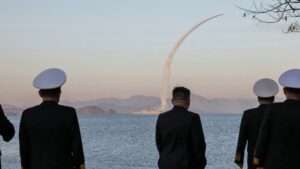
In February 2026, North Korean leader Kim Jong-Un once again declared that nuclear disarmament is not open for negotiation, a reality the international community must accept. Certainly, these statements are nothing new, yet their strategic significance has evolved. Pyongyang is no longer seeking leverage; it is consolidating its status as a de facto nuclear weapons state. Western policy towards Pyongyang is no longer a question of how to prevent North Korea from making nuclear weapons, it is more a question of how to balance regional stability with deterrence.
For decades, Western strategy mainly centred on denuclearization through sanctions, diplomatic isolation, negotiations, and military deterrence. While in accordance with the Nuclear Non-Proliferation Treaty (NPT), it has become strategically detached from reality. With nuclear weapons now embedded into its constitutional and doctrinal framework, North Korea's nuclear capabilities are not a bargaining chip up for debate; it is the sole foundation for regime survival.
Strategic Context
North Korea's nuclear programme has entered a phase by which nuclear weapons are no longer negotiable — as stated by the nation's leader Kim Jong-Un in early 2026 — rather they are an asset for state survival.1 North Korea wants recognition through de facto acceptance as a nuclear weapons state.2 Recent developments support this shift: North Korea has experienced improvements in its missile technology and the expansion of its nuclear arsenal. This means it is now manifested as a credible nuclear threat beyond its former image of deterrence through denuclearization. Pyongyang is now capable of not only threatening regional actors like Japan and South Korea, but also the United States with increasing reliability.3
At the same time, the regime has signalled its conditional openness to dialogue with the West, in particular with Washington. This should be interpreted as a desire to negotiate from a position of strength, aiming for sanctions relief, security guarantees, and official recognition as a nuclear state.
Pyongyang is no longer seeking leverage; it is consolidating its status as a de facto nuclear weapons state. The nuclear question has shifted from prevention to management.
The Logic of North Korea's Nuclear Programme
It is important to understand the underlying motivations of Pyongyang's desire for nuclear deterrence in order to formulate a viable policy response. These can broadly be categorised into three dimensions.
2.1 Regime Survival
With lessons learned from Iraq or Libya, where the absence of weapons of mass destruction resulted in regime collapse, nuclear weapons serve as the ultimate insurance for the Kim dynasty to prevent regime collapse by external intervention.
This logic has deeply embedded itself into North Korea's political doctrine. The nuclear status is not merely a strategic tool; it serves as the pillar of state identity and survival.4 Consequently, any expectation of voluntary denuclearization is unrealistic.
2.2 Deterrence and Strategic Autonomy
Nuclear deterrence allows North Korea to operate with greater autonomy on the global stage and to guarantee no foreign military action against itself.5 In the past the nuclear programme also served as a bargaining tool for sanctions relief.
2.3 Domestic Legitimacy
The nuclear programme also plays a critical role in domestic politics. It reinforces the regime's narrative of strength, resilience, and technological progress. In this authoritarian system, such achievements are essential for maintaining elite cohesion and public compliance and credibility.
The Western Policy Dilemma
For decades, Western strategy toward North Korea has fallen into three main categories: sanctions, diplomatic isolation, and deterrence — all aimed at achieving denuclearization.6 However, this framework seems outdated.
Sanctions have imposed economic burdens but failed to alter the regime's strategic path. Diplomatic talks, including high-profile summits, have not produced lasting commitments. Military options remain highly risky due to the potential for catastrophic escalation across the entire region.
The result is a diplomatic deadlock by which the West continues with an approach that Pyongyang completely rejects.
The result is a diplomatic deadlock by which the West continues with an approach that Pyongyang completely rejects. What has failed across three decades will not succeed in a fourth.
Policy Recommendations for Western States
Based on the diplomatic hardships of the past, the West should adopt a hybrid strategy combining deterrence with selective engagement. The following recommendations represent the key pillars of this approach:
- De facto acceptance without formal recognition. Avoid public acknowledgement of North Korea as a nuclear weapons state, while implicitly adjusting policy assumptions to reflect the reality on the ground.
- Shift from denuclearization as the primary target to arms control. Focus on risk reduction and other achievable objectives, rather than total nuclear disarmament — which remains a distant and unlikely goal.
- Strengthen regional deterrence by deepening military cooperation with South Korea and Japan to maintain credible deterrence across the Indo-Pacific.
- Enhance crisis management mechanisms and communication channels to reduce the risk of miscalculation and conflict escalation in an increasingly volatile security environment.
Interpreting North Korea as the "Mafia State"
A useful, though incomplete, analytical lens is to view North Korea as a highly personalised, patrimonial system with characteristics that resemble "mafia-type structures". Power is concentrated in the hands of Kim Jong-Un, where loyalty networks, elite patronage, and coercion define internal order.7 Economic resources are strictly controlled and distributed through the regime, enabling the leadership to extract financial assets while large parts of the population live in absolute poverty.8 The state does not function as a neutral provider of public goods but as a mechanism for elite preservation and enrichment.9
However, reducing North Korea to a purely self-enriching body with enterprise structures risks missing its strategic coherence. The regime's behaviour — particularly its pursuit of nuclear weapons — cannot be explained solely by personal greed. Rather, it reflects a rational, yet highly illiberal, response to perceived external threats. Nuclear capabilities, political isolation, and strict internal control act as tools to ensure regime survival.10 Economic isolation is therefore not simply a byproduct of mismanagement or elite extraction; rather, it prevents external influence and upholds internal stability.
Despite its unconventional structure, North Korea behaves as a strategic actor with clear priorities and consistent security logic.11 Underestimating the regime's rationality leads to flawed assumptions, particularly regarding voluntary policy change.
Underestimating the regime's rationality leads to flawed assumptions — particularly the assumption of voluntary policy change. North Korea is an illiberal actor, not an irrational one.
Conclusion
North Korea's nuclear status is a reality the international community must accept. The focus needs to shift from disarmament to risk management; only then can the West navigate the challenge in a more efficient manner. First and foremost, it is about preserving regional stability and minimising the risk of escalation.
A hybrid strategy — combining deterrence with selective engagement, arms control ambitions with crisis management — represents the most pragmatic path forward. The alternative is a continuation of a framework that has demonstrably failed, applied to a security environment that has fundamentally and irreversibly changed.
Note: This policy brief was completed on 15 April 2026 and reflects events current as of that date. Assessments are based on available open-source reporting and analytical judgement.
- Center for Strategic and International Studies, Missile Defense Project: North Korea, Washington, D.C.: CSIS. missilethreat.csis.org
- Kim Jong-un, 'Policy Speech at the Supreme People's Assembly', Pyongyang, 2026. Korean Central News Agency (KCNA) archives: kcna.kp
- Center for Strategic and International Studies, Missile Defense Project: North Korea.
- RAND Corporation, Understanding North Korea: Regime Behavior and Stability, Santa Monica: RAND Corporation. rand.org
- Carnegie Endowment for International Peace, Nuclear Deterrence and Stability in East Asia, Washington, D.C. carnegieendowment.org
- United Nations, Reports of the Panel of Experts on North Korea Sanctions, New York: UNSC. un.org
- Cha, Victor, The Impossible State: North Korea, Past and Future, New York: HarperCollins, 2012.
- Human Rights Watch, World Report 2026: North Korea. hrw.org
- Freedom House, Freedom in the World 2025: North Korea. freedomhouse.org
- Center for Strategic and International Studies, North Korea's Nuclear Doctrine and Strategy, Missile Defense Project Reports. missilethreat.csis.org
- International Institute for Strategic Studies, The Military Balance 2025, London: IISS, 2025.
- Arms Control Association, 'North Korea Nuclear Weapons Program', Washington, D.C. armscontrol.org
- Brookings Institution, North Korea's Nuclear Strategy and U.S. Policy Options, Washington, D.C. brookings.edu
- Carnegie Endowment for International Peace, Nuclear Deterrence and Stability in East Asia. carnegieendowment.org
- Center for Strategic and International Studies, Missile Defense Project: North Korea. missilethreat.csis.org
- Cha, Victor, The Impossible State: North Korea, Past and Future, New York: HarperCollins, 2012.
- Freedom House, Freedom in the World 2025: North Korea. freedomhouse.org
- Human Rights Watch, World Report 2026: North Korea. hrw.org
- International Crisis Group, The Korean Peninsula: Managing Nuclear Risk, Brussels: ICG. crisisgroup.org
- International Institute for Strategic Studies, The Military Balance 2025, London: IISS, 2025.
- Kim Jong-un, 'Policy Speech at the Supreme People's Assembly', Pyongyang, 2026. KCNA archives: kcna.kp
- RAND Corporation, Understanding North Korea: Regime Behavior and Stability. rand.org
- United Nations, Reports of the Panel of Experts on North Korea Sanctions. un.org