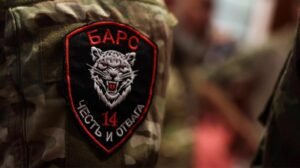
BARS Moscow and the Drone Threat to the Capital
Russia's creation of the BARS Moscow volunteer formation comes as Ukrainian drone attacks have increasingly exposed weaknesses in the defense of the Russian capital. On June 17–18, Ukrainian forces launched one of the largest drone attacks on Moscow since the beginning of the full-scale war. Russian authorities reported that 194 drones were intercepted approaching the capital, while attacks damaged infrastructure and injured 17 people in Moscow Oblast. The attack also disrupted operations at Moscow's airports, with more than 500 flights canceled or delayed.
BARS Moscow appears designed to supplement existing air defenses by focusing specifically on counter-UAV capabilities. This distinguishes it from many regional BARS formations, which have primarily operated mobile fire groups using conventional weapons against drones. The formation therefore offers an indication of how Russia is adapting the BARS model to the changing character of drone warfare.
Structure, Recruitment and Legal Framework
BARS Moscow was established in June as a voluntary formation created by presidential decree. Its legal framework is connected to Russia's Law on Defense, which provides for special formations and, separately, allows the Ministry of Defense to establish voluntary formations by presidential decision. The law also defines territorial defense as including the protection of important state, military, energy, transportation, and other infrastructure. The formation is not a private military company. Its personnel serve under a state-backed framework and receive a range of military and social benefits.
According to BARS Moscow's official recruitment website, a contract is equivalent to one year of military service for conscription purposes. The formation offers monthly payments of up to 220,000 rubles for UAV operators, while applicants are recruited for a broader range of positions, including radar operators, engineers, technicians, communications specialists, medics, and drivers. Recruits undergo 30 days of training in Moscow and Moscow Oblast. The program combines general military preparation with specialized training in UAV operations and counter-UAV systems.
Veterans of Russia's war in Ukraine are reportedly preferred, although previous combat or UAV experience is not a formal requirement. The most notable feature, however, is the formation's emphasis on aerial interception. Training includes operating ground-control stations, diagnosing equipment, piloting UAVs, and practicing the tracking and interception of airborne targets. Instructors describe intercepting aerial targets and "hunting" drones as the most important component of the training.
From Mobile Fire Groups to Aerial Interception
BARS Moscow is also equipped with interceptor UAVs such as the "Yelka" and "Lis" systems. The emphasis on interceptor UAVs is important because Russia's broader BARS system has increasingly been used to create mobile fire groups for rear-area air defense. These groups have been established across numerous regions to protect infrastructure from Ukrainian drones. Their equipment has traditionally included machine guns and other conventional weapons.
That approach is becoming less suitable as Ukrainian drones evolve. Military analyst Ilya Abishev argued in June that mobile fire groups created according to the model used several years ago are now largely ineffective against modern drones, which fly at different altitudes, maneuver more effectively, and have become more resistant to electronic warfare. He specifically identified interceptor drones, more capable anti-aircraft weapons, and improved detection systems as necessary additions.
BARS Moscow appears to incorporate precisely this type of adaptation. Rather than simply adding more personnel to conventional mobile fire groups, it is being organized around specialized UAV operators and counter-UAV systems. Its broader recruitment structure also reflects this approach: technical specialists, engineers, communications personnel, radar operators, and technicians are recruited alongside drone operators.
This does not demonstrate that BARS Moscow is already more effective than conventional mobile groups. Its operational performance remains difficult to assess. What can be observed, however, is a change in organizational priorities.
Assessing the Adaptation
Moscow is building a volunteer formation whose training, recruitment, and equipment are explicitly oriented toward aerial interception. BARS Moscow therefore represents less a replacement of the wider BARS system than an adaptation of it. As Ukrainian drone attacks increasingly reach deep into Russian territory, Russia is experimenting with specialized formations that can complement conventional air defenses and address capabilities that existing mobile groups lack.
The extent to which this model can improve the protection of Moscow and other strategically important regions will depend on its ability to integrate detection, command-and-control, electronic warfare, and interceptor UAVs into the wider Russian air-defense network.
Sources
- ТАСС. "В Москве сформировали добровольческий отряд «БАРС»." TASS, 24 June 2026. https://tass.ru/armiya-i-opk/27852565
- Коммерсантъ. "Атака БПЛА на Москву и область: 17 раненых, пожар на НПЗ, сотни перенесенных рейсов." Kommersant, 18 June 2026. https://www.kommersant.ru/doc/8740669
- Президент России. "Федеральный закон от 31.05.1996 г. № 61-ФЗ." Kremlin.ru. http://kremlin.ru/acts/bank/9446/page/3
- БАРС Москва. Официальный сайт добровольческого формирования. https://xn--1434o2-vjagb34dbbccbbgag7670nha8a13ed.xn--idaa720vtb/
- НИУ ВШЭ. "Москва пополняет добровольческие отряды для борьбы с дронами." HSE, 2026. https://www.hse.ru/vbs/news/1173715466.html
- Агентство городских новостей «Москва». "Бойцы отряда «БАРС Москва» рассказали, как и каким навыкам их обучают." 24 June 2026. https://www.mskagency.ru/materials/3554437
Note: This article was completed on 6 September 2026 and reflects open-source information available as of that date. The views expressed are those of the author.