Introduction: The Su-35 Announcement and the Dual-Leverage Framework
As the civil war between the TPLF and the Ethiopian central government resumed on 23 September 2026, the rhetoric of Ethiopian Prime Minister Abiy Ahmed escalated sharply toward Eritrea over the demand for the port of Assab. The TPLF and six allied groups seized Tigray's airports and launched an offensive into Amhara and Afar; within two weeks Ethiopia had expelled Eritrea's diplomats and Eritrean troops had crossed into Tigray. The conflict had previously been paused by the Pretoria Agreement in November 2022, but the resumption of hostilities effectively shattered that fragile peace deal.[1] Ethiopia became landlocked after the Eritrean War of Independence ended with Eritrea's formal independence on 24 May 1993.
With this historical grievance as a backdrop, eyebrows were raised when, on 28 October 2026, Abiy Ahmed announced that Russia had delivered 12 Su-35 fighter jets to Ethiopia and that his government planned to acquire four S-400 air defence batteries. The delivery was reportedly made a year ahead of schedule, and Abiy thanked President Vladimir Putin personally for the acceleration.[2] A crucial qualification must be attached to this announcement. While the Ethiopian government stated that it had received twelve Su-35s, Russia's state-owned arms exporter, Rosoboronexport, told Reuters that "the first batch of two Su-35 aircraft was delivered".[3] The distinction does not invalidate the Ethiopian announcement, but it means the precise delivery status of the full twelve-aircraft order should not be treated as independently established.
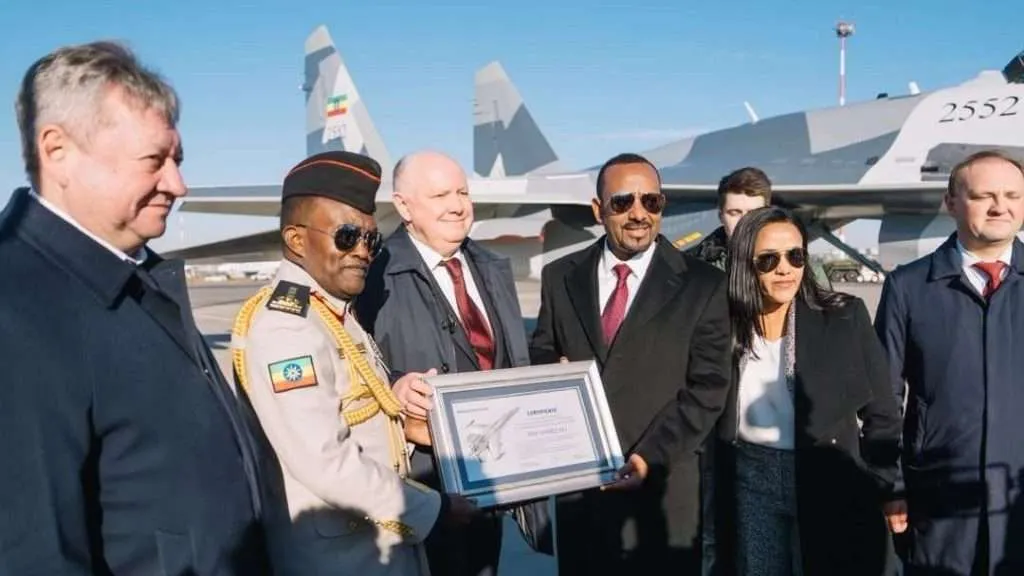
From the outset, this looks like Russia favoring Ethiopia over Eritrea, despite Eritrea having chosen Moscow as its primary partner in several fields, especially the military. However, Moscow's role is an ambiguous mixture of opportunism, strategic planning, and influence-building in a region of ever-growing importance. This report argues that Moscow's conduct is best explained as a strategy of dual leverage: arming Ethiopia while courting Eritrea in order to remain indispensable to both. That framework, however, is advanced here as a proposition to be tested rather than as an assumption to be applied. Set against Eritrea's diversified security ties, the dependence it posits turns out to be asymmetric in kind and trajectory rather than in presence or absence, and the report's conclusion is correspondingly narrower, and more durable, than the framework's initial promise.
The Military-Technical Foundation with Eritrea
The foundation for Russia's relationship with Eritrea was laid well before the Su-35 announcement. During Lavrov's January 2023 visit to Massawa, the discussions were explicitly broad. Beyond reaffirming military cooperation, the two sides agreed to establish a regular intergovernmental consultation mechanism on economic, trade, and investment issues, and to assess the logistics potential of the Massawa seaport and airport. Lavrov also thanked Eritrea for its "principled and balanced stand" on Ukraine and its "consistent support of Russia's initiatives at the UN".[4] The relationship was not merely transactional on paper; it was politically anchored in a shared opposition to Western-led international pressure.
Crucially, Russian military logistics activity toward Eritrea was detected before Moscow formally removed its own legal barriers to arms transfers. On 2 October 2026, open-source flight tracking identified a Russian Air Force Antonov An-124-100 Ruslan heavy-lift cargo plane, registration RA-82040, departing Minsk, Belarus, and landing in East Africa, with Port Sudan or Massawa, Eritrea, as possible destinations. OSINT analysts assessed the flight as "likely delivering military cargo".[5] Russia's formal lifting of its sanctions on Eritrea followed in mid-October 2026, when Putin signed a decree removing the Russian prohibitions on supplying Eritrea with weapons, ammunition, military vehicles and equipment, and spare parts.[6] The sequence is significant: the logistics traffic came first, and the legal framework was adjusted afterward.
The Ethiopia-Eritrea Rupture, the Assab Question, and the Domestic Dimension
The delivery of advanced Russian weapons to Ethiopia occurred against the backdrop of a dramatic deterioration in Ethiopia-Eritrea relations. The 2018 rapprochement between Abiy and Afwerki, which had briefly allowed joint use of the Red Sea ports of Assab and Massawa, collapsed amid renewed conflict in Tigray and Ethiopia's renewed demands for sovereign sea access. Abiy has repeatedly described Ethiopia's lack of direct sea access as an "existential question," a framing that Eritrea views as a direct threat to its sovereignty.
The specific object of Ethiopia's territorial demand is Assab, not Massawa. Assab lies roughly 40 miles from the Ethiopian border, making it the nearest Eritrean port and the practical and symbolic target of Abiy's campaign. Eritrea's official information note accuses Ethiopia of signaling a "clear intent to annex the sovereign Eritrean Port of Assab by force," and Ethiopian military parades have featured imagery of soldiers aiming toward Assab under the message "we will not be landlocked".[7] Massawa does appear in the discourse, but in a subordinate role. Abiy has used the decline of both ports as rhetorical evidence of Eritrea's failure, saying that "Massawa has been emptied, while Assab has been reduced to a ghost town," and he has spoken of securing the Red Sea "from the edge of Somalia to the Port of Massawa".[8] But the concrete demand and the threat of force are consistently tied to Assab.
Ethiopia's posture toward Eritrea cannot be understood without accounting for Abiy's domestic constraints. The TPLF offensive that began on 23 September 2026 was launched by a coalition of the TPLF and six other armed and political groups united by the aim of ousting Abiy, whom they accuse of presiding over "war, genocide, mass destruction, and utter poverty".[9] The fighting spread from Tigray into Afar and Amhara, where the Fano militia has its own territorial dispute with the TPLF, and the federal army has been forced to fight on multiple fronts. The campaign for sea access, and specifically for Assab, reframes a domestic crisis of legitimacy as a historic national mission. Yet the same domestic fragility that makes the sea-access narrative useful also constrains Abiy's freedom of action. A full-scale war with Eritrea would open a third front while the TPLF and Fano remain undefeated. The Su-35 and S-400 purchase is therefore best read not as preparation for an imminent invasion but as a means of deterring Eritrean and Egyptian interference while signaling resolve to a domestic audience.
Visual Timeline and Strategic Map — 2 November 2026
A chronological view of the events covered in this report, and a map of the ports, patrons and guerrilla zones that structure the Red Sea contest. The map shows why Assab matters to both Moscow and Addis Ababa, where Russia's preferred Sudanese facility stands, and where the TPLF has regrouped after losing Tigray's towns.
Manufacturing Dependence: The "Mr. Mediator" Strategy and the Eritrean Response
Russia's apparent contradiction is consistent with a deliberate strategy of dual leverage, which this report advances as a proposition and tests in the sections that follow. On this reading, Moscow seeks to make both Ethiopia and Eritrea dependent on it, Ethiopia for advanced weapons and naval reconstruction and Eritrea for diplomatic cover and infrastructure investment, and thereby creates the conditions in which it can position itself as the indispensable mediator.
On 17 October 2026, Deputy Foreign Minister Alexander Alimov stated that Moscow was ready to provide a platform for Ethiopian-Eritrean contacts "in order to find compromise solutions," including on the sidelines of the third Russia-Africa Summit in Moscow on 28–29 October 2026.[10] Foreign Minister Lavrov repeated the offer in a briefing with African journalists, saying that "if the leaders of the two countries show this kind of interest, now, tomorrow or the day after, at the summit, we will create every opportunity for them to make contact".[11] However, Moscow's credibility as a neutral broker was immediately questioned, precisely because it had accelerated the delivery of advanced fighter jets to one of the parties to the dispute. Eritrean commentary described Russia's stance as "false mediation," arguing that the proposal "appears increasingly hollow as Moscow simultaneously finalizes major arms deliveries that strengthen the Ethiopian military amid Addis Ababa's open demands for access to Eritrea's sovereign coastline".[12]
Eritrea's response to the Russian offer was swift and revealing. Neither government publicly accepted Lavrov's proposal, and no meeting between Abiy and Afwerki was confirmed during the summit, despite both leaders being in Moscow. Eritrean voices rejected the premise of the mediation itself. One widely circulated Eritrean comment insisted that "Eritrea does not negotiate on its sovereignty and territorial integrity," a statement made in direct reference to Ethiopia's claim on Assab, adding that if Ethiopia wanted commercial access to the sea under international law, "Eritrea doesn't need Russia or any other third party".[13] President Afwerki traveled to Moscow not to accept mediation but to strengthen Eritrea's bilateral relationship with Putin, holding talks on energy, mining, infrastructure, and agriculture. The message from Asmara is clear: Eritrea values its Russian partnership, but it will not allow that partnership to be used as a lever to extract territorial concessions, least of all over Assab.
The Su-35 and S-400 Package: Announced, Not Fully Delivered
28 October 2026 announcementThe Economic Dimension and the Status of the S-400 Batteries
The financial terms of the Su-35 and S-400 deal remain undisclosed. Abiy has revealed neither the contract value nor its financing structure, nor the delivery timetable for the S-400s or the remaining aircraft. Estimates of the total package vary widely, with some analysts putting the cost at around $3.5 billion and others suggesting it could be as high as $5–6 billion.[14] As benchmarks, China agreed to pay more than $2 billion for 24 Su-35s in 2015, while Turkey contracted for four S-400 batteries at about $2.5 billion in 2017.[15] Those figures suggest Ethiopia is undertaking a multibillion-dollar commitment while restructuring its external debt under a $3.4 billion IMF programme.
How Ethiopia is paying matters for the argument about dependence. Russia has an established pattern of financing African arms purchases through loans, resource-backed deals, and concessional arrangements, and Moscow has strategic reasons to subsidize the sale if it deepens Ethiopia's long-term reliance on Russian training, spare parts, and maintenance. One unconfirmed OSINT claim links the deal to Emirati financing, noting that the UAE pledged $3 billion in financial and investment support to Ethiopia in 2018 and reaffirmed a strategic security partnership in January 2026.[16] If a Gulf backer is involved, the dependence dynamic is more complex than a simple Russia-Ethiopia patron-client relationship, but the effect on Ethiopia's autonomy is similar: a multibillion-dollar military commitment amid debt restructuring narrows Addis Ababa's fiscal and diplomatic room for maneuver.
The four S-400 batteries have been confirmed as part of the agreement but not yet delivered. Abiy stated that they would follow the Su-35s but gave no delivery date, and subsequent reporting confirmed that no timetable for the S-400s or the remaining ten Su-35s had been announced. Where they will be deployed has also not been disclosed. The most likely candidates are the GERD, Addis Ababa, or the Eritrean border, and each choice carries different strategic implications. Deployment around the GERD would directly challenge Egypt's military options against the dam. Deployment near the Eritrean border, particularly toward Assab, would signal a defensive or even offensive posture toward Asmara. Deployment around the capital would prioritize regime security amid the TPLF and Fano insurgencies. The absence of a public deployment plan is itself strategically useful for Moscow and Addis Ababa: it preserves ambiguity and allows Russia to calibrate the escalatory signal as circumstances evolve.
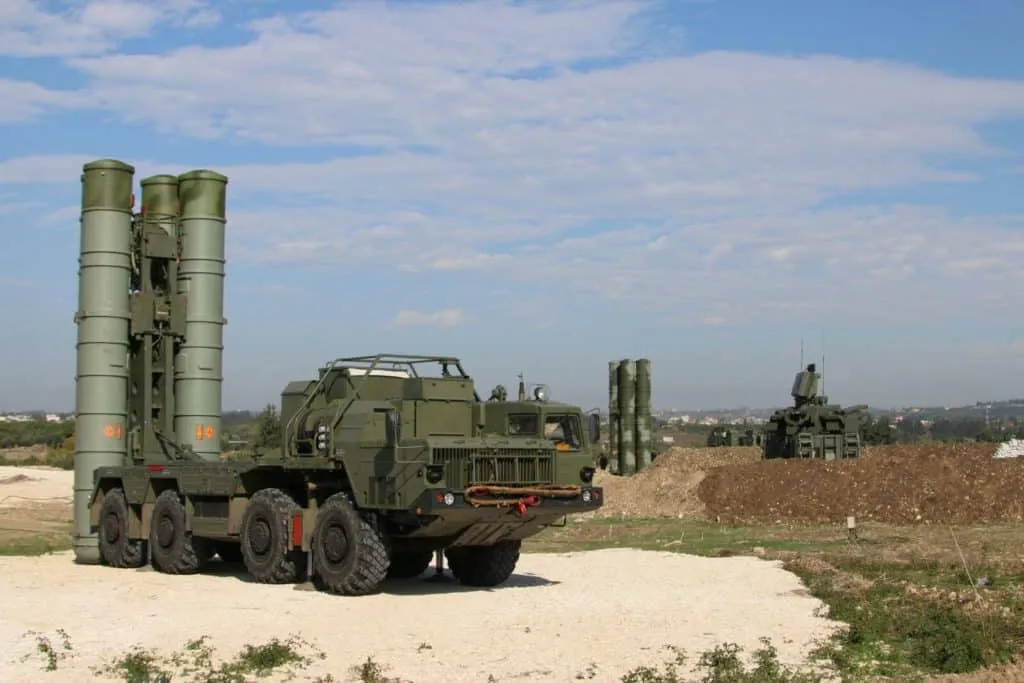
S-400 Triumf: System Specifications
NATO: SA-21 GrowlerTesting the Dual-Dependence Thesis: Supplementary Patrons Are Not Substitutes
The dual-leverage framework set out earlier assumes that both Ethiopia and Eritrea depend on Moscow in broadly comparable ways. The evidence does not support that assumption as stated, and the qualification matters for everything that follows. Eritrea is not solely dependent on Russia. It has built alliances with Arab Gulf states, and the UAE supports Saudi-led military operations in Yemen, to which Eritrea contributes troops, from a base on the Eritrean coast. Saudi Arabia has emerged as a security guarantor for Eritrea against Ethiopian ambitions, viewing Asmara as a containment barrier against Iran in the Red Sea. Eritrea has also developed a deny-and-defend posture at its ports, including Assab, supported by Iranian-sourced drone capabilities and advanced SAM batteries.[17] Russia sells arms to and trains the Eritrean Armed Forces and protects Eritrea with its veto at the UN Security Council, but Moscow does not yet have an operational military base in the country.
But having alternatives is not the same as having substitutes, and this is where the framework needs refining rather than abandoning. What the UAE, Saudi Arabia and Iran provide is supplementary: money, basing rights, drones, investment and diplomatic cover in the Arab League. What Russia provides is substitutable in no other quarter: a permanent UN Security Council veto, tier-one weapons systems that the Gulf states buy rather than sell, great-power deterrence that registers in Addis Ababa, Cairo and Washington in a way no regional guarantee does, and the naval partnership that the port negotiations imply. Eritrea's dependence on Russia is therefore functionally deep but non-exclusive. Asmara can refuse specific Russian demands because sovereignty over Assab is non-negotiable, not because it has an equivalent patron to turn to. It is refusing a demand, not exiting a relationship.
Ethiopia's position is different in kind and in trajectory. Its dependence is new, growing and one-directional, concentrated in arms supply chains, training, spare parts and naval reconstruction, and it has no comparable alternative supplier for tier-one systems. Both states are therefore structurally dependent on Moscow; the difference lies in what each needs from it and in which direction the dependence is moving. Ethiopia is being drawn deeper into Russian supply chains with every delivery. Eritrea's relationship with Moscow is older and broader, but it is anchored in goods that no other patron can supply and that Asmara cannot readily forgo. That is a narrower asymmetry than the report initially posited, and a more durable one, because it means neither side has a genuine exit.
Russia's pursuit of a Red Sea naval facility has long been a central objective, but its preferred option, a base at Port Sudan, has collapsed. The agreement negotiated with Omar al-Bashir in 2017 stalled with the outbreak of hostilities in 2023, and by 2026 Moscow had effectively abandoned the project.[18] This failure makes Eritrea, and specifically the ports of Assab and Massawa, far more critical to Moscow's ambitions. Russia has sought a logistics or naval facility there since at least 2018, and Lavrov confirmed in 2023 that Moscow planned to establish a "logistics center" at an unspecified Eritrean port. A Russian naval vessel visited Massawa in 2024, welcomed by President Afwerki.[19] In late October 2026, simultaneously with the Su-35 announcement, Russia and Eritrea held talks on modernizing Eritrea's port and railway infrastructure, with Russian companies expressing readiness to participate in construction and modernization projects at Assab and Massawa.
The Grand Strategic Objective, the Symmetry of Risk, and the US and Egypt Factors
A leased Red Sea port is not a peripheral ambition for Moscow; it is a grand strategic objective. Russia's naval and logistics presence in the Mediterranean has been severely constrained by the loss of Tartus, and its ability to project power into the Indian Ocean and the Red Sea depends on securing a reliable, long-term facility on the African coast. If Ethiopia were to militarily cross the border, seize the Assab region, and establish control, Russia could conceivably position itself to obtain a leased port from Addis Ababa in return for military support or diplomatic pressure on Eritrea to cede the territory. Assab is the logical target of such a scenario, not only because it is the port Ethiopia actually demands, but because its proximity to the Ethiopian border makes seizure and sustained control far more militarily plausible than any operation against Massawa, which lies deep in Eritrean territory near Asmara.
However, this scenario is far from assured. Addis Ababa maintains robust relationships with the United States and several European Union nations, and handing over a port to Russia would risk heavily degrading those relationships. It would also leave Ethiopia excessively dependent on Moscow, a prospect the leadership in Addis Ababa would certainly not prefer over an open, balanced, multi-vectored relationship with several major and great powers.
Just as Moscow cannot afford to alienate Addis Ababa by backing Asmara too openly, it cannot afford to alienate Asmara by backing Addis Ababa too openly. Russian officials have been explicit about this symmetry. Deputy Permanent Representative to the UN Anna Evstigneeva stated in November 2026 that both Ethiopia and Eritrea are "long-standing partners of Moscow," and that Russia therefore advocates resolving their differences "through diplomatic means".[20] Moscow's ultimate interest is therefore not victory for either side but the prevention of war itself. A war would force Russia to choose, and every choice would cost it something valuable.
The probability of Ethiopia actually invading Eritrea and seizing Assab is further constrained by the position of the United States. Washington is already deeply consumed by the Iranian axis and the broader Red Sea security crisis. In September 2026, the United States lifted sanctions on Eritrea imposed in 2021, with the State Department stating that Trump had chosen not to renew the measures "to advance US regional interests" in a country bordering the strategic Red Sea.[21] Analysts noted that the Red Sea has become a key oil shipping route with the Strait of Hormuz blocked, and that Eritrea's location could be key amid the ongoing conflict with Iran. An Ethiopian invasion of Eritrea would not be a localized border clash; analysts have warned it could draw in "10 to 15 countries from three different continents" and risk becoming "Africa's Second World War".[22] The structural conditions therefore militate against a full-scale invasion: Russia does not want it, the United States does not want it, and Ethiopia's own multi-vector interests and domestic fragilities argue against it.
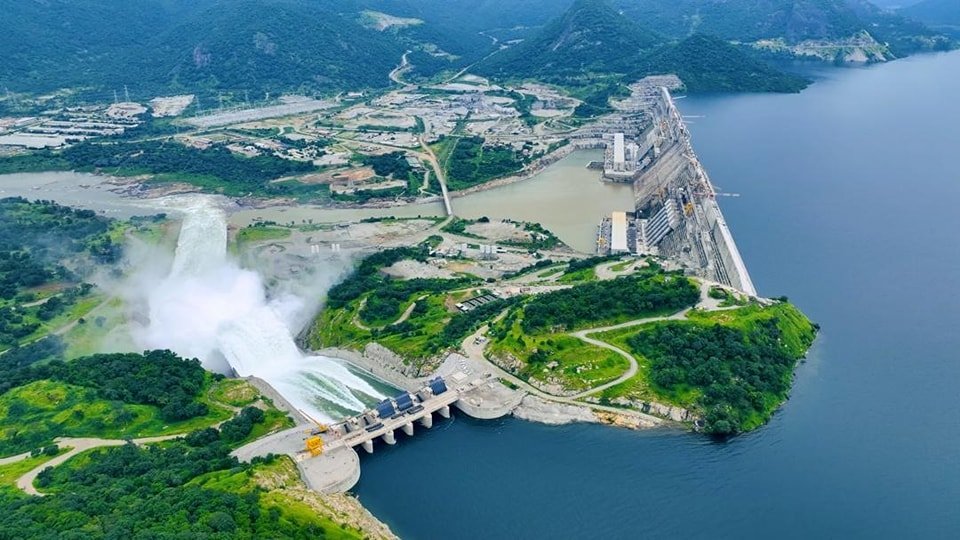
The Su-35 and S-400 package also cannot be understood without reference to the Grand Ethiopian Renaissance Dam (GERD), which has become the central fault line in Nile basin geopolitics. The GERD is a $4 billion hydroelectric megastructure on the Blue Nile near the Sudanese border, standing 145 to 170 metres high and stretching nearly two kilometres across the river. Its reservoir is designed to hold 74 billion cubic metres of water, and its installed capacity is intended to generate 5,000 to 5,150 megawatts of electricity, more than double Ethiopia's previous capacity.[23] For Egypt, the GERD is an existential threat. Egypt depends on the Nile for 97 percent of its water, and any reduction in downstream flows is viewed as a direct danger to national stability.[24]
This is where the technical character of the Russian package becomes strategically significant. The Su-35 is a highly capable air superiority fighter, designed to dominate the skies and protect critical assets, including the GERD, from air attack. The S-400 is a purely defensive long-range air defence system. Neither system is a dedicated offensive strike platform. The Su-34, by contrast, is a fighter-bomber optimized for long-range tactical strikes against ground targets, a system Russia has not sold to Ethiopia. By providing a potent defensive and air-superiority package rather than an offensive strike package, Russia can claim that it is helping Ethiopia "defend" itself and its infrastructure without providing the tools for a blatant, unprovoked invasion of Eritrea. The message to Cairo is not that Ethiopia can bomb Egypt with impunity, but that any Egyptian military option over the GERD would become far riskier and more costly. The sale is calibrated to maximize leverage with Ethiopia while managing escalatory risk with both Eritrea and Egypt.
Conclusion: From Dual Leverage to Mutually Binding Dependence
What began as a framework of dual leverage turns out, on closer inspection, to be something more textured and more durable. Russia's diplomacy between Eritrea and Ethiopia is neither incoherent nor accidental. It is a deliberate strategy of dual engagement, executed in a region where Moscow has high ambitions and limited margin for error. By arming Ethiopia with advanced but calibrated weapons systems, courting Eritrea with port and railway infrastructure deals at both Assab and Massawa, and offering to referee their dispute, Russia seeks to remain indispensable to both sides without ever being forced to choose between them. The Su-35 and S-400 package is a textbook example of this calibration: capable enough to give Ethiopia a meaningful deterrent and to deepen its dependence on Russian training and spare parts, yet defensive enough in character to avoid handing Addis Ababa the tools for a blatant offensive and to avoid provoking Egypt into a direct confrontation over the GERD.
Yet the test of the framework yields a narrower, and more durable, finding than its initial promise. Backing Ethiopia too openly would cost Russia its Eritrean port ambitions and its mediator role. Backing Eritrea too openly would cost it its Ethiopian arms client and push Addis Ababa toward Washington and Brussels. A full-scale war would force Moscow to choose, and every choice would be a loss. But the asymmetry is one of kind and trajectory, not of presence or absence. Ethiopia's dependence is new, growing and one-directional, concentrated in arms supply chains, training and naval reconstruction. Eritrea's dependence is older and functionally deeper, anchored in a Security Council veto, tier-one weapons and great-power weight that the Gulf states, Saudi Arabia and Iran cannot substitute. Its supplementary patrons let Asmara refuse specific Russian demands, as it did when it declined to meet Abiy under Russian auspices and insisted that "Eritrea does not negotiate on its sovereignty and territorial integrity." But they do not let it exit the relationship. What looked like dual leverage is in practice an asymmetric but mutually binding dependence, in which both clients need something only Moscow can supply, and Moscow can afford to lose neither.
Analytical Judgement: That mutual binding is what makes Moscow's position more stable than a simple balancing act would suggest, and it is also what makes it fragile. The United States, preoccupied with Iran and invested in Red Sea stability, has reinforced the constraint against war by lifting sanctions on Eritrea and signaling that it does not want a direct Ethiopia-Eritrea conflict. Ethiopia's own domestic fragmentation, its multi-vector foreign policy, and its relationships with Western powers further reduce the likelihood that Addis Ababa would trade a balanced global position for dependence on Moscow in exchange for a conquered port. The structural conditions that would allow Russia to convert its position into a leased port, by force or by proxy, whether at Assab or elsewhere, are therefore absent on every side.
The grand strategic objective of a leased Red Sea port remains elusive but not abandoned. Eritrea has so far resisted granting one, and Ethiopia's own interests make it an unlikely substitute even if it were to seize Assab, the port its campaign actually targets. Moscow's balancing act is therefore best understood as a long game: keeping both clients engaged, keeping the tension managed, keeping the arms flowing, and keeping the port negotiations alive, all while hoping that a future shift in regional circumstances will allow it to convert its leverage into a permanent foothold. For now, the only outcome that preserves Moscow's interests is a managed tension that never escalates into full-scale war. Whether Russia can sustain that balance without a safety net, and whether Eritrea's room for manoeuvre or Ethiopia's Western ties shift first, is the central question on which its Red Sea ambitions depend.
Note: This report was completed on 2 November 2026. It draws on open-source reporting, official statements, UN voting records, and OSINT flight tracking. The Su-35 delivery figures are contested: the Ethiopian government stated that twelve aircraft were received, while Russia's Rosoboronexport confirmed only two in the first batch. The S-400 batteries have been announced but not yet delivered, and their deployment locations remain undisclosed. The dual-leverage framework is advanced as a proposition and tested against Eritrea's diversified security ties; the conclusion is that the dependence is asymmetric in kind and trajectory, with both parties structurally dependent on Moscow for goods no other patron can supply. Footnotes 5, 19 and 20 are attributed to reporting rather than linked to a single retrievable source. This report does not constitute military, legal, or policy advice.