From Soviet-Era Prototypes to Battlefield Necessity
Unmanned Ground Vehicle (UGV) concepts existed long before the war in Ukraine, although many early systems differed significantly from the lighter and cheaper platforms increasingly seen today. One example is the Russian Uran family developed by the Special Design Bureau of the Russian Ministry of Defense, including the Uran-6 mine-clearing vehicle, Uran-9 combat UGV, and Uran-14 firefighting platform. Although these systems never saw large-scale adoption, the Uran-6 saw limited deployment in Syria and Ukraine. Russia was also technically the first side to use UGVs in the war in Ukraine, as Uran-6 vehicles were deployed already in 2022, with at least one reportedly destroyed after detonating a mine during operations.
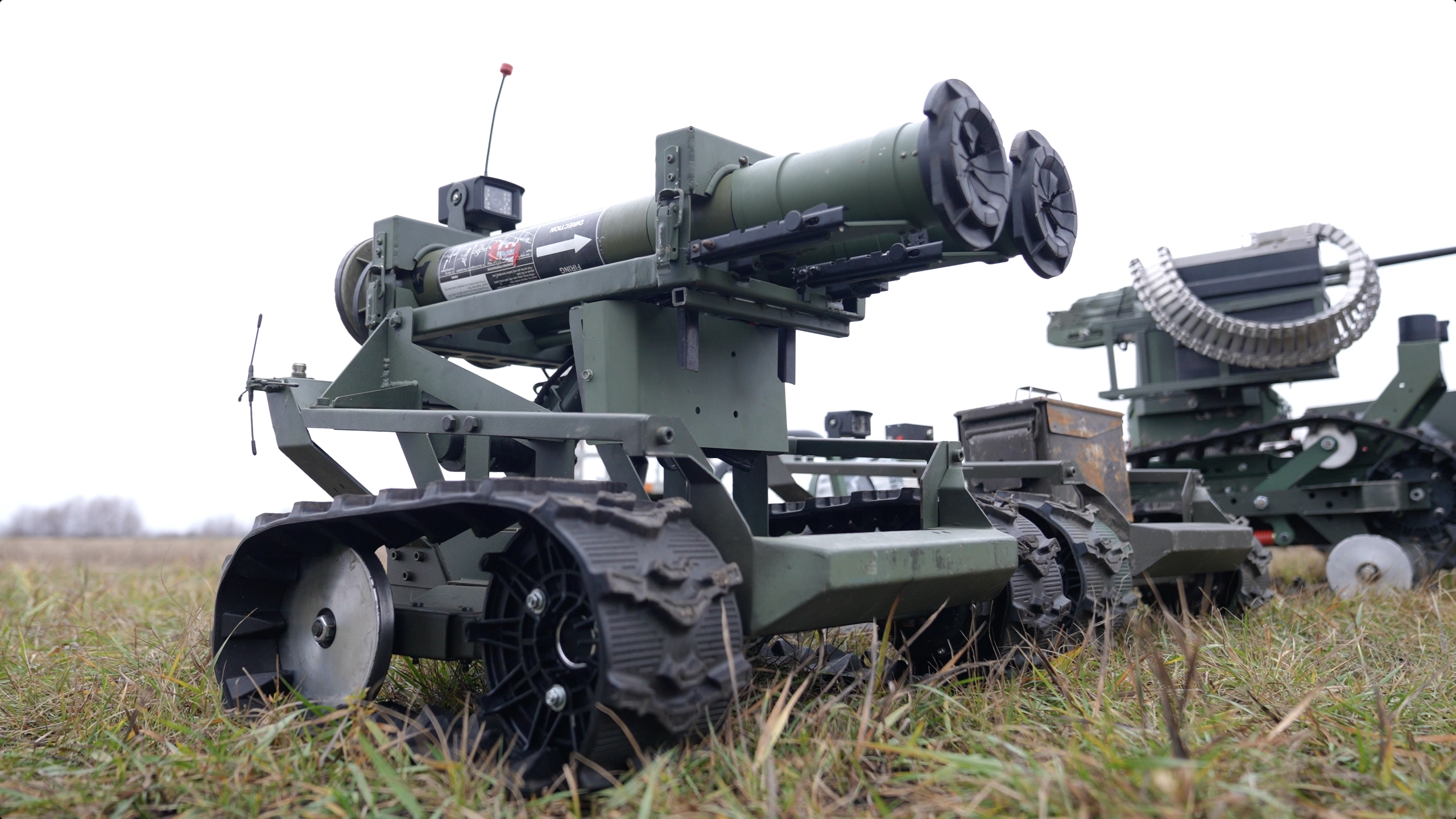
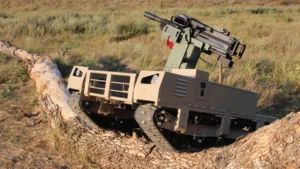
Modern UGVs began emerging on a much larger scale only after 2024, driven by logistical difficulties, personnel shortages, and especially the expansion of "kill zones" where movement of personnel without losses became almost impossible. Unlike the bulky Uran platforms, Ukraine increasingly adopted smaller, cheaper, and more flexible UGVs adapted for logistics, engineering, reconnaissance, and combat support tasks. Their rapid integration was made possible by battlefield necessity, decentralized innovation, and continued frontline-level adaptation. Whether other states can successfully replicate this process remains an open question, particularly in the post-Soviet space where many armies and defense-industrial sectors still retain centralized Soviet-era structures.
IIIdentifying the Successfulness of Robots in Ukraine
UGVs conduct a wide variety of tasks in Ukraine, reducing the risks soldiers would otherwise face while performing them. Unlike UAVs, whose impact is clearly visible through strike missions, UGVs are less publicly noticeable because much of their activity is not directly combat-related. Nevertheless, their battlefield impact is significant. UGVs increasingly conduct logistics operations inside contested areas while also performing medical evacuation, engineering, and mine-laying tasks. In some sectors around Pokrovsk, UGVs reportedly carried out up to 90% of frontline logistics operations. One Ukrainian mine-laying UGV allegedly deployed 1,500 mines before being destroyed, demonstrating the usefulness of these systems in dangerous engineering missions.
The combat role of UGVs is also gradually expanding. In 2026, President Volodymyr Zelensky announced that Ukrainian forces had for the first time captured a Russian position and prisoners using only UAVs and UGVs operating together. Although this does not mean that UGVs are now replacing soldiers, it demonstrates that these platforms possess genuine combat potential. Importantly, UGVs have also shown capability against conventional armored targets. In 2025, a Ukrainian HPK Droid TW 12.7 reportedly disabled a Russian MT-LB during a direct engagement, resulting in the elimination of its crew.
IIICharacteristics of UGV Deployment in Ukraine
Despite their growing battlefield role, UGVs continue to face major operational limitations. The Jamestown Foundation notes that poor terrain, especially for wheeled platforms, and bad weather conditions remain serious vulnerabilities for many systems. The report also emphasizes the importance of precise terrain knowledge for successful deployment and navigation. At the same time, communications and network integration remain critical requirements for effective battlefield use. The Modern War Institute describes stable network integration as almost indispensable for successful UGV deployment. Although Ukraine has achieved significant progress in this field, operators still frequently face problems such as connection loss or poor Starlink connection quality resulting in degraded video transmission.
Similar problems appear on the Russian side. A State Watch report on Russian UGV capabilities identifies communications as one of the main continuous weaknesses of Russian robotic systems, particularly after restrictions on Starlink access forced Russian operators to rely on less effective alternatives.
UGVs are not "deploy and forget" systems. A Ukrainian UGV reportedly held its position for 45 days — but required servicing every two days for several hours in a temporary maintenance facility only a few kilometers behind the frontline.
UGVs also remain highly vulnerable to mines and UAV attacks. Their relatively large infrared signature makes them easy targets for FPV drones equipped with thermal cameras. Another critical observation from Ukraine is that UGVs require constant maintenance close to the frontlines. Ukraine has managed this relatively successfully through unit-level workshops that continuously service, repair, and modify robotic platforms. Without continuous maintenance, even highly capable UGVs supported by experienced operators and reliable communications systems are unlikely to survive long on an active battlefield.
State and Industry-Level Conditions Allowing UGV Integration
Successful large-scale UGV integration in Ukraine was driven by battlefield necessity and industrial conditions supporting rapid adaptation. Ukraine possesses a highly decentralized defense-industrial ecosystem of numerous small-scale private defense technology companies capable of quickly developing and testing these systems. As of 2025, Ukraine reportedly had around 1,500 private defense technology companies operating in different sectors. This structure allowed Ukraine to innovate much faster than traditional state-dominated military-industrial systems still dominant across much of the post-Soviet space.
Russia's experience demonstrates this clearly. Before 2022, Russia's state-directed UGV efforts largely failed despite significant funding and major defense corporation involvement. Russia's first practical successes in modern UGV development appeared only in 2024 with systems such as the Courier, developed by volunteers and smaller initiatives rather than major state corporations. Since then, Russia has increasingly adopted a bottom-up approach similar to Ukraine's model. Nevertheless, indications show Russia continues to struggle due to the legacy of its Soviet-style military-industrial system.
Russia's state-dominated defense sector made it difficult for smaller private military innovators to emerge independently. Many volunteer or civilian initiatives were initially ignored, distrusted, or blocked by both local officials and traditional defense corporations. Approval procedures for introducing new systems into military procurement remained slow, bureaucratic, and expensive, causing potentially valuable innovations to disappear before even reaching the production stage. Although Vladimir Putin and Defense Minister Andrey Belousov later publicly recognized the importance of Russia's so-called "People's Military Industrial Complex," the Russian military establishment still largely favors traditional state suppliers and remains skeptical toward independent civilian initiatives. In many cases, successful volunteer initiatives were eventually absorbed into the larger state structure. While this allowed Russia to increase production of drones and unmanned platforms on a larger scale, it also created another problem: state structures are capable of mass production, but often struggle to innovate quickly.
This became increasingly important in a war where the battlefield relevance of technologies often changes within months rather than years. Russian military procurement and industrial adaptation remain relatively slow compared to the rapid frontline-driven innovation visible in Ukraine. Ukraine's advantage lies not only in production itself, but in the speed at which smaller actors can react to battlefield realities and introduce new solutions. Most post-Soviet states currently possess procurement and defense-industrial systems much closer to Russia's model than Ukraine's.
Beyond industry, there is also the problem of the armed forces themselves. Many militaries in the South Caucasus and Central Asia continue to retain Soviet-style force structures, operational doctrine, and communication systems, while relying heavily on Soviet-era or Russian military equipment. Zhirayr Amirkhanyan identified outdated Soviet attritional warfare doctrine, obsolete unit structures, and technological stagnation among the key reasons for Armenia's defeat during the 2020 war over the occupied Nagorno-Karabakh. Armenia has since attempted to modernize and recently showcased UGVs during its military parade, but whether the country possesses the infrastructure, communications systems, and maintenance capabilities necessary for effective battlefield integration remains uncertain. Similar questions apply across much of the region.
In some cases, the technological gap is even larger. Tajikistan, for example, continues operating tanks more than sixty years old, while meaningful UGV integration requires modern military infrastructure, communication equipment and trained personnel. Such reforms would likely require one of the most significant transformations these armed forces have experienced since the collapse of the Soviet Union. This broader regional problem is partly rooted in the unequal Soviet military inheritance itself. Ukraine and Belarus inherited some of the Soviet Union's most advanced military infrastructure because they formed the USSR's primary western defensive line. Many states in the Caucasus and especially Central Asia inherited far more limited and technologically outdated military equipment, a reality that in many ways persists today.
Conclusion and Future Outlook
Not all post-Soviet states are in a similarly weak position in terms of future UGV integration. Uzbekistan represents one example of a state with relatively favorable conditions for future UGV integration. The country possesses a comparatively large defense budget, partially established domestic UAV production capabilities, clear state interest in modern warfare technologies, and most importantly at least some signs of emerging private defense-industrial actors such as Electronic Autonomous Solutions (EAS). Uzbekistan is also expected to gain access to Starlink this year, something that would help address communications limitations critical for effective UGV deployment. With an estimated defense budget of approximately $6.2 billion, the country possesses considerably greater room for modernization and adaptation than many other states in the region. President Shavkat Mirziyoyev has also repeatedly emphasized the importance of innovation and integration of modern technologies into the defense sector while acknowledging that Uzbekistan's private military-industrial sphere remains relatively young and requires continued support and development.
Other states demonstrate different dynamics. Kyrgyzstan has already begun incorporating UGVs into military exercises and has demonstrated another potential use for robotic systems in the post-Soviet space — domestic counter-terrorism and security operations. During one anti-terrorism exercise, Kyrgyz forces reportedly used an unmanned ground robot to assault a building and destroy a vehicle during a simulated terrorist scenario. Such applications are likely far less demanding than full-scale battlefield integration and may serve as useful training and adaptation platforms for future military development.
For other states, such as Tajikistan, geography itself may become one of the main limitations to UGV integration. A significant portion of Tajikistan's territory consists of mountainous terrain poorly suited for many ground robotic platforms, while UAVs remain considerably more practical for border security and reconnaissance purposes in such conditions. This may partly explain why Tajikistan has already shown interest in UAV capabilities while demonstrating little interest in UGV development.
What remains certain is that interest in modern unmanned systems is steadily growing across much of the post-Soviet space, and UGVs are slowly beginning to emerge in regional arsenals. Whether these states will successfully adapt, however, will depend not simply on procurement of the systems themselves, but on their ability to reform Soviet-era military-industrial structures, communications systems, command culture, and battlefield organization in order to meet the complex requirements of modern unmanned warfare. Integration is therefore unlikely to be uniform across the region.
Note: This article was completed on 1 July 2026 and reflects open-source information available as of that date. Defense budget figures are estimates drawn from publicly available sources and should be treated as approximations. The views expressed are those of the author.